
If you've ever enjoyed kayaking, you owe a debt of gratitude to the ancient Greenlandic Inuit who originally designed them for hunting. The thrilling adventures people now have navigating some of the world's most challenging rapids wouldn't be possible without the Inuit's need for a nimble form of water transportation. While travelers still use kayaks in this region, they are typically not fishing, whaling, or sealing. Consequently, recreational kayaks have been adapted to fit their new role.
When Were Kayaks Invented?
The Inuit began using kayaks thousands of years ago for hunting, but the exact time frame of their origin remains unknown. What we do know is that the earliest kayaks were designed for a single person, and there were two types used by the Aleut and Inuit tribes in the Arctic region. The first type was made from light driftwood, while the alternative required whalebone for the frame. The Inuit also used whale fat and seal bladders to waterproof the vessels and provide the necessary buoyancy.
What is the Difference between Kayaks and Umiaqs?
Kayaks, known as qajaq by the Inuit, were essential for hunting but did not accommodate additional passengers. In situations where Inuit tribes needed to relocate using water pathways, they built a larger version of the kayak called an umiaq. This bigger vessel could be as large as 18.3 meters (60 feet) and was capable of transporting an entire family along with their possessions.
The Inuit of Greenland: A Brief History
Greenland was first discovered by Europeans in 982 CE by Erik the Red, a Norwegian Viking exiled from Iceland. By 986, Erik the Red had brought settlers to the area and named it Greenland. Vikings lived in Greenland until the late 1500s, but by 1600, all their settlements were gone. At this time, only the Inuit remained, and they had Greenland mostly to themselves until a Danish settlement began in 1721. Interestingly, Greenland was never fully explored and mapped until the 1800s, although the Inuit were likely already aware of many of the geological features discovered during these mapping efforts.
Most of the Inuit living in Greenland today can trace their heritage to Siberia, Alaska, and Canada. In fact, the last Inuit immigration into Greenland occurred less than 150 years ago. Currently, there are only 55,000 Greenlandic residents, and a surprising 20 percent were not born there. The vast majority of native residents are Inuit, and those who were not born in Greenland have relocated from other countries.
Although ancient Inuit relied on kayaks for hunting, the area still depends on fishing for 95 percent of its exports. Whaling and sealing are also crucial in the outer areas. In some ways, life has not changed much for the Inuit people, but some have turned to tourism for financial resources. For example, Greenlandic Inuit arts and crafts are highly sought after by collectors.
The most popular Inuit art forms are small figures carved from reindeer antler, narwhal tooth, or walrus tooth, which were once believed to be evil spirits. It's easy to see why the ancient Inuit held this belief when you look at how gruesome these carvings are. Today, art is used to keep ancient myths alive, and cultural enthusiasts who wish to acquire one of these creations should ask for a tupilak. Note that it is illegal to export a tupilak made from whale or walrus tooth, but all other versions should be permissible to take home. Travelers can purchase a tupilak from almost any souvenir shop or tourist office in Greenland.
The Evolution of Kayaking from Hunting to Sport
By the mid-1800s, the kayak design was adopted by Europeans. However, instead of using these boats for hunting, they created the sport of kayaking. At this time, kayaks had a soft-sided frame and became very popular among French and German men. Although this changed the world's perception of kayaks, it did not eliminate their original purpose. Explorers visiting the South Pole and the North Pole continued to use them to navigate icy waters.
In 1931, Adolf Anderle introduced the world to a new way of using a kayak by white-water kayaking down the Salzachofen Gorge. While it's impossible to determine if Anderle was the first to try this, he is often credited with creating modern white-water kayaking. Just five years later, kayaking became an Olympic sport. By 1938, Genevieve De Colmont became the first known female to kayak in the Colorado and Green Rivers in the United States.
Kayaking in the Arctic
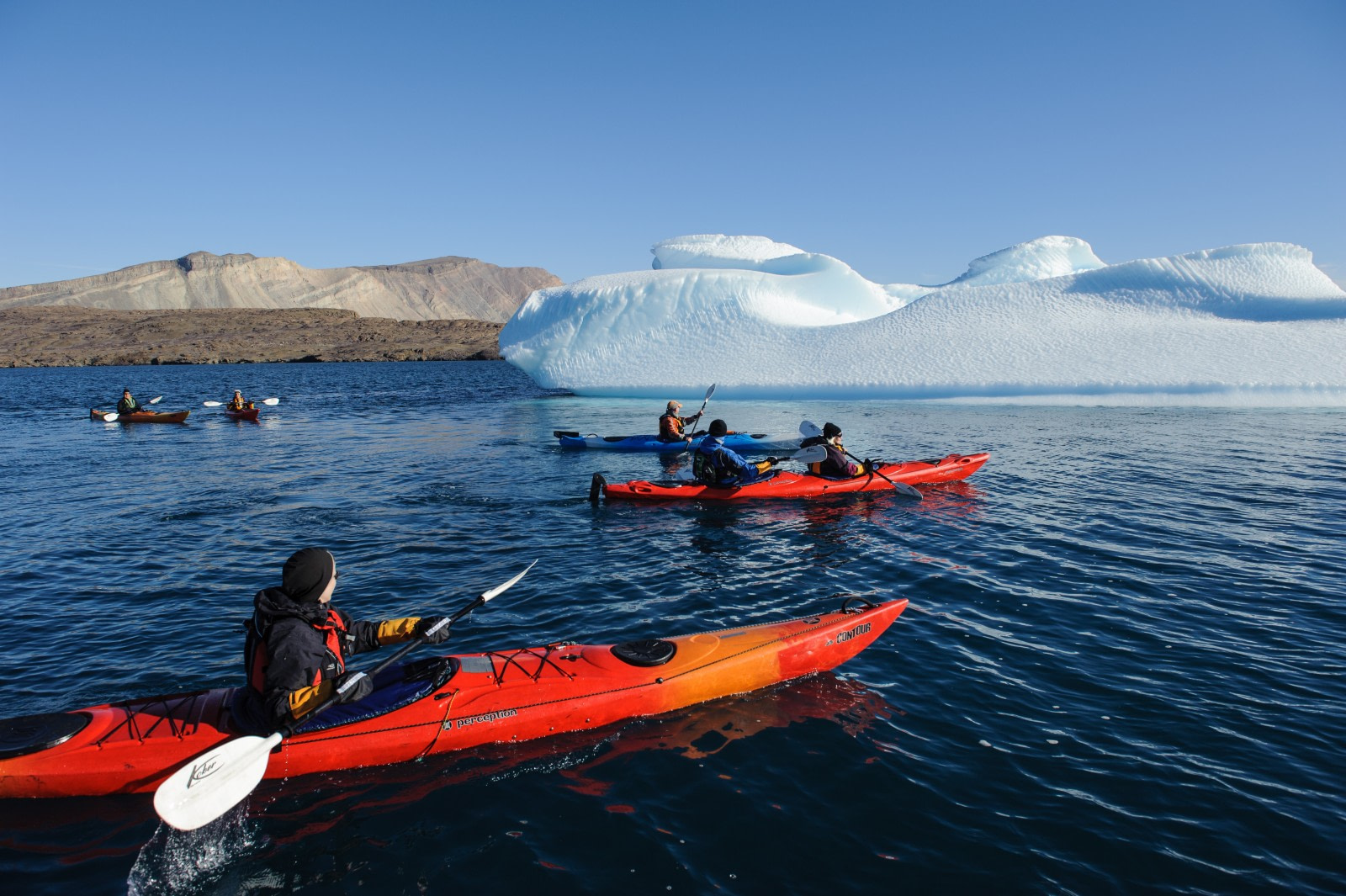
It's no surprise that the kayak has become a national symbol in Greenland. This not only allows modern residents and Inuit tribes to acknowledge the area's past but also serves as a way to attract tourists. Kayaking during Greenland cruises has become a popular way for people worldwide to experience the thrill of this extreme sport. Many of the people who join Arctic cruise expeditions are kayaking enthusiasts, and it definitely enhances the overall experience to know that ancient Inuit once kayaked through the same areas.
In the past, each Inuit who took a kayak into the water knew that a single miscalculation could lead to death because there was no one else around to save them from the freezing cold water. Fortunately, today's travelers can take advantage of modern safety equipment and the security of having others nearby. Instead of being a life-threatening way to feed an entire tribe, kayaking in this area is now an exciting adventure that allows exploration of stunningly beautiful waters while taking in some of the best Greenlandic scenery.
Interested in kayaking in the Arctic or Antarctica? See our kayaking trips >>
 12 Aug - 31 Aug 2026
 15 Aug - 28 Aug 2026
 16 Aug - 25 Aug 2026
 25 Aug - 07 Sep 2026
 21 Sep - 01 Oct 2026
Related Trips
Spitsbergen - Northeast Greenland, Fly & Sail
12 Aug 2026 - 31 Aug 2026  20 Days / 19 Nights
Northeast Greenland Extreme
15 Aug 2026 - 28 Aug 2026 14 Days / 13 Nights
East Greenland, Scoresby Sund, Including Long Hikes
16 Aug 2026 - 25 Aug 2026 10 Days / 9 Nights
Northeast Greenland Extreme
25 Aug 2026 - 07 Sep 2026 14 Days / 13 Nights
East Greenland, Scoresby Sund - Aurora Borealis, Fly & Sail
21 Sep 2026 - 01 Oct 2026 11 Days / 10 Nights
East Greenland, Scoresby Sund - Iceland , Aurora Borealis, Fly & Sail
01 Oct 2026 - 12 Oct 2026 12 Days / 11 Nights

Blog


The Ice-Jewelled Geology of Spitsbergen
Arctic Seals
Path of Polar Heroes: Hiking Shackleton’s Historic Route
Weddell Sea, Shackleton’s Endurance, and New Swabia
“The polar bear will still be there”
Baleen Whales – The Gentle Giants of the Ocean
Highlights from the First Arctic Voyage of Hondius
Weddell Sea: the Original Antarctic Adventure
The Secret Life of Glaciers: How They Form, Move, and Melt
The Pack Ice and Polar Bears of North Spitsbergen

The World Is Changing for Greenland's Native Inuit People
Solargraphy & Pin Hole photography in the Arctic
Harp seals harping on in Greenland
Ice streams and lakes under the Greenland Ice Sheet

Earth vs. Mars: Polar Regions Compared
The Best Arctic and Antarctic Trips for Families
Freshwater ecosystems in the Arctic
A Diving Dream Fulfilled
Imperial Antarctica: the Snow Hill Emperor Penguins