


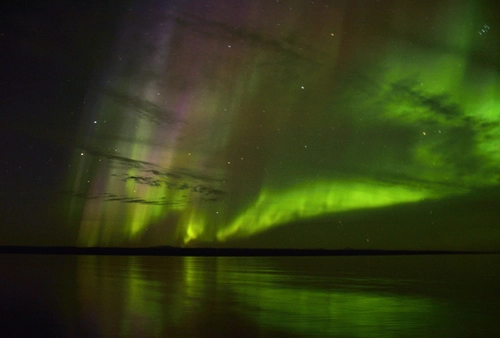
The Northern Lights typically manifest in a belt with a radius of 2,500 kilometers centered on the magnetic North Pole. This auroral zone spans northern Scandinavia, Iceland, the southern tip of Greenland, and continues over northern Canada, Alaska, and along the northern coast of Siberia.

Particles colliding in the skies
The Northern Lights are caused by collisions between gaseous particles in the Earth’s atmosphere and charged particles released from the sun’s atmosphere.

The temperature above the sun’s surface reaches millions of degrees Celsius, causing frequent and explosive collisions between gas molecules. Free electrons and protons are ejected from the sun’s atmosphere by its rotation and escape through gaps in the sun’s magnetic field. These charged particles are then propelled towards Earth by the solar wind, taking about 40 hours to reach our planet. When they arrive, most are deflected by Earth’s magnetic field, but some enter the atmosphere at the poles where the magnetic field is weakest, colliding with gas particles. These collisions emit lights that appear to dance in the sky, extending from 80 kilometers to as high as 640 kilometers above the Earth’s surface.
Sunspots bigger than Earth
The intensity of the Northern Lights depends on the size of the sun’s solar flares, which are massive explosions on the sun’s surface caused by a sudden release of magnetic energy. These flares occur near sunspots, which are cooler, darker areas on the sun’s surface. Some sunspots can be enormous, with one measured at around 62,000 kilometers across, about five times the width of Earth. Solar activity varies with the amount of magnetic flux rising to the sun’s surface, with an average cycle of about 11 years. During periods of high solar activity, there can be up to 100 or more sunspots on the sun’s surface, releasing solar flares and particles into space.
Solar flares shooting out magnetized gas
When solar flares explode, they release energy equivalent to 1 billion hydrogen bombs. These flares are often accompanied by a coronal mass ejection, a huge bubble of magnetized gas blown outward from the sun. This bubble travels through space at about a million miles per hour, taking 17 hours to 3 days to reach Earth’s orbit. If such an explosion hits Earth, it can disturb the planet’s magnetic field, causing a geomagnetic storm that can damage electrical systems, cause power blackouts, disrupt radio communications, and affect Earth-orbiting satellites.

Dancing lights in the skies
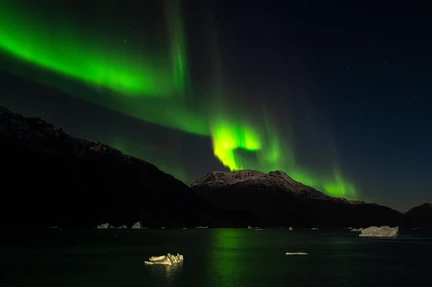
The colors seen in the Northern Lights are due to the type of gas particles colliding. The most common color, a pale yellowy-green, is produced by oxygen molecules about 60 miles above Earth. An all-red sky is produced by high-altitude oxygen around 200 miles up, while blue and purplish-red colors result from nitrogen. The colors also vary with altitude: green lights appear up to 150 miles high, red above 150 miles, blue up to 60 miles, and purple and violet above 60 miles. There is debate about whether people can hear the Northern Lights, with some reporting a ‘swish’ as the lights move and flicker, and others claiming to hear electrical, crackling sounds.
Mythology of the Northern Lights
For thousands of years, the Northern Lights have inspired speculation, superstition, and awe. Cave paintings in France dating back 30,000 years depict this phenomenon. In superstitious times, the lights were thought to be a precursor to conflict or disaster. It wasn’t until 1616 that astronomer Galileo Galilei named the lights aurora borealis, inspired by the Roman goddess of the dawn, Aurora, and the Greek name for the north wind, Boreas.
Seeing the Northern Lights
The Northern Lights can be observed across Alaska, northern Canada, Norway, Svalbard, Greenland, Iceland, Sweden, and Finland. During periods of active solar flares, the lights can be seen as far south as Scotland and northern England. In times of heightened solar activity, multiple solar flares can amplify the Northern Lights, making them visible in the northern United States. In rare instances, the lights have been seen even further south, such as by European settlers in New England in 1791.

The best times to see the Northern Lights
In parts of Norway and Finland, the Northern Lights can be seen every other clear night. Contrary to popular belief, the lights are present year-round but are only visible when the nights are dark enough. This means the Northern Lights can be observed from early September until mid-April.
The Northern Lights are often called the ‘night aurora’ because they occur on the night side of Earth and frequently appear in the early evening, continuing into the night. In some places that experience complete darkness during midday, the Northern Lights can be seen. Clear skies are essential for viewing the aurora, as clouds can obstruct the view. Therefore, inland regions are better suited for auroral observations than coastal areas.
Full moons are not ideal for viewing the lights, as the bright moonlight can make the sky too light. City lights also pose a challenge, so it’s best to be far from urban centers to see the bright, dancing colors.
Recreating the Northern Lights
To better understand the Northern Lights, scientists have recreated the phenomenon at NASA’s Langley Research Center in Virginia. The simulation is made possible by a device called Planterella, which combines a magnetic field, charged particles, and a sphere to display the colorful re-enactment of Earth’s Northern Lights.
The simulator can recreate the Earth’s atmosphere at 80 kilometers in altitude, where an aurora occurs. The lab’s machine is a modern version of a 19th-century experiment that first demonstrated the glowing result of electrically-charged particles interacting with a magnetic field. NASA scientists have updated the experiment for the 21st century by adding several spheres, allowing them to recreate the auroral ovals that occur on Earth and other planets.
Expert tips for photographing the aurora borealis
No photo can replace seeing the Northern Lights in person, so it’s recommended to lower your camera and enjoy the sight firsthand. However, it’s natural to want to capture the moment in pictures. To make the most of your photography, check out the video below where our expedition leader and professional nature photographer Sara Jenner provides expert advice on photographing the magical Northern Lights.
 12 Aug - 31 Aug 2026
 15 Aug - 28 Aug 2026
 16 Aug - 25 Aug 2026
 25 Aug - 07 Sep 2026
 21 Sep - 01 Oct 2026
Related Trips
Spitsbergen - Northeast Greenland, Fly & Sail
12 Aug 2026 - 31 Aug 2026  20 Days / 19 Nights
Northeast Greenland Extreme
15 Aug 2026 - 28 Aug 2026 14 Days / 13 Nights
East Greenland, Scoresby Sund, Including Long Hikes
16 Aug 2026 - 25 Aug 2026 10 Days / 9 Nights
Northeast Greenland Extreme
25 Aug 2026 - 07 Sep 2026 14 Days / 13 Nights
East Greenland, Scoresby Sund - Aurora Borealis, Fly & Sail
21 Sep 2026 - 01 Oct 2026 11 Days / 10 Nights
East Greenland, Scoresby Sund - Iceland , Aurora Borealis, Fly & Sail
01 Oct 2026 - 12 Oct 2026 12 Days / 11 Nights

Blog


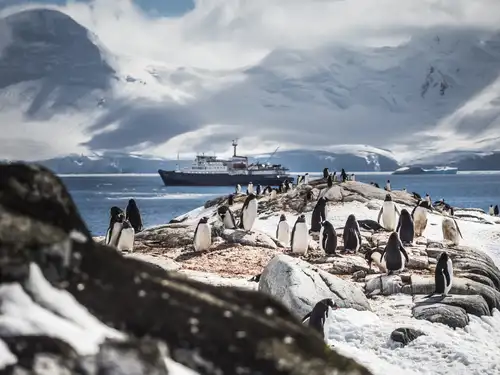
Top 10 Antarctic Attractions

The Evolving Shipboard Eco-traveler
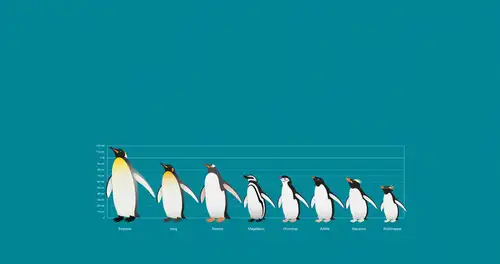
The Eight Great Penguin Species of Antarctica
Polar Cruises: The Ultimate Icebreaker
Secrets of the Snowy Owl: Habitat, Adaptations, and Other Facts
The Ancient Fossil Forests of Antarctica
All About Ice: Glaciers and Icebergs of the Arctic and Antarctica
Seven Tips to Get the Most out of Your Expedition Cruise
Antarctic Icon: 44 Facts About the Emperor Penguin
Guidelines for visitors to Antarctica
5 Life Lessons You'll Learn in Antarctica
Hondius Photography and Video Workshops
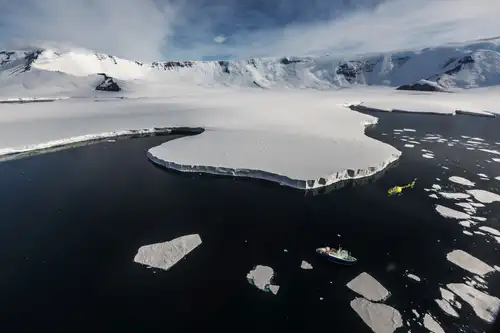
Taking a polar expedition cruise delivers no shortage of show-stopping highlights, but one of the most exhilarating is lifting off from the ship in a helicopter and taking flight over the incomparable Antarctic wilderness.
10 Common Misconceptions About the Arctic
Where the Polar Bears Roam
Antarctica’s Hourglass Dolphin
Five Reasons You Should Cruise the Ross Sea Immediately
Bouvet Island: The Most Remote Island in the World
Tracking Greenland’s Wildlife from Space