

There are 17 species of penguin on the planet, but the eight you’ll most likely recognize live in Antarctica, its nearby islands, and the sub-Antarctic archipelagos of South Georgia and the Falklands. These are the core species we tend to see on our expedition cruises.
Of these eight types of penguin, two live exclusively on the Antarctic Continent (emperor penguins and Adélie penguins), three live in both northern Antarctica and the sub-Antarctic islands (chinstraps, macaronis, and gentoos), and three species of penguin reside exclusively in the sub-Antarctic (rockhoppers, Megallanics, and kings).
Here we’ll give you the key information on all of them. By the time you embark on one of our adventurous Antarctica cruises, you will be fully equipped to identify and discuss any of the eight great penguin species you might encounter.
Also, don’t miss our penguin “bird call” video at the end!

1. Emperor penguin (Antarctica only)
Of all the penguin species on the planet, emperor penguins may be the most emblematic.
It helps that they're also the largest: Emperor penguins grow up to 122 cm tall (48 inches) and weigh 22 to 45 kg (49 to 99 pounds). They live on crustaceans, squid, and fish, and are usually found in the Ross Sea and Weddell regions, especially Snow Hill Island. Forming large colonies on the sea ice, emperor penguins rarely head north to sub-Antarctic waters.
Emperors are the only penguins (or any bird species) in the Antarctic that breeds during the winter. Baby emperor penguin chicks are born between the end of July and the middle of August, but they're unable to explore the sea alone until January.
Temperatures can plummet to -50 degrees Celsius (-58 degrees Fahrenheit) and winds reach speeds up to 200 kph (124 mph) during the emperor breeding period.
The female lays a single egg, then passes it over to the male, who incubates it while she heads to sea to feed. During a nine-week period, the male fasts while keeping the egg warm, losing up to 45 percent of his body weight.
When the female comes back in August, it's the male's turn to head out to sea and feed. He often has to trek up to 100 km (62 miles) over the ice to find food. Once fed, he returns and helps the female rear the chick. And when the sea ice starts to break up in December and January, the emperor penguin family heads out to sea. Scientists think the adults take the chick to sea when food is plentiful so that it can learn to be independent.
Emperor penguins dive deeper and longer than any bird, reaching over 200 meters (700 feet) and staying underwater for up to 18 minutes. And while they have a high survival rate, they're also the least common penguin: Only around 220,000 breeding pairs are alive today.
They live about 15-20 years in the wild.

2. Adélie penguin (Antarctica only)
The most widely distributed penguin species in the world, Adélies are found on the northerly Antarctic pack ice during the winter and in the summer return to the continental coastline and Antarctic islands.
There are an estimated 2.5 million breeding pairs of Adélie penguins in Antarctica.
They weigh from 3.6 to 6.0 kg (7.9 to 13.2 pounds), grow between 46 to 71 cm (18 to 28 inches) tall, and their preferred diet is fish and krill. Though Adélie penguins can dive to 175 meters (574 feet), they usually catch their meals near the surface.
Adélie penguins live in tightly-packed breeding colonies that number in the thousands, giving birth to chicks during the Southern Hemisphere summer, usually in December.
Their breeding season is one of the shortest of all the penguin species, and courtship is similarly brief, with a lot of flipper-waving and calls. The Adélie female lays two eggs in mid-November, and both parents take care of them before they hatch.
Two to three weeks after the chicks hatch, the young Adélie penguins join a crèche, or nursery, before heading out to sea by February.
During the crèche stage, Adélie chicks are extremely vulnerable, and only about two-thirds survive. Once out to sea, however, the young Adélies are relatively safe and enjoy a typical lifespan of about 11-20 years.

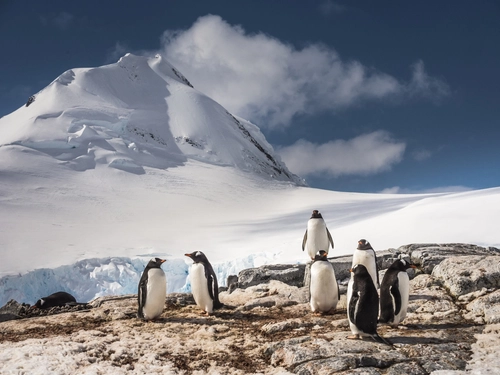
3. Gentoo penguin (Antarctica and sub-Antarctic)
There are estimated to be about 300,000 breeding pairs of gentoo penguins in the Antarctic region, putting them second only to emperor penguins in terms of population scarcity.
As adults, gentoos are the third largest penguin behind emperors and kings, reaching 50 - 90 cm (19.7 - 35.4 inches) tall and weigh 4.5 - 8.5 kg (9.9 - 18.7 pounds). They feed on a diet of squid, fish, and crustaceans.
Gentoo penguins live in large, gregarious breeding colonies along the coastlines of the northern Antarctic Peninsula, South Sandwich Islands, South Shetlands, South Orkneys, and in the sub-Antarctic Falklands and South Georgia. They build nests on beaches and in grass tussocks and are highly aggressive in defending their turf.
Gentoos use stones to form their nests, and males often give stones to females as courtship gifts. They'll also attract females by “trumpeting” skyward, and if a female gentoo chooses a mate, both sexes point their bills at the nest the female has built.
Egg-laying can occur as early as June but in colder areas is delayed until December. Gentoo penguins are monogamous and have up to three breeding seasons, but generally they find new partners after that.
Female gentoo penguins lay two eggs, switching incubation duties with males daily. After hatching about 35 days later, it takes another month for gentoo penguin chicks to fledge, at which point they're able to venture out to the sea. Unlike other penguins, gentoo chicks fledge prior to becoming independent.
Gentoo penguins live about 15-20 years and are one of the fastest-swimming birds, reaching speeds up to 36 kph (22 mph).

4. Chinstrap penguin (Antarctica and sub-Antarctic)
With roughly seven million pairs of chinstrap penguins in the world, it's not surprising when one of these penguins is spotted from an expedition ship.
Adult chinstrap penguins are one of the most abundant penguins in the world, with an average height of 68 to 76 cm (27 to 30 inches) and weight between 3.2 to 5.3 kg (7.1 to 11.7 pounds).
They live on a diet of fish and krill, and typically have two chicks per mating season, born between late February and early March.
Chinstrap penguins are near-shore feeders, usually foraging among pack ice. And because they feed by pursuit, they have short dive times of less than a minute and seldom dive to depths of more than 60 meters (200 feet). Most of their dives are less than 45 m (150 feet).
When in water chinstrap penguins reach speeds of about 30 kph (18 mph), and on land they slide around the ice on their stomachs with their feet and flippers propelling them.
Chinstrap penguins live for about 20 years and breed in large colonies, even at times living on icebergs floating in the open ocean. They are also an aggressive species, often getting into fights with other penguins.

5. Macaroni penguin (Antarctica and sub-Antarctic)
These island-dwelling crested penguins have an estimated population of 12 million pairs. Adult macaroni penguins and chinstrap penguins are virtually identical in terms of height and weight, growing to around 70 cm (28 inches) and 5.5 kg (12 pounds), with a main diet of fish, krill, and squid.
Macaroni penguins are found close to the Antarctic Convergence, breeding in the Falklands, South Georgia, South Sandwich, and South Orkney Islands. They form huge colonies that can number in the hundreds of thousands and are located on hillsides as well as rocky cliffs.
In South Georgia, macaroni penguins arrive to breed in late October and lay their eggs two weeks later. Females lay two eggs, the first much smaller than the second, and the smaller egg rarely hatches.
Both parents share incubating duties, but it comes at a great energy expense: Adult macaronis lose up to half their body weight in the process.The young macaroni chick fledges for two months after hatching, with just one parent staying at home to look after it. This focus on raising one chick means that the macaroni penguin population doesn't have the boom-bust population cycle like some other penguin species.
Macaroni chicks grow enough within 10 weeks to leave their parents behind and integrate into the adult penguin population. They live about 15 years in the wild.

6. Rockhopper penguin (Antarctica and sub-Antarctic)
Because there's contention as to what distinguishes a rockhopper penguin, the species has been divided into three fairly distinct subspecies by reproductive behavior and breeding location: northern, southern, and eastern rockhopper penguin.
On our Antarctica voyages, we mostly see northern and southern rockhopper penguins.
Rockhoppers are one of the smallest penguin species, and the smallest of the crested penguins, with an average height of 50 cm (19.7 inches) and weight of 2.5 kg (5.5 pounds). They usually stick to shallow water but can dive up to 100 meters (330 feet) in pursuit of prey, which consists mostly of fish, krill, and small crustaceans.
Rockhopper penguins get their name from their preferred habitat of rocky, windswept shorelines on the islands north of Antarctica.
During their annual breeding times, rockhoppers gather in chatty colonies that often number in the hundreds of thousands. They construct burrows in tall tussock grasses near shore, returning each year to the same breeding site, nest, and sometimes, the same mate.
Habitat loss, human disturbance, and starvation due to commercial fishing has led to a nearly 30% decline in rockhopper penguin population over the last 30 years, putting the most recent population estimate at 1.5 million breeding pairs.
Rockhopper penguins live to be about 10 years old in the wild.

7. Magellanic penguin (sub-Antarctic)
These penguins are named after the famous explorer Ferdinand Magellan, and are closely related to Galápagos penguins, Humboldt penguins, and African penguins.
Magellanic penguins stand between 60 to 75 cm (23.6 to 29.5) tall and weigh around 2.5 to 6.5 kg (5.5 to 14.3 pounds). They tend to be shy around humans, running for cover in their nesting burrows if people are near. And if it gets too hot, they will shed beak feathers, pant, and stretch their flippers to catch a breeze and release excess heat.
Magellanic penguins are primarily found around the Falkland Islands and South America, where they are numerous, but scant vagrant populations have been recorded in South Georgia and the South Shetlands.
The Falklands population, in fact, is over 100,000 breeding pairs, but this is small compared to South America, where Magellanic penguins number around 900,000 breeding pairs in Argentina and 800,000 pairs in Chile.
Magellanics like islands with dense vegetation and deep layers of soil for burrowing, which offers protection from aerial predators.
Opportunistic feeders, Magellanics take equal proportions of fish, squid, and crustaceans. While out to sea, they usually forage at depths of less than 50 meters (165 feet), but may at times dive up to 100 meters (330 feet).
Magellanic penguins are comparably long-living, reaching around 25 years in the wild.

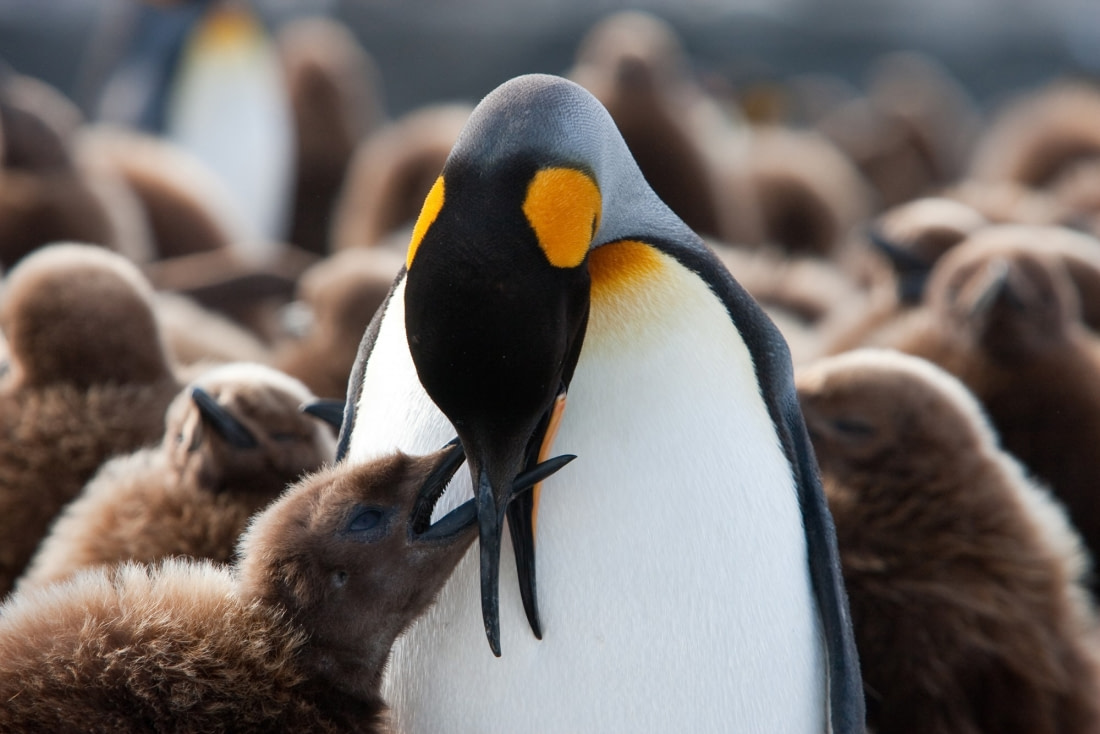
8. King penguin (sub-Antarctic only)
King penguins are the second-largest penguin species after emperors: Once they reach full maturity, they weigh about 16 kg (35 pounds) and stand 94 cm (37 inches) tall.
The estimated 2.2 million breeding pairs of king penguins dine on squid and fish, and live along the coastlines of the sub-Antarctic islands. They are the most marine of all penguins - and indeed all birds, spending more time at sea than any other.
King penguins can dive to depths of more than 300 meters (985 feet) to pursue prey, staying underwater for up to nine minutes.
They are highly social birds that gather in massive colonies (like the St. Andrews Bay rookery of over 150,000 members) to breed. King penguins have an unusual breeding timeframe that lasts approximately 14 months from courtship to the fledging of the chick.
Not natural nest builders, king penguins instead lay one green-white egg that they incubate on their webbed feet and below a fold of skin.
King penguins are known by scientists to have mid-afternoon naps, sleeping more deeply after lunch than during the morning. They live to be about 25 years old in the wild.
See and hear these eight penguins in their Antarctic habitat
There’s only so much writing and pictures can communicate about the beauty of polar wildlife. Ultimately, you just need to experience it in person. But if you still need convincing before you book an Antarctica cruise, check out the video below for some great shots (and sounds) of both species and scenery.
 21 Dec - 08 Jan 2026
 28 Dec - 09 Jan 2026
 29 Dec - 10 Jan 2026
 08 Jan - 18 Jan 2026
 09 Jan - 19 Jan 2026
Related Trips
Falkland Islands - South Georgia - Antarctica
21 Dec 2025 - 08 Jan 2026  19 Days / 18 Nights
Antarctica - Basecamp - free camping, kayaking, snowshoe/hiking, mountaineering, photo workshop
28 Dec 2025 - 09 Jan 2026 13 Days / 12 Nights
Antarctica - Basecamp - free camping, kayaking, snowshoe/hiking, mountaineering, photo workshop
29 Dec 2025 - 10 Jan 2026 13 Days / 12 Nights
Antarctica - Discovery and learning voyage
08 Jan 2026 - 18 Jan 2026 11 Days / 10 Nights
Antarctica - Discovery and learning voyage
09 Jan 2026 - 19 Jan 2026 11 Days / 10 Nights
Antarctica - Discovery and learning voyage
18 Jan 2026 - 28 Jan 2026 11 Days / 10 Nights
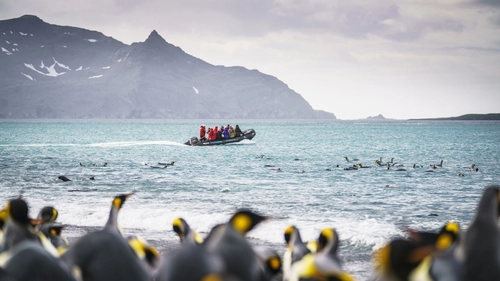
Falkland Islands - South Georgia - Antarctica
19 Jan 2026 - 06 Feb 2026 19 Days / 18 Nights
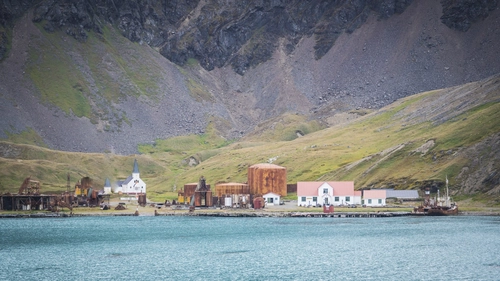
Falkland Islands - South Georgia - Antarctica
28 Jan 2026 - 16 Feb 2026 20 Days / 19 Nights
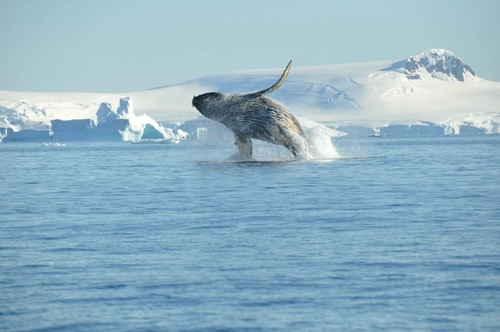
Antarctica - Discovery and learning voyage
06 Feb 2026 - 16 Feb 2026 11 Days / 10 Nights
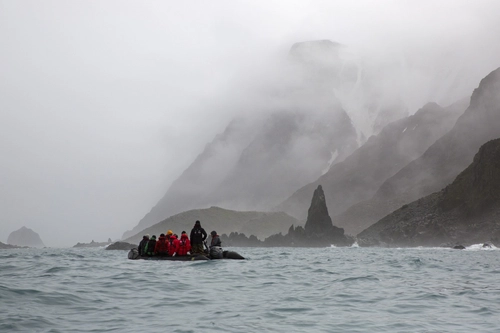
Falkland Islands - South Georgia - Elephant Island - Antarctica - Polar Circle
16 Feb 2026 - 10 Mar 2026 23 Days / 22 Nights
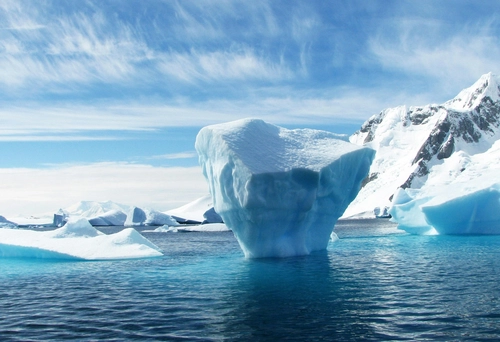
Antarctica – Uncharted islands of the Deep South
18 Feb 2026 - 04 Mar 2026 15 Days / 14 Nights
Deep South Basecamp experience
04 Mar 2026 - 17 Mar 2026 14 Days / 13 Nights

Blog


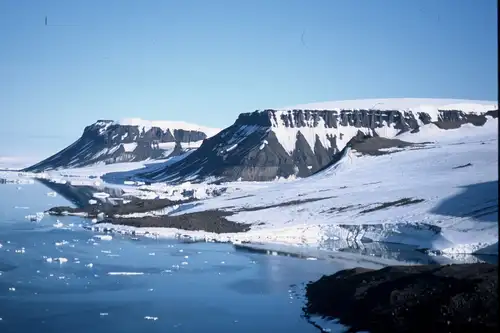
Franz Josef Land Sites, Species, and Experiences
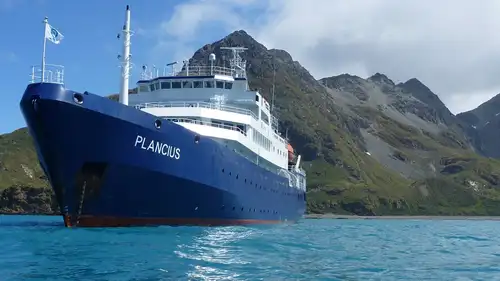
A Day on m/v Plancius
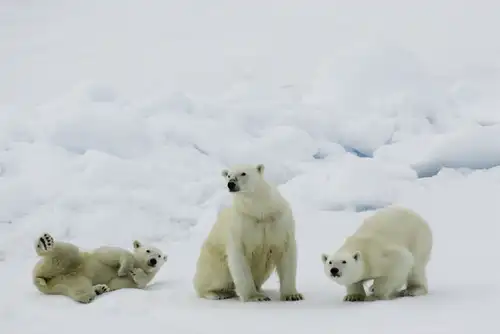
Polar bear encounter in Spitsbergen
International Polar Bear Day
Humpback Whales: the Stars of the Western Antarctic Peninsula
Ice streams and lakes under the Greenland Ice Sheet
9 Facts about the Greenland Shark
What to Expect When Crossing the Drake Passage
How and When Did Greenland Become Covered in Ice?
Adding Antarctica to Your Seven-Continents Bucket List
The Northern Lights dancing across the skies
The secrets of Antarctic seals revealed
Encounter with the emperor penguin in Antarctica

Svalbard a Disneyland for geologists
Ancient Arctic Exploration
Narwhals: the Aquatic Unicorns of the Arctic
Port Pastimes: 7 Fun Things to Do in Longyearbyen
Diving in Antarctica: The Ultimate Underwater Experience
Orcas (aka Killer Whales) of Antarctica and the sub-Antarctic