
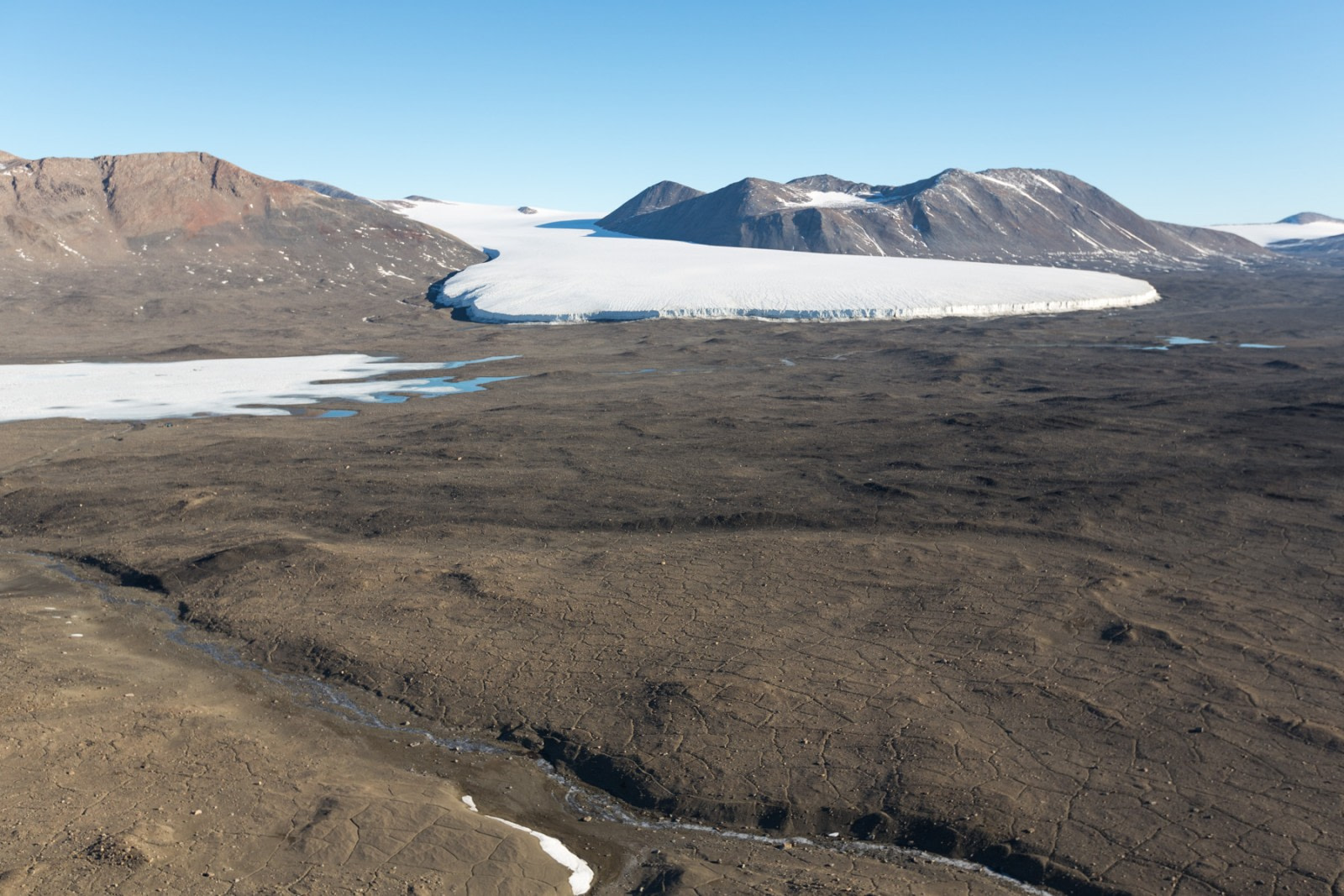
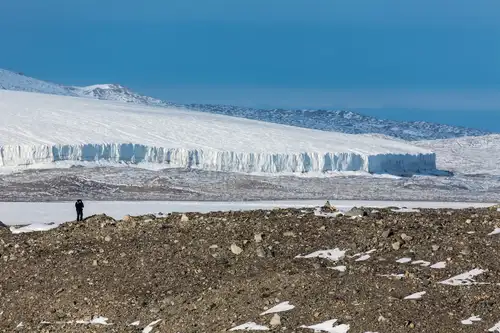
Situated on the western coast of McMurdo Sound, the McMurdo Dry Valleys represent the largest ice-free region in Antarctica.
Spanning an area of roughly 4,800 square km (1,850 square miles), the Dry Valleys are notable for their frozen lakes and vast expanses of exposed soil, making them one of Earth's most extreme environments for supporting life.
With low temperatures, minimal precipitation, and high salt accumulation, the McMurdo Dry Valleys bear a closer resemblance to Mars than to other parts of Earth or Antarctica.
The Dry Valleys remain arid because the snow that falls on the Antarctic Continent is swept away by strong, dry katabatic winds through sublimation.
As a result, the only ice present in the Dry Valleys comes from alpine glaciers and lake ice, making this area a unique anomaly in an already extraordinary continent.
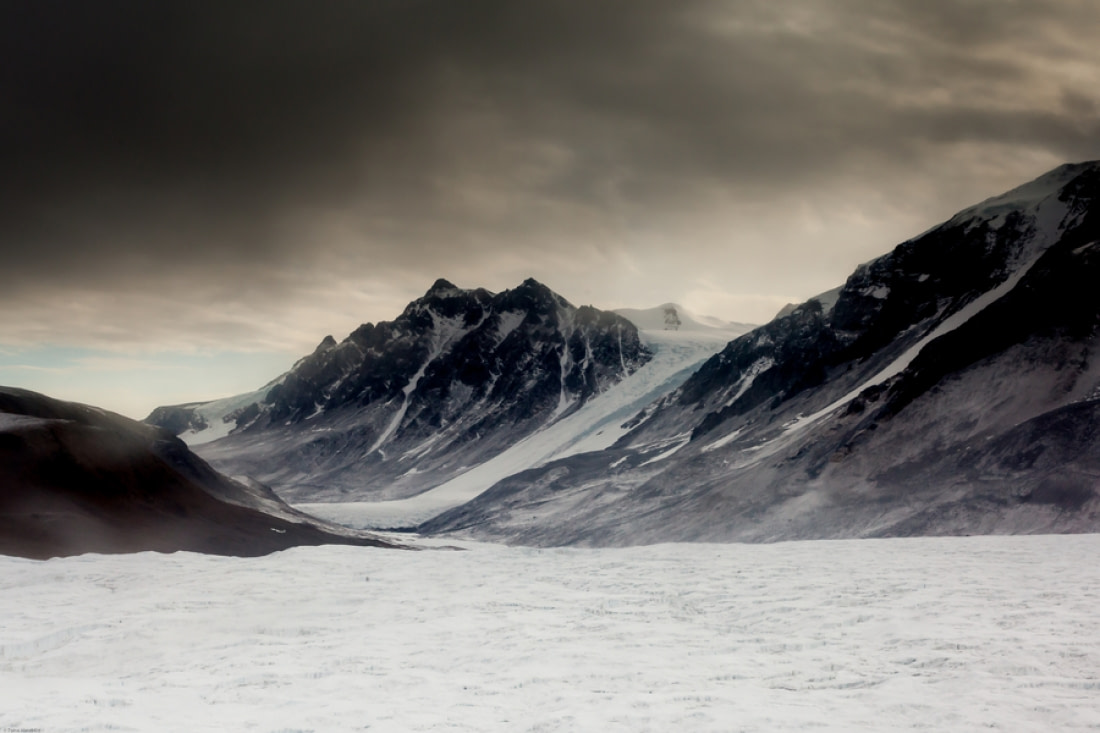
Antarctic Life in the McMurdo Dry Valleys
When Captain Scott first encountered the Dry Valleys in 1903, he and his team believed the area to be devoid of life.
Contrary to their initial belief, a variety of aquatic ecosystems thrive in the harsh conditions of the McMurdo Dry Valleys, thanks to glacier melt-streams that feed into the ice-covered lakes.
This flow is not constant but varies based on temperature, wind, and sunlight.
The flow levels can range from a trickle to a torrent throughout the day, month, and year, allowing only certain organisms to survive in this unique environment.
These organisms are typically cyanobacteria, known for their "stress-tolerant" nature and dark pigments that protect them from high UV rays.
Despite the harsh conditions, the McMurdo Dry Valleys host a diverse range of species, as there are few other plants or animals to compete with or prey on them.
One remarkable aspect of cyanobacteria is their ability to initiate photosynthesis within 48 hours of receiving liquid water, even after being in a virtually freeze-dried state.
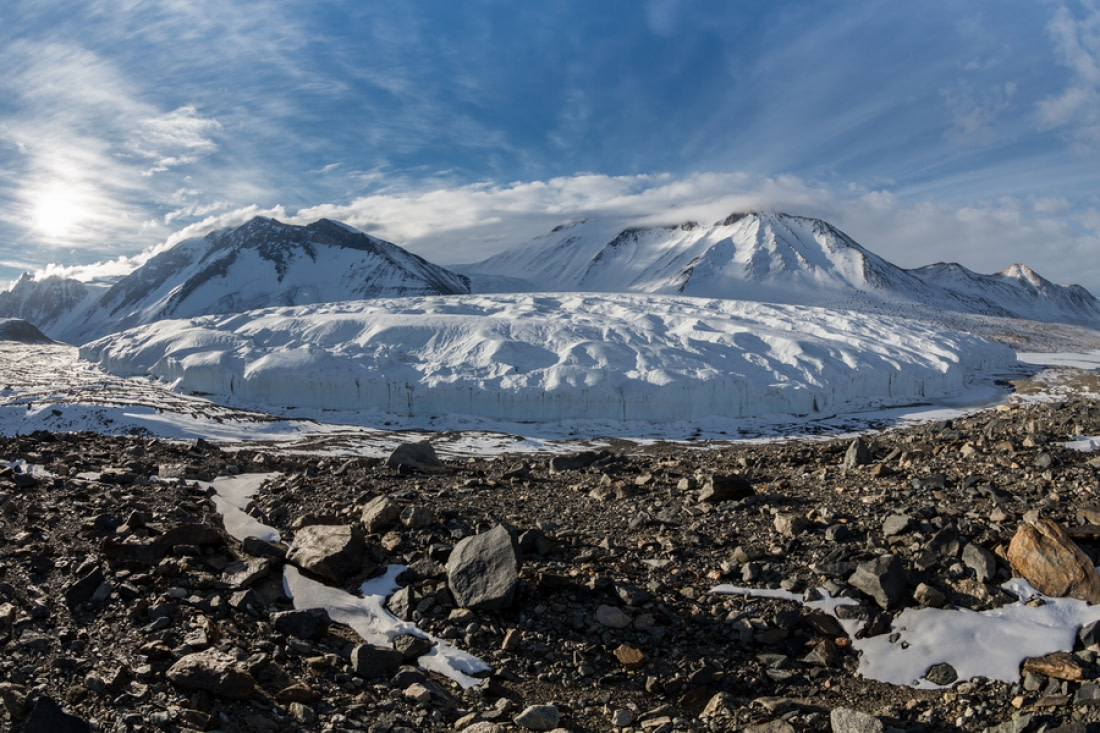
The Ice-Covered Lakes of the McMurdo Dry Valleys
The ice-covered lakes in the Dry Valleys, with ice thickness ranging from 3 to 5 meters (9.8 to 16.4 feet) year-round, offer a unique habitat for life. Key characteristics of these lakes include:
- Ice cover that stabilizes the water column, allowing saltwater layers to persist for many years
- Limitation on the speed at which nutrients from deep waters return to the lake's upper layer
- Thick ice that blocks 80-99% of the sun’s energy
These features result in the Dry Valleys lakes being dark, cold, and nutrient-poor, creating a slow-growth environment for various species. The most common life forms in these lakes are microbial mats on the lakebeds, primarily composed of cyanobacteria.
Despite the cold temperatures inhibiting their growth, these mats accumulate in large quantities due to limited disturbance and lack of grazing. Interestingly, the mats grow in annual layers, with each layer appearing as alternating bands of black (winter) and white (summer), allowing researchers to track past temperature changes in the Dry Valleys.
Lake levels are determined by the volume of available melt-water, which fluctuates over time. For instance, Lake Vanda's depth has varied from 130 meters deep around 5,000 years ago to nearly dry levels around 1,200 years ago, leaving a brine pool. During the 1970s, the lake depth was 65 meters. Due to the lack of wind mixing the water, the brine pool dating from 1,000 years ago remains at the bottom of the lake.
Discovery of Antarctic Groundwater in the McMurdo Dry Valleys
Researchers recently discovered a salty aquifer beneath the Dry Valleys that could potentially support previously unknown microbial ecosystems. UC Santa Cruz glaciologist Slawek Tulaczyk, along with other researchers, gathered evidence of groundwater using a helicopter-borne sensor to penetrate below the surface.
The study found that brines, or salty water, form aquifers beneath the Dry Valleys' glaciers and lakes and within its frozen soil. The brines were found to flow towards the Antarctic coast from around 18 kilometers inland, eventually discharging into the Southern Ocean. The study speculates that the nutrients carried in the brine are released into the ocean, affecting biological productivity in and around the shoreline areas.
Another significant discovery was the detection of microbial habitats in the surface and near-surface of the Dry Valleys. These habitats are remarkable because the tiny pore spaces are filled with hyper-saline brine that remains liquid down to -15 °C. This study is part of an international, interdisciplinary team using an electromagnetic sensor called SkyTEM, mounted on a helicopter, to produce imagery of the Dry Valleys' subsurface. The technology was developed at Aarhus University in Denmark.
SkyTEM lead Esben Auken has flown the sensor in many places worldwide, but this was the first time the technology was deployed in Antarctica. The data from this project will provide scientists with a better understanding of how the Dry Valleys have changed over time and how this history influences current observations.
The Science of the McMurdo Dry Valleys
The McMurdo Dry Valleys Long Term Ecological Research (LTER) project is an interdisciplinary study of the Dry Valleys' aquatic and terrestrial ecosystems. The site was selected in 1992 for the National Science Foundation’s Long-term Ecological Research Program.
With project funding renewed in 2010 for another six years, the McMurdo LTER project conducts long-term ecological research to leave a legacy of well-designed and well-documented long-term field experiments and observations. This will help future generations better understand the basic components of the ecosystem and the factors causing widespread changes. Specifically, the McMurdo LTER aims to understand the influence of physical and biological constraints on the structure and function of Dry Valley ecosystems.
A Barometer of Global Change: The McMurdo LTER
The McMurdo LTER project emphasizes the importance of research conducted in the Dry Valleys. While all ecosystems depend on liquid water for survival, few places on Earth are as sensitive to minor climate changes as the Dry Valleys.
Data collected by the LTER indicate that the Dry Valleys are highly sensitive to small variations in solar radiation and temperature, providing researchers with a natural regional-scale laboratory for studying responses to human activities that alter the climate.
Importantly, while Antarctic ice sheets respond to climate change over thousands of years, the streams and ice-covered lakes in McMurdo's Dry Valleys respond almost immediately. This makes the McMurdo Dry Valleys one of the first places on Earth where the impacts of climate change will be observed.


Blog


Humpback Whales: the Stars of the Western Antarctic Peninsula
How and When Did Greenland Become Covered in Ice?

What to pack for your Atlantic Odyssey voyage?
The first race to the South Pole in 50 years

Birding Opportunities Abound in Spitsbergen

Earth vs. Mars: Polar Regions Compared
Exploration of the Polar Regions
Six Must-See Svalbard Sites
A visit to the fascinating island of Jan Mayen
The Seasons of Antarctica: When to Visit and Why
Polar Bear Primer: Eight Facts About the Arctic Wanderer
The Secret Life of Glaciers: How They Form, Move, and Melt
The Arctic’s Most Phenomenal Fjords
Top 10 Antarctic Attractions
South Georgia Whaling Stations
The South Georgia Seven: Hikes, Fjords, Whales, & Penguins
Shackleton’s Long-Lost Endurance Discovered in Antarctica
The Seven Best Things to Do in Antarctica
Greenland's History: When Vikings Ruled the Ice Age