A Visit To The Fascinating Island Of Jan Mayen - Nexta Expeditions
A visit to the fascinating island of Jan Mayen

A visit to the fascinating island of Jan Mayen

After exploring the remote island of Fair Isle, our Atlantic Odyssey voyage once more turned its attentions northwards and left the outer extremities of the UK behind. Our destination was Jan Mayen, a volcanic island situated on the mid-Atlantic ridge just north of 71° (about 550 kilometers north of Iceland and 450 kilometers east of Greenland).

Jan Mayen is reputedly shrouded in mist the vast majority of the time so it was a very pleasant surprise to see the conical crater appearing over the horizon. Over eighty nautical miles away and completely cloud free.

blog-image

Brief history of Jan Mayen

Jan Mayen was recorded in early manuscripts from Norse and Irish travellers but was first occupied in the 17th century by English and Dutch whalers. It was visited infrequently till the 1900’s and then in 1906 Norwegian trappers and hunters inhabited the island seeking the blue Arctic fox for its fur.

In 1921 a meteorological station was established and since then, the island has been continually occupied. It was officially annexed to Norway in 1930 and shortly after was the only part of Norway not under German occupation, despite a number of attempts. Now, it is run by the Norwegian military and supports meteorological science year round.

Landing Båtvika, at the southern part of Jan Mayen

The Zodiacs left the ship and headed towards Båtvika (The Boat Cove), a bay lying on the eastern coast close to the Norwegian base. Even setting off in reasonably calm seas was no guarantee of getting ashore as even a small swell out at seas can dump large waves on the steeply sloping shoreline making for a tricky landing. We need not have worried. An idyllic cove fringed with ash black sand little troubled by the gently lapping water greeted us. Also there to greet us was an assembly of Norwegian base staff eager to welcome us onto and show off their island in the sun.

Volcanic landscape

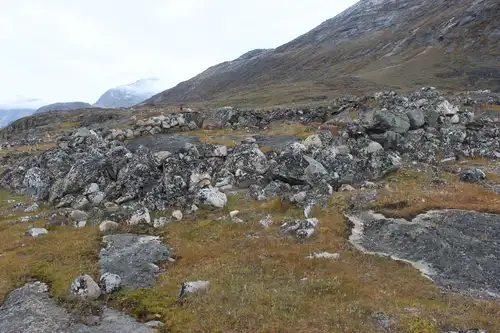
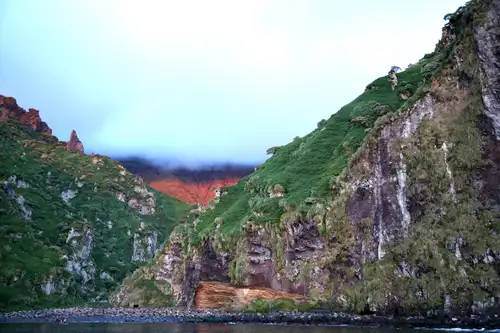
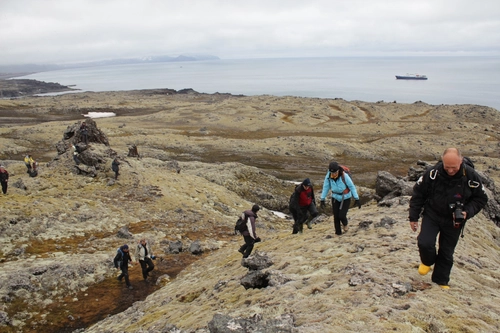
A steady stream of passengers followed our initial Zodiac disembarking with ease and steadily made their way northwards along the islands only road. Many stopped for some retail therapy at the base shop and nearly all explored the landscape beyond the base. The volcanic history of the island is evident all around and reminded me of islands in the South Shetlands. Jan Mayen can be approximated into two halves. The northern half of the island, Nørd Jan, is where Beerenburg the northernmost active volcano in the world lies. It has a classic ’Mount Fuji’ shape to it and sports a nice caldera when viewed from the satellite imagery. The southern end is no less volcanic but is a confusion of lava flows, striated hillsides and cinder cones.

blog-image

The two sections are separated by a narrow isthmus of land sometimes less than 3 kilometres wide. One of the more magical experiences was when one paused and took in the volume of the kittiwake’s calls echoing from the cliffs above the road. Turning seaward, the beaches were lined with driftwood debris in the form of logs separated from their Siberian loggers and ships flotsam as well as buoys from the fishing industry.

Sailing North

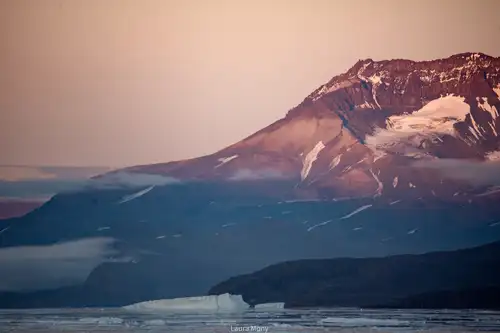
After an uneventful departure, we weighed anchor and departed Jan Mayen under darkening skies with poor weather encroaching from the south. The Plancius worked its way along the spectacular coast of Nørd Jan. Stratified volcanic cliffs could be scoured through binoculars for a myriad of seabirds until our attention was diverted to a pair of humpbacks. Lovely evening light on the summit of Beerenburg dispatched us north in search of the ice.
Best Deals

Related Trips

Arctic Ocean - Fair Isle, Jan Mayen, Ice Edge, Spitsbergen, Birding - Nexta Expeditions
The Arctic
Aberdeen

Arctic Ocean - Fair Isle, Jan Mayen, Ice Edge, Spitsbergen, Birding

calendar27 May 2026 - 05 Jun 2026
clock10 Days / 9 Nights
From $ 3.100 per person
Arctic Ocean - Jan Mayen, Ice edge, Spitsbergen, Birding - Nexta Expeditions
The Arctic
Akureyri

Arctic Ocean - Jan Mayen, Ice edge, Spitsbergen, Birding

calendar05 Jun 2026 - 13 Jun 2026
clock9 Days / 8 Nights
From $ 2.800 per person
Arctic Ocean - Fair Isle, Jan Mayen, Ice edge, Spitsbergen, Birding - Summer Solstice - Nexta Expeditions
The Arctic
Aberdeen

Arctic Ocean - Fair Isle, Jan Mayen, Ice edge, Spitsbergen, Birding - Summer Solstice

calendar12 Jun 2026 - 21 Jun 2026
clock10 Days / 9 Nights
From $ 3.100 per person

Blog
go-leftgo-right

Polar bear feast - Nexta Expeditions
Blog

Polar bear feast

The polar bear was relishing his meal; the snow and his face were turning red from the blood. As we observed him eating, our own stomachs began to grumble. It was time for lunch.
Svalbard’s 12 Most Iconic Animals - Nexta Expeditions
Blog

Svalbard’s 12 Most Iconic Animals

Each of our Arctic regions offers its own distinct and unforgettable features: Greenland boasts mountainous shorelines and record-setting fjords, Northern Norway is renowned for the aurora borealis and historic masted schooners, and Svalbard (especially Spitsbergen) is where you're most likely to encounter a variety of Arctic wildlife.
Tracking Greenland’s Wildlife from Space - Nexta Expeditions
Blog

Tracking Greenland’s Wildlife from Space

Despite Greenland’s harsh environment, life has found a way to thrive there. If you’re lucky enough to embark on a Greenland cruise, you stand the chance of encountering many species of cold-adapted mammals, birds, and fish.
Five Reasons You Should Cruise the Ross Sea Immediately - Nexta Expeditions
Blog

Five Reasons You Should Cruise the Ross Sea Immediately

In our search for lesser-known holiday spots that still offer fully developed amenities like spas and gift shops, we often miss out on some of the planet's truly underrated treasures.
Kayaking In Greenland - Nexta Expeditions
Blog

Kayaking In Greenland

Think of Greenland and two images come to mind:
5 Life Lessons You'll Learn in Antarctica - Nexta Expeditions
Blog

5 Life Lessons You'll Learn in Antarctica

Embarking on a journey to the Antarctic might seem daunting. However, cruise lines strive to simplify the process as much as possible. They typically assist with travel insurance, guide you to the embarkation point, and advise on the appropriate clothing to bring.
Polar Amore: 14 Wildlife Pics to Warm up Your Valentine’s Day - Nexta Expeditions
Blog

Polar Amore: 14 Wildlife Pics to Warm up Your Valentine’s Day

Embarking on a journey to the Antarctic might seem daunting. However, cruise lines strive to simplify the process as much as possible. They typically assist with travel insurance, guide you to the embarkation point, and advise on the appropriate clothing to bring.
The Arctic Borderland of Kongsfjorden, Svalbard - Nexta Expeditions
Blog

The Arctic Borderland of Kongsfjorden, Svalbard

Kongsfjorden is a glacial fjord in Svalbard that hosts a diverse array of flora and fauna.
Greenland: Where the Kayak Was Invented - Nexta Expeditions
Blog

Greenland: Where the Kayak Was Invented

If you've ever enjoyed kayaking, you owe a debt of gratitude to the ancient Greenlandic Inuit who originally designed them for hunting. The thrilling adventures people now have navigating some of the world's most challenging rapids wouldn't be possible without the Inuit's need for a nimble form of water transportation. While travelers still use kayaks in this region, they are typically not fishing, whaling, or sealing. Consequently, recreational kayaks have been adapted to fit their new role.
Polar Marine Visitors: the Whales of Antarctica and the Arctic - Nexta Expeditions
Blog

Polar Marine Visitors: the Whales of Antarctica and the Arctic

Whales are the world’s largest mammals, found in the Arctic and Antarctica. This article covers some of the major species you may see on voyages to these remarkable areas.
Antarctic krill: Antarctica's Superfood - Nexta Expeditions
Blog

Antarctic krill: Antarctica's Superfood

The size of a paper clip, pink, krill is a shrimp-like crustacean that does not look like much. Without them, though, the Earth's marine ecosystems would collapse completely.
Arctic on Foot: Hiking and Snowshoeing the Far North - Nexta Expeditions
Blog

Arctic on Foot: Hiking and Snowshoeing the Far North

The focus of our voyages is always to get you off the ship and into the action as frequently as possible. While we travel from site to site on ice-strengthened vessels, our expeditions are crafted to provide you with the maximum firsthand experience of the polar regions and their unique wildlife.
Inside the Svalbard Global Seed Vault - Nexta Expeditions
Blog

Inside the Svalbard Global Seed Vault

Literature, cinema, and even video games often present us with various global disaster scenarios. These typically involve devastating wars, catastrophic natural events, or widespread pandemics that leave survivors scavenging for food and supplies amidst hordes of zombies.
Antarctica’s first Marine Protected Area - Nexta Expeditions
Blog

Antarctica’s first Marine Protected Area

In October of this year, the Commission for the Conservation of Antarctic Marine Living Resources, which includes 24 countries such as the United States, the European Union, Australia, and New Zealand, reached a consensus on a New Zealand/United States proposal to establish a large-scale Marine Protected Area (MPA) in the Ross Sea region.
Everything you need to know about Antarctic icebergs - Nexta Expeditions
Blog

Everything you need to know about Antarctic icebergs

The ice in Antarctica might seem static, but it is constantly moving. Pieces of ice are continuously breaking off from ice shelves, glaciers, or other icebergs. They float freely along with the Antarctic currents, with about 90 percent of their mass below the surface of the water. This fact is actually what gave rise to the nowadays popular phrase “the tip of the iceberg”. Regardless, the sighting of the first iceberg is always a moment to celebrate in any and all Antarctic expeditions. So that you may appropriately ready yourself for that joyous moment, in this article you will find everything you need to know about Antarctic icebergs.
Port Lockroy: History, Post Office, and Resident Penguins - Nexta Expeditions
Blog

Port Lockroy: History, Post Office, and Resident Penguins

Sometimes it’s easy to get caught up in the stunning coastlines, fjords, and other natural wonders of Antarctica, overlooking the man-made attractions nestled in between.
Exploration of the Polar Regions - Nexta Expeditions
Blog

Exploration of the Polar Regions

From the Vikings via the first whale and seal hunters to Scott and Amundsen, from the maritime explorers Franklin and Nordenskiöld to present-day polar tourism, a quick tour through history reveals some of the aspects which motivated people to extend their horizons. Existential need, sheer curiosity, imperial greed, polar science, and a taste for adventure all converged in regions which pardon no mistakes.
Adding Antarctica to Your Seven-Continents Bucket List - Nexta Expeditions
Blog

Adding Antarctica to Your Seven-Continents Bucket List

Many travelers aspire to visit all seven continents, a goal that fits naturally with the concept of a "bucket list," a term popularized by the 2007 movie.
Narwhals: the Aquatic Unicorns of the Arctic - Nexta Expeditions
Blog

Narwhals: the Aquatic Unicorns of the Arctic

Though narwhals are among the rarest whale species encountered during our Arctic expeditions, a journey to the Arctic regions of Greenland and Svalbard always holds the potential for spotting these elusive creatures.
10 Illuminating Facts about the Northern Lights - Nexta Expeditions
Blog

10 Illuminating Facts about the Northern Lights

In Roman mythology, Aurora was the goddess of the dawn. The term "borealis" is derived from the Greek word for "wind." Thus, "aurora borealis" translates to "dawn wind," commonly known as the Northern Lights. This natural phenomenon has captivated humanity for millennia and remains a major attraction in the Arctic, with numerous cruises dedicated to witnessing this mesmerizing light display.