The Polar Bear King Of The Arctic Food Chain - Nexta Expeditions
The polar bear: king of the Arctic food chain

The polar bear: king of the Arctic food chain

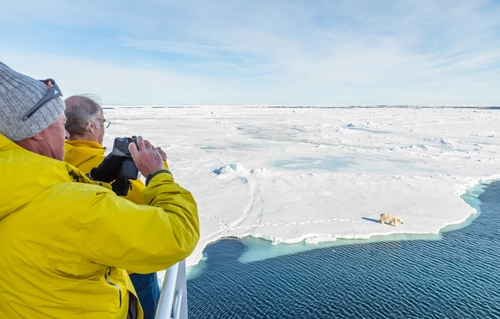
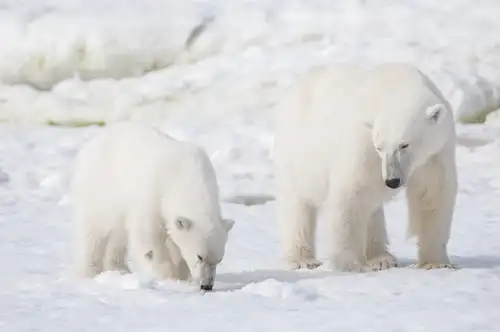
As apex predators, polar bears reign supreme in the Arctic food chain. Only humans pose a threat to this massive and majestic species. But one look at these magnificent creatures explains why so many people embark on Arctic trips hoping to spot a polar bear in its natural habitat.

While witnessing these animals is incredible, their position at the top of the far-north food chain necessitates caution when entering their territory. That's why we have strict safety policies on our Arctic cruises, ensuring the safety of both our staff and passengers as well as the polar bears.

Nonetheless, there's nothing like seeing a polar bear in its ruggedly beautiful home. If you decide to join us on an Arctic cruise and are fortunate enough to see a polar bear in person, here are a few polar bear facts to enhance that awe-inspiring experience.
blog-image

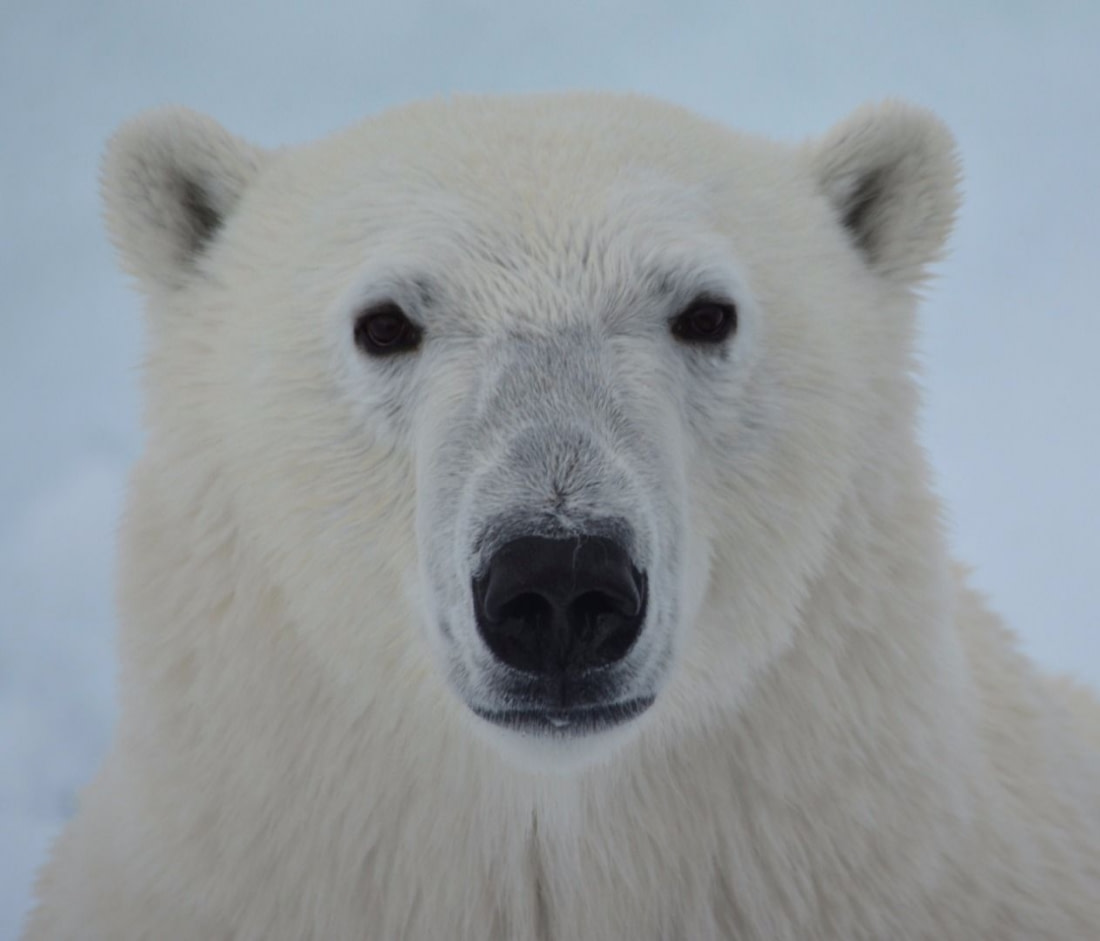
Polar bear size between the sexes

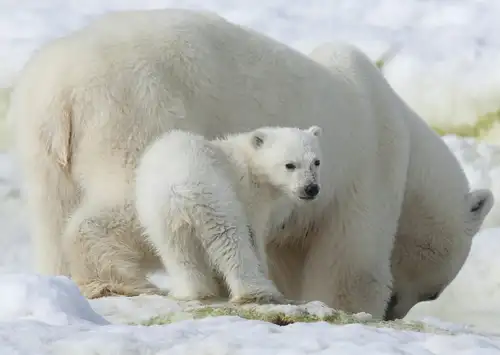
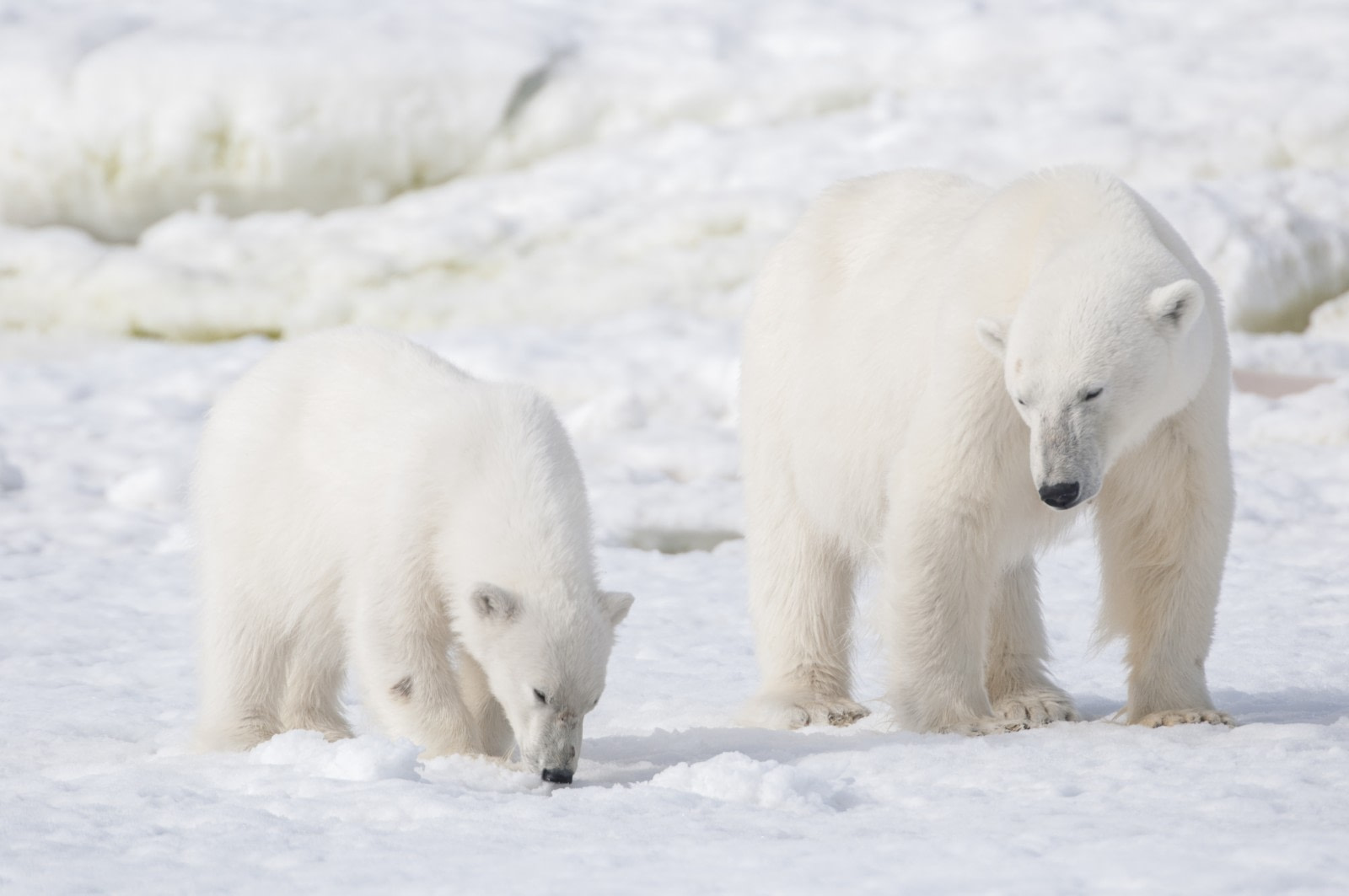
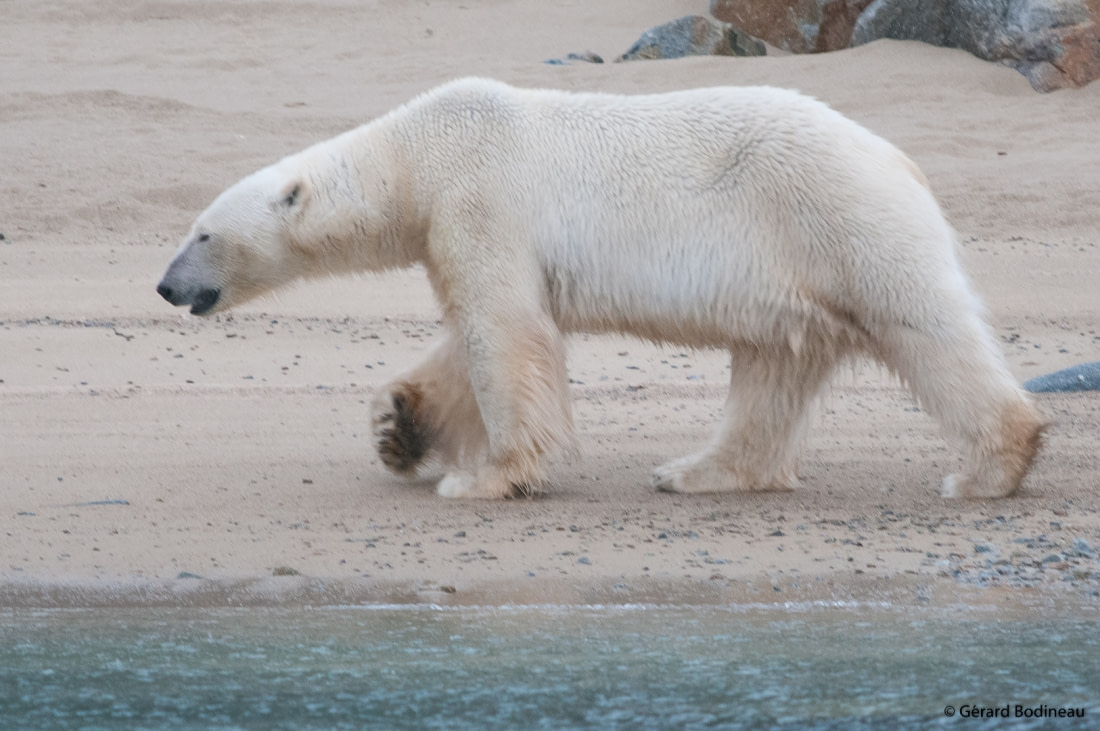
Though they are the largest species of bear, there is a significant size difference between male and female polar bears. Males weigh between 350 and 800 kg (770 and 1,750 pounds) and females between 150 and 300 kg (350 and 650 pounds). Polar bear weights fluctuate throughout the year, depending on the season. Female polar bears can often double their weight between early spring and late summer. Polar bears have adapted to the Arctic well, with a small head to minimize heat loss, short fur-covered ears, and more powerful claws compared to other types of bears. They also have longer teeth and sharper molars that aid in their meat-heavy diet.
blog-image

The polar bear's most common prey

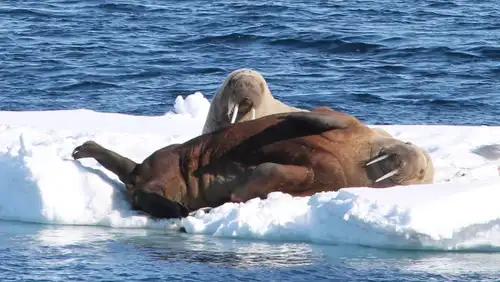
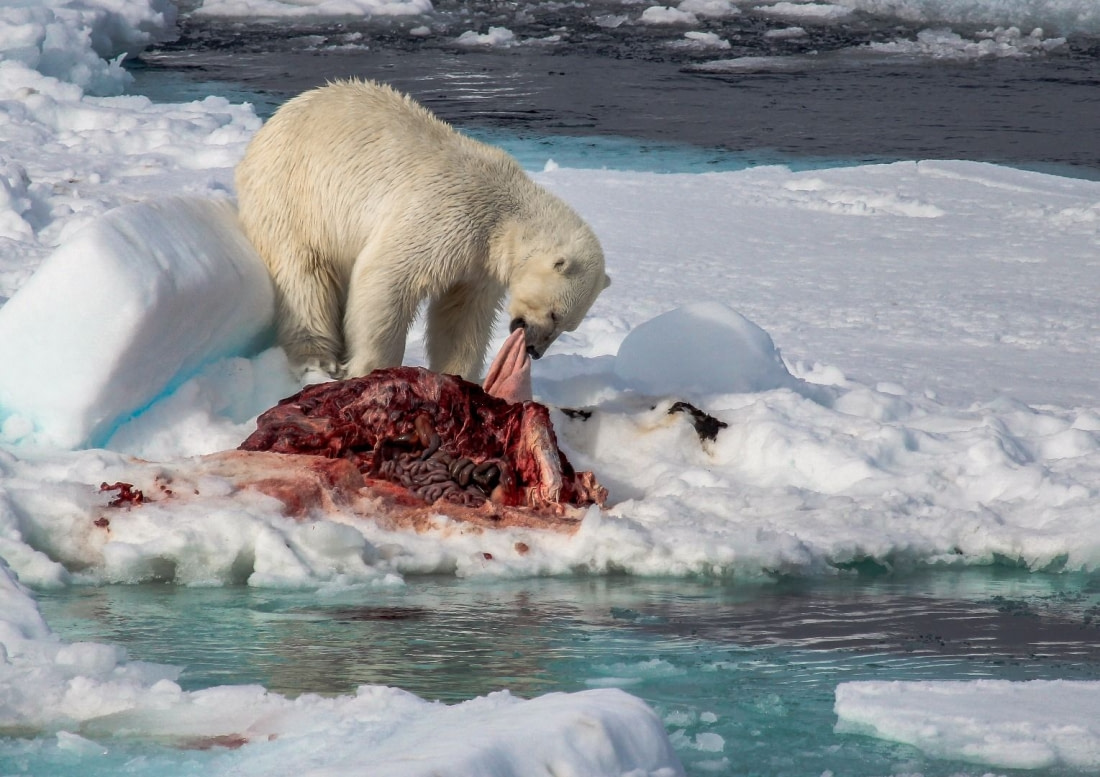
When you're at the top of the food chain, you can afford to be picky. But polar bears will actually eat just about anything they can catch. Their preferred meal, however, is seal – specifically ringed seals and bearded seals. On the sea ice, they eat young walruses, Greenland seals, hooded seals, beluga whales, and narwhals. On land, polar bears catch reindeer, musk oxen, rodents, young seabirds, and bird eggs. They even feast on the carcasses of whales that have washed ashore. During leaner months, polar bears also have a taste for non-meat foods, including berries, grass, and seaweed.
blog-image

Polar bear hunting rituals

Polar bears can run quickly for their size, but they do not generally rely on speed for catching their prey. That consumes too much energy. Instead, polar bears tend to approach their prey stealthily, using the wind direction to avoid being detected by scent. They often hunt at seal breathing holes, waiting for hours for a seal to appear and then pouncing when it surfaces. Being at the top of the food chain means hunting smart, not hard.

The lifespan and breeding of polar bears

In the wild, polar bears normally live 20-30 years. Both males and females mature at four to five years old. Females often give birth to their first litter of cubs when they reach maturity, while males do not usually start mating until they are eight to ten years old. From April to May, young male polar bears find females by their scent. This usually leads to bloody fights between competing males, after which victors mate with females.

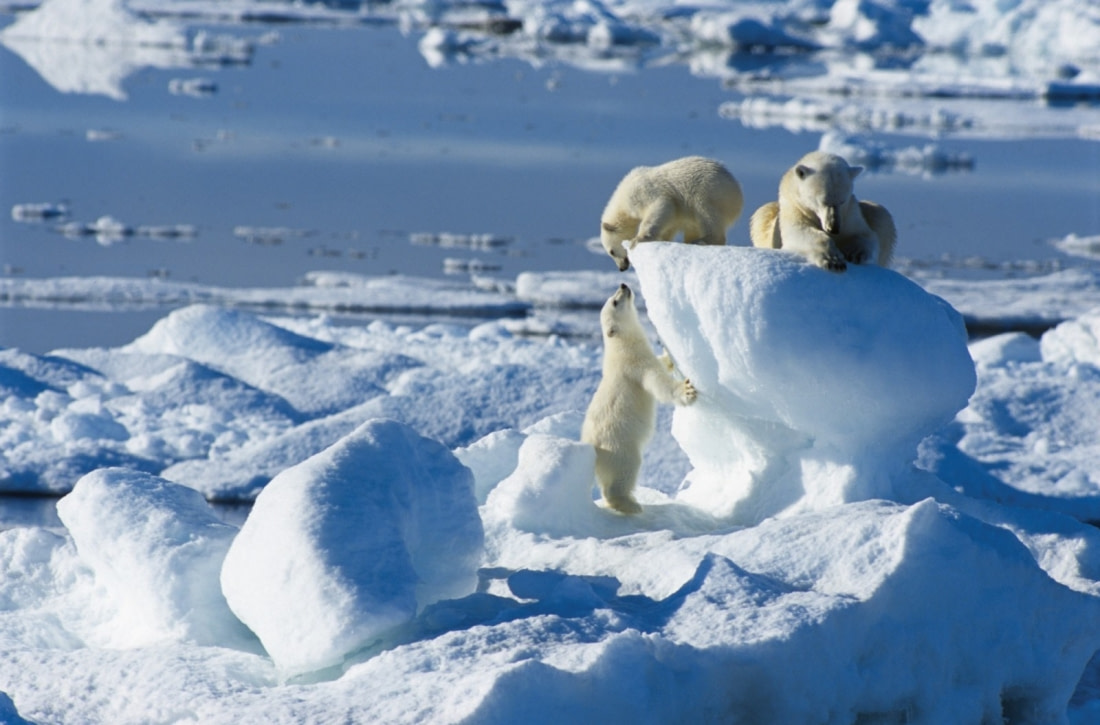
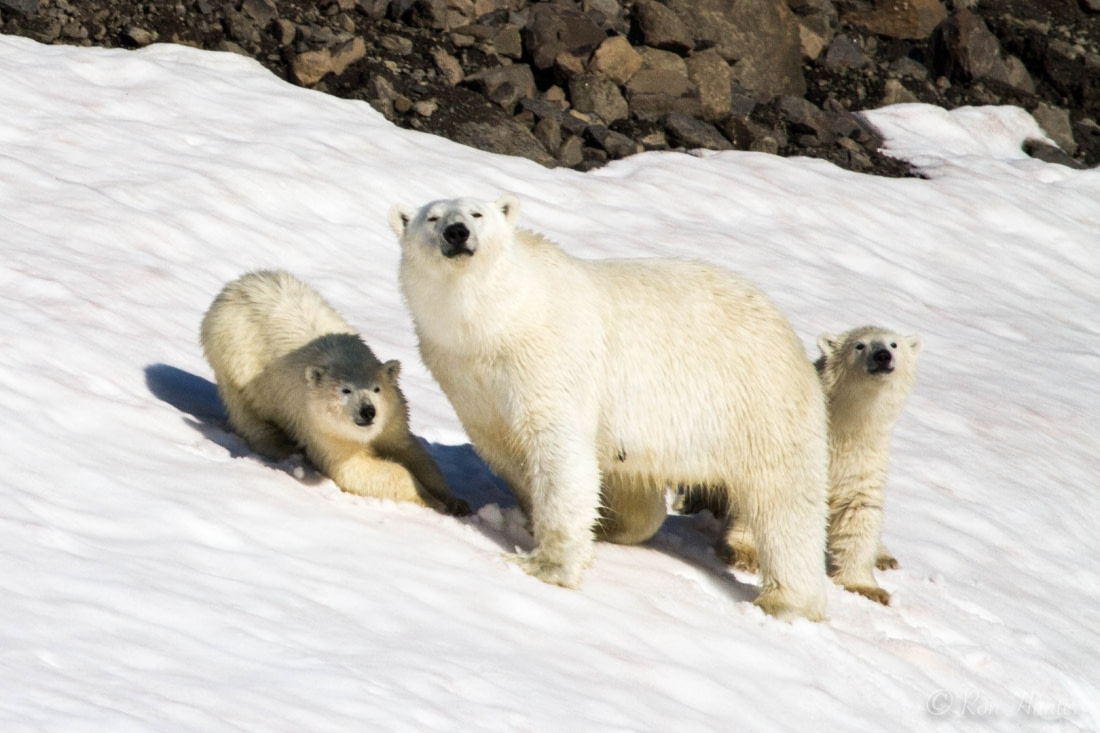
Once pregnant, females leave to eat as much as possible. In late September, they dig dens in the snow and enter a kind of hibernation (not official hibernation, as polar bears do not hibernate). About four to six months later, females give birth to one or two cubs who remain with her two to three years before leaving. Polar bear cubs weigh only about half a kilo (one pound) when born but grow rapidly due to the high fat content of their mother's milk.
blog-image

Polar bear populations and habitat

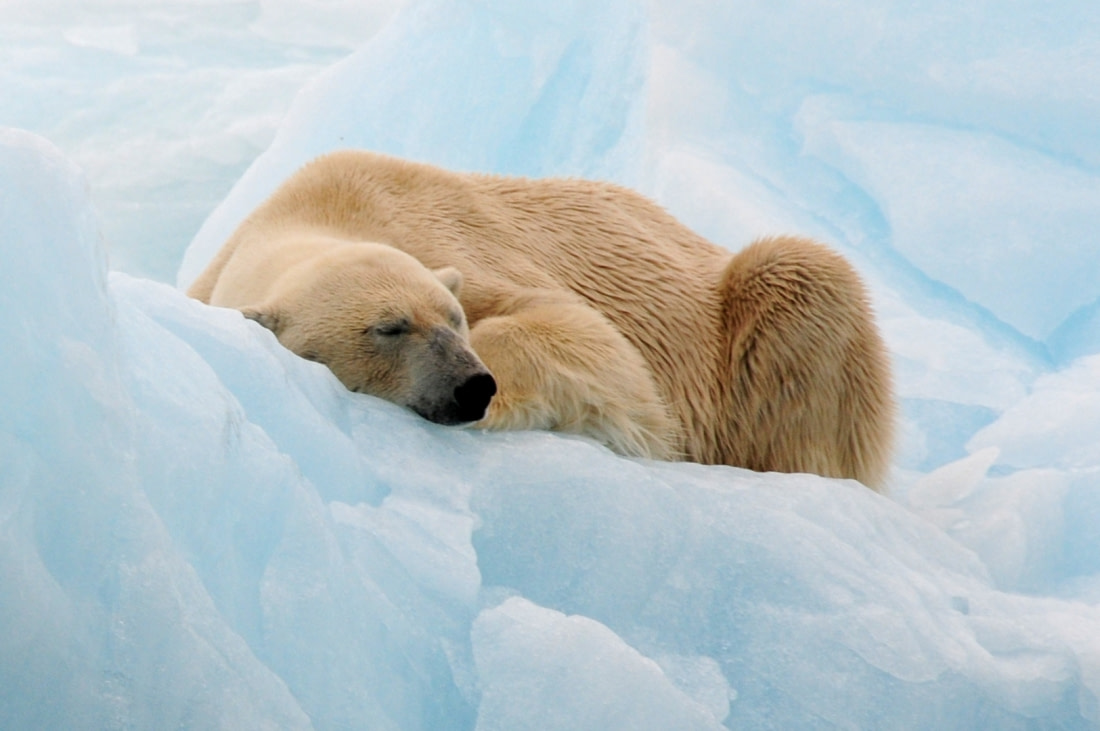
Polar bears are not a single large homogenous population that roams the Arctic in unison. Rather, groups of polar bears called "stocks" or "populations" are distributed throughout the Arctic. Since the 1960s, thorough research has been conducted by scientists to learn more about these populations, collecting information on demographics, population boundaries, movements, size, reproduction, and survival parameters. Research has found that polar bears do not live in large numbers and their reproductive ability is low.

Exclusively Arctic animals, polar bears live in the far north of Canada, Alaska, Greenland, Russia, and Northern Europe. We visit some of the most populated polar bear habitats in Svalbard and Franz Josef Land, where polar bears have vast hunting grounds called "home ranges." These ranges can extend for several thousand square kilometers / miles, by far outsizing every other bear hunting range.
blog-image

Technological advances in studying polar bears

Scientists often use satellites to follow individual polar bears and make inferences as to population movements and boundaries. Infrared technology is also useful in monitoring polar bears hidden beneath the snow. Aircraft as well as marine technology has likewise given scientists access to larger populations of polar bears than ever before.

To understand more about polar bears and how they are impacted by the changing Arctic environment, scientists have even isolated polar bear DNA from tracks left in the snow. According to the WWF, this method is an invaluable tool for conservation biology, as it is a less expensive and invasive way of tracking polar bear population size and health than previously used methods.
blog-image

Polar bears and climate change

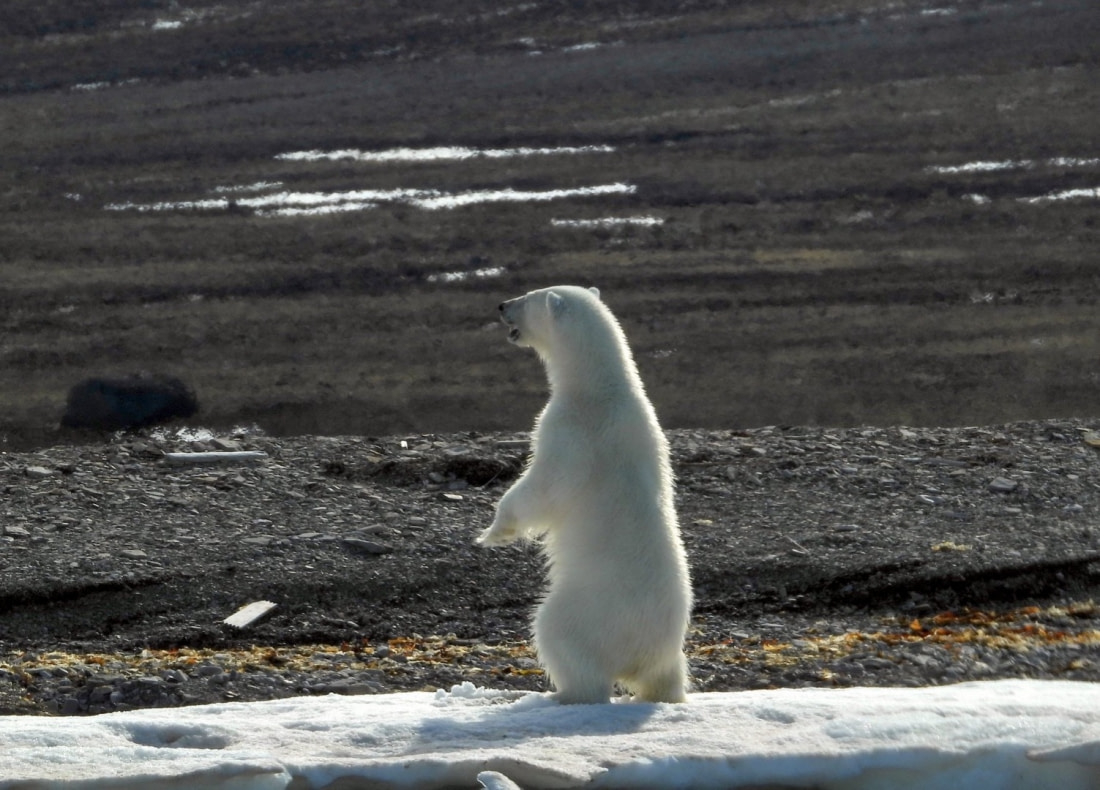
Both the polar bears you'll see on a Svalbard cruise as well as their prey have evolved over time. Both are dependent on sea ice for foraging, resting, and reproduction. As such, both polar bears and seals are key indicators of the effects of climate change on the Arctic environment. With global temperatures rising, polar bear populations are facing threats they've never encountered in recorded history. While it is not certain yet what exactly climate change will do to the polar bear, studies indicate it will have a negative effect on its populations.
blog-image

Likelihood of a polar bear encounter

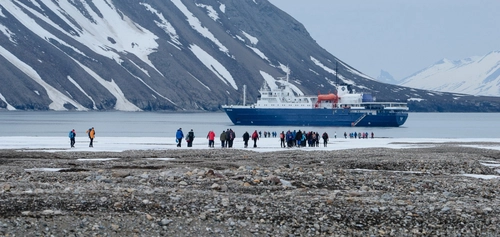
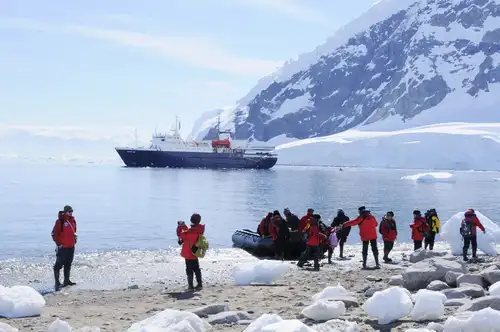
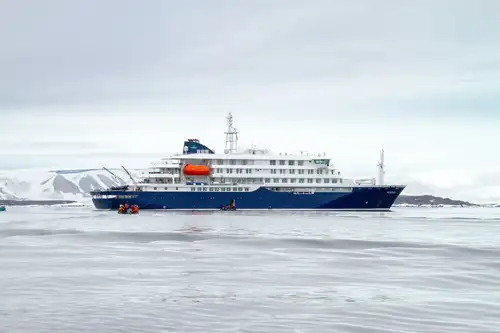
We want to see polar bears from our ship, not when on land. For this reason, our guides thoroughly examine every landing sight from the vessel first, then from the Zodiacs, and then on shore before making any landing with passengers. We never land in an area where a polar bear has been sighted, both for the safety of our guests and colleagues as well as the polar bears. For more information about the safety protocol we follow with regard to polar bears, please see our video below.

Photo credit main photo: Josh Harrison Photography.
Best Deals

Related Trips

Alpine Peaks of Spitsbergen, Ski & Sail - Nexta Expeditions
The Arctic
Longyearbyen

Alpine Peaks of Spitsbergen, Ski & Sail

calendar24 Apr 2026 - 01 May 2026
clock8 Days / 7 Nights
From $ 3.950 per person
Alpine Peaks of Spitsbergen, Ski & Sail - Nexta Expeditions
The Arctic
Longyearbyen

Alpine Peaks of Spitsbergen, Ski & Sail

calendar01 May 2026 - 08 May 2026
clock8 Days / 7 Nights
From $ 3.950 per person
Arctic Ocean - Fair Isle, Jan Mayen, Ice Edge, Spitsbergen, Birding - Nexta Expeditions
The Arctic
Aberdeen

Arctic Ocean - Fair Isle, Jan Mayen, Ice Edge, Spitsbergen, Birding

calendar27 May 2026 - 05 Jun 2026
clock10 Days / 9 Nights
From $ 3.100 per person
North Spitsbergen - Arctic Spring ,  Hike & Sail - Nexta Expeditions
The Arctic
Longyearbyen

North Spitsbergen - Arctic Spring , Hike & Sail

calendar29 May 2026 - 05 Jun 2026
clock8 Days / 7 Nights
From $ 4.000 per person
North Spitsbergen Explorer - Into the pack ice - Polar Bear Special - Nexta Expeditions
The Arctic
Longyearbyen

North Spitsbergen Explorer - Into the pack ice - Polar Bear Special

calendar05 Jun 2026 - 12 Jun 2026
clock8 Days / 7 Nights
From $ 4.500 per person
Arctic Ocean - Jan Mayen, Ice edge, Spitsbergen, Birding - Nexta Expeditions
The Arctic
Akureyri

Arctic Ocean - Jan Mayen, Ice edge, Spitsbergen, Birding

calendar05 Jun 2026 - 13 Jun 2026
clock9 Days / 8 Nights
From $ 2.800 per person
Arctic Ocean - Fair Isle, Jan Mayen, Ice edge, Spitsbergen, Birding - Summer Solstice - Nexta Expeditions
The Arctic
Aberdeen

Arctic Ocean - Fair Isle, Jan Mayen, Ice edge, Spitsbergen, Birding - Summer Solstice

calendar12 Jun 2026 - 21 Jun 2026
clock10 Days / 9 Nights
From $ 3.100 per person
North Spitsbergen Explorer - Into the pack ice - Polar Bear Special - Nexta Expeditions
The Arctic
Longyearbyen

North Spitsbergen Explorer - Into the pack ice - Polar Bear Special

calendar12 Jun 2026 - 19 Jun 2026
clock8 Days / 7 Nights
From $ 4.500 per person
North Spitsbergen Explorer - Versatile landscapes, sea ice & wildlife - Nexta Expeditions
The Arctic
Longyearbyen

North Spitsbergen Explorer - Versatile landscapes, sea ice & wildlife

calendar13 Jun 2026 - 20 Jun 2026
clock8 Days / 7 Nights
From $ 4.500 per person
North Spitsbergen Basecamp – Summer Solstice - Free Kayaking, Hiking, Photo Workshop, Diving (supplemented) - Nexta Expeditions
The Arctic
Longyearbyen

North Spitsbergen Basecamp – Summer Solstice - Free Kayaking, Hiking, Photo Workshop, Diving (supplemented)

calendar19 Jun 2026 - 26 Jun 2026
clock8 Days / 7 Nights
From $ 4.500 per person
North Spitsbergen Explorer - Versatile landscapes, sea ice & wildlife - Summer Solstice - Nexta Expeditions
The Arctic
Longyearbyen

North Spitsbergen Explorer - Versatile landscapes, sea ice & wildlife - Summer Solstice

calendar20 Jun 2026 - 27 Jun 2026
clock8 Days / 7 Nights
From $ 4.500 per person
North Spitsbergen Explorer - Versatile landscapes, sea ice & wildlife - Summer Solstice - Nexta Expeditions
The Arctic
Longyearbyen

North Spitsbergen Explorer - Versatile landscapes, sea ice & wildlife - Summer Solstice

calendar21 Jun 2026 - 28 Jun 2026
clock8 Days / 7 Nights
From $ 4.500 per person

Blog
go-leftgo-right

Arctic on Foot: Hiking and Snowshoeing the Far North - Nexta Expeditions
Blog

Arctic on Foot: Hiking and Snowshoeing the Far North

The focus of our voyages is always to get you off the ship and into the action as frequently as possible. While we travel from site to site on ice-strengthened vessels, our expeditions are crafted to provide you with the maximum firsthand experience of the polar regions and their unique wildlife.
Polar Cuisine in Pictures - Nexta Expeditions
Blog

Polar Cuisine in Pictures

Embarking on a polar expedition cruise to some of the world's most remote and wild locations doesn’t mean you have to compromise on fine dining.
Eight Ultimate Antarctica Adventures - Nexta Expeditions
Blog

Eight Ultimate Antarctica Adventures

Antarctica has adventure in its bones. Long before most travelers even reach the continent, they have to cross the Drake Passage, an oft-tumultuous waterway considered by many a hallmark of high adventure in itself. Once you do reach the Antarctic shores, the variations of landscape and wildlife are as multiform as the activities you can pursue there. While not all of these activities can or should be shoehorned into a single article, this piece will give you a survey of the top eight. Like everything in the polar regions, these activities are subject to weather conditions – and your own threshold for adventure.
The Norse Settlement of Greenland - Nexta Expeditions
Blog

The Norse Settlement of Greenland

Erik the Red is a significant and vibrant figure in the history of the Norse Vikings. His story is primarily documented in the Icelandic Sagas Huaksbók (14th Century) and Skalhóltsbók (15th Century). These accounts offer slightly different versions of events that occurred 3-400 years earlier. The original saga of Erik the Red is believed to have been written around 1200 A.D., with the Skalhóltsbók version considered closest to the original. Additionally, Flateyjarbók (13th Century), which includes the Saga of the Greenlanders, is a crucial source for understanding the settlement of Greenland and the discovery of Vinland – North America.
Five Reasons to Love St. Helena - Nexta Expeditions
Blog

Five Reasons to Love St. Helena

Being one of the most remote islands on Earth gives St. Helena a unique allure. Named after a Roman empress and the mother of Constantine the Great, this island also holds the distinction of being Napoleon’s final place of exile, making it a fascinating topic of conversation.
Deception Island deceptively active - Nexta Expeditions
Blog

Deception Island deceptively active

In Antarctica, the South Shetland archipelago is home to Deception Island, a volcanic-rounded island that is 15 km in diameter with a shield volcano. The volcano is mainly basalt-andesite and was one of the first parts of Antarctica to be discovered, probably around 1820 by UK and USA sealers.
The Dirty Details of Antarctica's Dry Valleys - Nexta Expeditions
Blog

The Dirty Details of Antarctica's Dry Valleys

Situated on the western coast of McMurdo Sound, the McMurdo Dry Valleys represent the largest ice-free region in Antarctica.
Shackleton’s Push to the South Pole - Nexta Expeditions
Blog

Shackleton’s Push to the South Pole

On the evening of February 11, 1907, Irish-born polar explorer Ernest Shackleton, already among the more famous polar explorers in the world, announced his intention to embark on a momentous Antarctic expedition.
Arctic Icon: 10 Facts about the Polar Bear - Nexta Expeditions
Blog

Arctic Icon: 10 Facts about the Polar Bear

Polar bears are to the Arctic what penguins are to Antarctica.
Of Treacherous Rocks & Audacious Fin Whales - Nexta Expeditions
Blog

Of Treacherous Rocks & Audacious Fin Whales

Soon large blows filled our view; small groups of fin whales sped by heading north all the while feeding on concentrations of krill & small fish. Group after group was seen, with many simply feeding in the general area and not heading anywhere in particular. Soon it became evident that we were not simply seeing a few random groups of fins, but a very large concentration spread out over a large area of sea just north and around the islands north of the South Shetlands. Dozens upon dozens of fin whales were feeding, diving around the ship and on the horizon in massive numbers; we must have seen well over fifty fin whales in the general area of Elephant Island, something many of the guides had never seen before.
Exploration of the Polar Regions - Nexta Expeditions
Blog

Exploration of the Polar Regions

From the Vikings via the first whale and seal hunters to Scott and Amundsen, from the maritime explorers Franklin and Nordenskiöld to present-day polar tourism, a quick tour through history reveals some of the aspects which motivated people to extend their horizons. Existential need, sheer curiosity, imperial greed, polar science, and a taste for adventure all converged in regions which pardon no mistakes.
What to Pack for Your Expedition Cruise to the Arctic or Antarctica - Nexta Expeditions
Blog

What to Pack for Your Expedition Cruise to the Arctic or Antarctica

It’s easy to get confused about what to pack for a polar cruise. Some items are provided and some are not, and it’s not always clear which is which. This article will make your polar pack list painstakingly clear. Promise.
Puffins: Clown Birds of the Atlantic - Nexta Expeditions
Blog

Puffins: Clown Birds of the Atlantic

Puffins are part of a family of 22 seabird species known as auks, which are pigeon-sized birds that thrive on a diet of small fish and crustaceans.
“The polar bear will still be there” - Nexta Expeditions
Blog

“The polar bear will still be there”

For several hours, we had been navigating the pack ice in search of polar bears. Despite numerous binoculars scanning the ice, no bears were visible, and only a few tracks were found. This suggested we might be in an area with fewer bears. Later that morning, we decided to head a few miles east, suspecting a higher bear population there.
A Day on m/v Plancius - Nexta Expeditions
Blog

A Day on m/v Plancius

Stepping aboard this long-running expedition vessel, it’s easy to forget that she’s been making voyages to the polar regions since “Afternoon Delight” by Starland Vocal Band was on the Billboard Hot 100.
A visit to the fascinating island of Jan Mayen - Nexta Expeditions
Blog

A visit to the fascinating island of Jan Mayen

After exploring the remote island of Fair Isle, our Atlantic Odyssey voyage once more turned its attentions northwards and left the outer extremities of the UK behind. Our destination was Jan Mayen, a volcanic island situated on the mid-Atlantic ridge just north of 71° (about 550 kilometers north of Iceland and 450 kilometers east of Greenland).
The Impact of Small vs. Large Cruise Ships - Nexta Expeditions
Blog

The Impact of Small vs. Large Cruise Ships

The generalization that larger ships impact the environment more than smaller ships seems like such a no-brainer that if someone said it to you, you’d be easily forgiven for thinking you were being tricked.
The History of Antarctica in Maps - Nexta Expeditions
Blog

The History of Antarctica in Maps

Long before human eyes ever beheld Antarctica, the ancients were convinced that it existed – or at least something like it.
Two for the Snow: Polar Cruises for Couples - Nexta Expeditions
Blog

Two for the Snow: Polar Cruises for Couples

Do you know the old saying, “Cold hands, warm heart”? In our opinion, that bodes well for couples who visit the polar regions.
The polar bear: king of the Arctic food chain - Nexta Expeditions
Blog

The polar bear: king of the Arctic food chain

As apex predators, polar bears reign supreme in the Arctic food chain. Only humans pose a threat to this massive and majestic species. But one look at these magnificent creatures explains why so many people embark on Arctic trips hoping to spot a polar bear in its natural habitat.