

When we think about reindeer, we might also think of Saami herders or the holidays or teams of these beloved Arctic animals pulling a bell-covered sleigh across the nighttime sky. Only the first of these options, however, is something you're likely to encounter on an Arctic expedition cruise - and that's only in Northern Norway.
In Svalbard, where we most often see reindeer, you might spot one or more of these deer-like creatures munching plant life on the open tundra. In fact, Svalbard even has its own distinct species of reindeer. But we'll get to that.
Until you can see one in person (or even if you already have), here are 8 engaging reindeer facts you might like to know.

1. Reindeer can be found in most Arctic areas
Also referred to as caribou, reindeer are a member of the deer family and live in the tundra regions of the Arctic. But reindeer can also be found in the far north of North America, Russia, and the sub-Arctic regions of Scandinavia.
We most often see reindeer in Svalbard. And as mentioned, that Arctic island group has its own distinct species of reindeer. This species is precisely if not too imaginatively named the Svalbard reindeer, which is the smallest subspecies of reindeer.

2. Cartoons rarely do reindeer justice
One of the less well-known facts about reindeer is that they are typically bulkier than they've been depicted in cartoons.
Adult males weigh around 159 -182 kg (350 - 400 pounds) and females 80 -120 kg (176 - 264 pounds). Adult female reindeer are slightly smaller, but they also have a unique physical characteristic: They're the only females in the deer family to grow antlers.
Male reindeer can develop antlers with up to 44 points, and the antlers might become as long as 1.4 meters (4.59 feet). This means the antlers of a large, fully-developed male have the potential to be taller than the rest of the reindeer’s body.
Reindeer fur also changes color with the seasons. If you take a Svalbard cruise during the summer, keep an eye out for brown fur. But if you visit during the fall or spring, you'll see the white fur help Svalbard reindeer blend into the snowy environment.

3. There's more than one type of reindeer
There are two main types of reindeer: forest reindeer and tundra reindeer. Some people also refer to forest reindeer as woodland reindeer. Though there used to be an Arctic reindeer subspecies known also as the Greenland caribou or East Greenland caribou, it became extinct in 1900. Hence, this is our only Arctic reindeer fact.
Interestingly, tundra reindeer migrate between the forest and tundra on an annual basis, and in some areas there are as many as 500,000 tundra reindeer that make this trek each year. Forest reindeer, on the other hand, are not nearly as abundant in any area of the world.
Regardless of the type of reindeer you see, all have distinctively deep-cloven hooves. This makes it easy for reindeer to navigate through multiple types of Arctic terrain, including soft tundra and frozen ground covered by snow. Both reindeer types are adept at swimming, which gives them an advantage when migrating and navigating offshore.

4. The reindeer diet is highly variable
The standard diet of a reindeer changes throughout the year. They typically dine on green leaves, grass, mushrooms, and sedges during the summer.
During the winter, reindeer experience a reduction in their metabolic rate, and this alters their dietary needs. Reindeer often survive almost solely on lichens throughout this season, requiring far fewer calories than at any other time.

5. Herding area affects how reindeer group
The area where reindeer form herds can have a profound impact on whether or not they spend time in a group. For example, forest reindeer found in America and Eurasia generally spend the majority of their lives within a 500-square-km (190 square miles) area, and they often stick to small family groupings that contain no more than 13 members.
Tundra reindeer, however, spend most of the winter spread out into small groupings, or they may even spend most of their time alone. In the spring, these reindeer join back together with a bigger herd for migrating.

6. Reindeer have been around for a really long time
Reindeer fossils have been found that date back to the Pliocene Epoch, which means reindeer came into existence at least 2.6 million years ago.
Anthropologists have also determined that reindeer were commonly hunted throughout southern Europe during the Stone Age, then again in New Mexico approximately 11,700 years ago. The reindeer range, therefore, was once much larger.

7. A famous Christmas poem started the flying reindeer myth
One of our favorite reindeer facts has to do with the 1822 poem, "The Night before Christmas," by Clement Clarke Moore. This is credited as the first appearance of Santa Claus’s sleigh and the magical reindeer pulling it through the sky. Native Saami people of Norway, however, were herding reindeer for thousands of years before Moore's poem was published. In fact, reindeer are integral to Saami history and culture.
Reindeer were brought to Alaska for the first time in 1898 by Sheldon Jackson. The Saami, Jackson, and the U.S. government temporarily joined forces to herd 600 reindeer to Alaska with the intention of providing Inuit people with a new source of food.
By 1926, reindeer were thriving in Alaska. Around the same time, businessman Carl Lomen conceived the idea of using reindeer as part of the Macy’s Christmas parade. But rather than wanting to make reindeer a cultural icon, Lomen's goal was to convince people to eat the animal and wear its fur.
The first parade worked so well that it was replicated throughout the country. Reindeer meat did not catch on, though, and in 1937 the government made it illegal for non-indigenous people to own the animals. This decision was reversed in 1997, but by then reindeer had become firmly entrenched in Christmas tradition.

8. Svalbard has its own species of reindeer
Reindeer have been a major member of Svalbard's ecosystem for thousands of years and are the most common of the 17 mammal species prevalent there. Indeed, it's not that unusual to see reindeer walking the streets of downtown Longyearbyen.
These Svalbard reindeer are smaller than other species, with males averaging around 65 - 90 kg (143 - 198 pounds) and females 53 - 70 kg (117 - 154 pounds). This makes them roughly half the size of other reindeer types, though Svalbard reindeer are hardly self-conscious about that. And because these reindeer are the only large grazing mammal in the high Arctic of Europe, they're great for studies on the introduction of pollutants to the region.
So there you have it - beauty and usefulness, a winning combo. Do you want to learn more? Feel free to watch our reindeer facts video below.
 24 Apr - 01 May 2026
 01 May - 08 May 2026
 27 May - 05 Jun 2026
 29 May - 05 Jun 2026
 05 Jun - 12 Jun 2026
Related Trips
Alpine Peaks of Spitsbergen, Ski & Sail
24 Apr 2026 - 01 May 2026  8 Days / 7 Nights
Alpine Peaks of Spitsbergen, Ski & Sail
01 May 2026 - 08 May 2026 8 Days / 7 Nights
Arctic Ocean - Fair Isle, Jan Mayen, Ice Edge, Spitsbergen, Birding
27 May 2026 - 05 Jun 2026 10 Days / 9 Nights
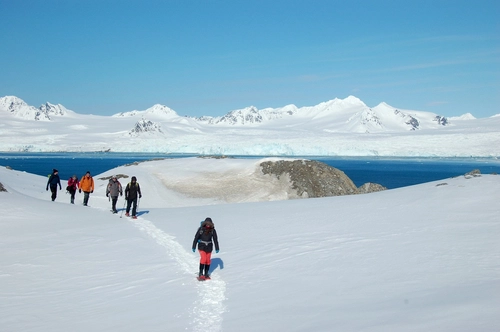
North Spitsbergen - Arctic Spring , Hike & Sail
29 May 2026 - 05 Jun 2026 8 Days / 7 Nights
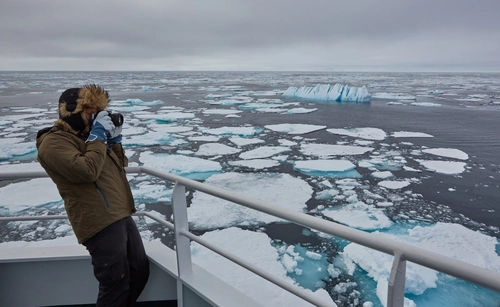
North Spitsbergen Explorer - Into the pack ice - Polar Bear Special
05 Jun 2026 - 12 Jun 2026 8 Days / 7 Nights

Arctic Ocean - Jan Mayen, Ice edge, Spitsbergen, Birding
05 Jun 2026 - 13 Jun 2026 9 Days / 8 Nights
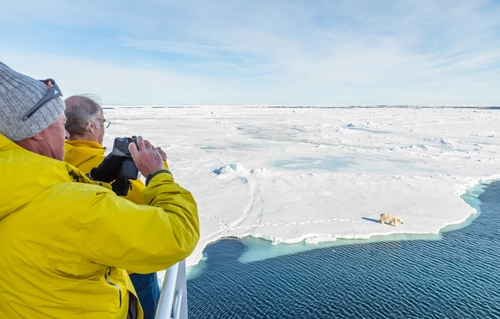
Arctic Ocean - Fair Isle, Jan Mayen, Ice edge, Spitsbergen, Birding - Summer Solstice
12 Jun 2026 - 21 Jun 2026 10 Days / 9 Nights
North Spitsbergen Explorer - Into the pack ice - Polar Bear Special
12 Jun 2026 - 19 Jun 2026 8 Days / 7 Nights
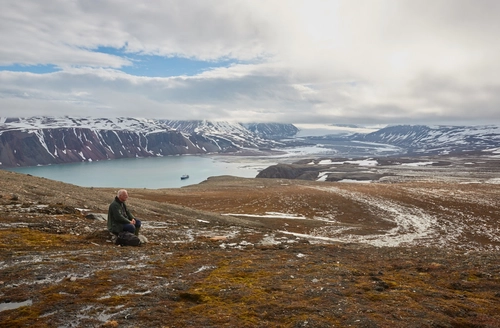
North Spitsbergen Explorer - Versatile landscapes, sea ice & wildlife
13 Jun 2026 - 20 Jun 2026 8 Days / 7 Nights
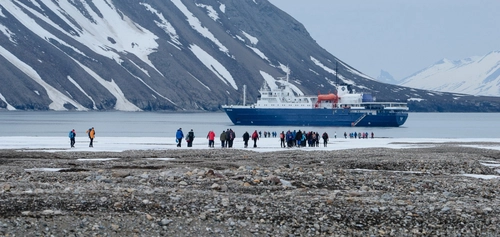
North Spitsbergen Basecamp – Summer Solstice - Free Kayaking, Hiking, Photo Workshop, Diving (supplemented)
19 Jun 2026 - 26 Jun 2026 8 Days / 7 Nights
North Spitsbergen Explorer - Versatile landscapes, sea ice & wildlife - Summer Solstice
20 Jun 2026 - 27 Jun 2026 8 Days / 7 Nights
North Spitsbergen Explorer - Versatile landscapes, sea ice & wildlife - Summer Solstice
21 Jun 2026 - 28 Jun 2026 8 Days / 7 Nights

Blog


The Northern Lights dancing across the skies
A Day on m/v Plancius
Top Antarctica Cruise Experiences for 2025
The polar bear: king of the Arctic food chain
Five Reasons to Love St. Helena

Ancient Arctic Exploration
Five Reasons Why Snowshoeing is a Perfect Polar Activity
All About Ice: Glaciers and Icebergs of the Arctic and Antarctica
Franz Josef Land Sites, Species, and Experiences
Why You Should Visit Greenland: 11 Things to See, Do, and Explore

The ozone layer in Antarctica

Two for the Snow: Polar Cruises for Couples
Seven Things to Do around Ushuaia

What to Expect When Crossing the Drake Passage
Weddell seals: The data collectors scientists of Antarctica
The Overlooked Treasures of Ascension Island
South Georgia Whaling Stations
Seven Sublime Antarctic Bays
Antarctica: When to Visit, How to Plan, What to Expect