Black Guillemot - Nexta Expeditions
Black Guillemot

Black Guillemot

These special puffin relatives are good at blending in with their surroundings and often hold fish in their beaks.
About

Name: Black Guillemot, Guillemot à Miroir, Tystie (Cepphus grylle)

Length: 30 cm

Weight: 320 to 480 grams

Location: Arctic coastlines

Conservation status: Least Concern

Diet: Fish, crustaceans, marine invertebrates

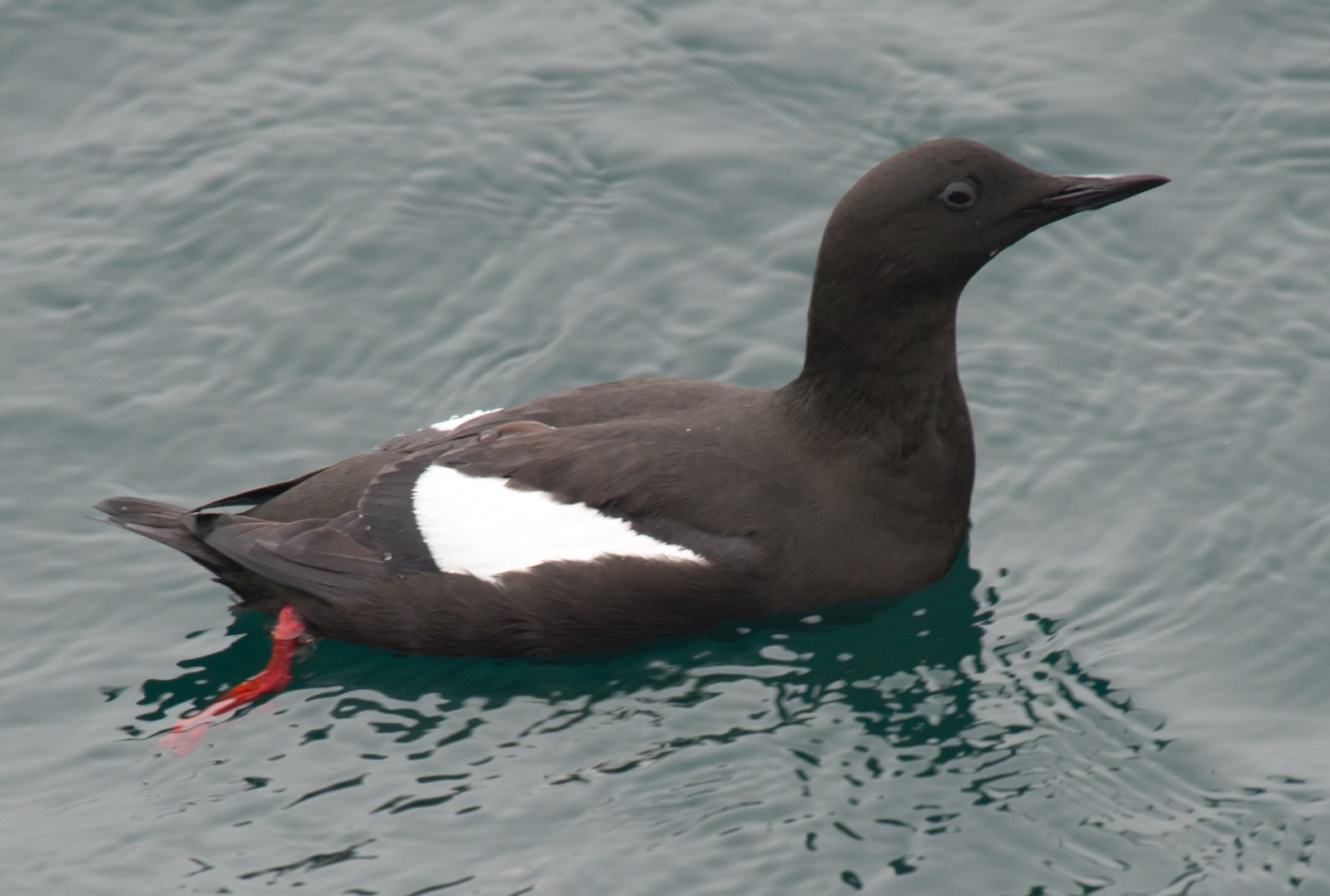
Appearance: Black body with black bill, white patch on wings, red feet. Winter plumage is white with a darker back.

How do Black Guillemots feed?

Black Guillemots dive in shallow waters, using their wings to swim. They can stay underwater for about 2.5 minutes. Smaller prey is swallowed underwater, while larger prey is brought to the surface.

Are Black Guillemots social?

Outside mating season, they are usually found solo or in pairs, but they gather over feeding areas.

How fast do Black Guillemots fly?

They generally fly at about 20 km per hour.
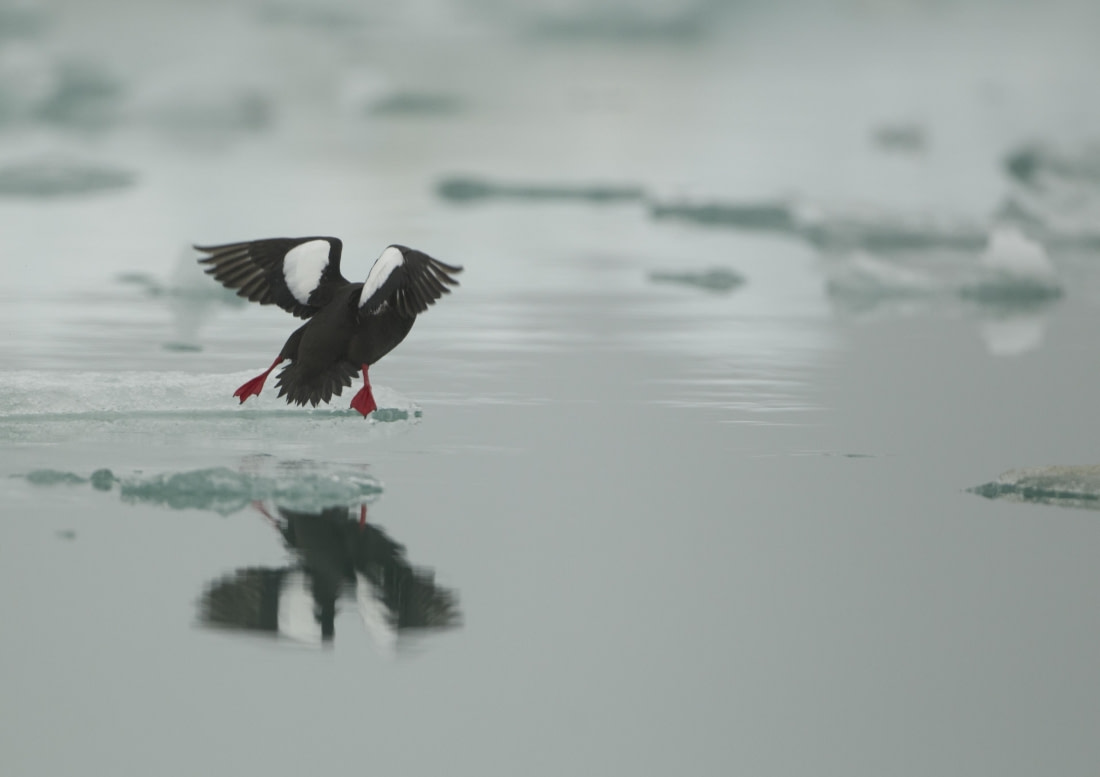
What are Black Guillemot birthing rituals like?

Black Guillemots reach sexual maturity at 4 years and breed in colonies, especially in northern areas where food is abundant. Colonies can number up to 10,000 breeding pairs. Nests are made on rocky coastlines, often with pebbles, shells, or seaweed under overhangs. Males court females by strutting with exaggerated steps. Up to 2 eggs are laid, and both parents incubate and feed the chick. Chicks leave the nest after 1-2 months and head to the water.

How long do Black Guillemots live?

They live for about 11 years in the wild.

How many Black Guillemots are there today?

There are an estimated 400,000 to 700,000 individuals worldwide.

Do Black Guillemots have any natural predators?

Their young and eggs are preyed upon by rats, foxes, and minks.

7 Bountiful Black Guillemot Facts

  • They are part of the Alcidae family, like Puffins.
  • Some Black Guillemots show a preference for holding fish in a specific direction in their bills, possibly related to their feeding grounds.
  • Their winter plumage gets whiter the further north they are found.
  • They breed on Surtsey, a volcanic island off Iceland.
  • There are five subspecies: Cepphus grylle arcticus, faroeensis, grylle, islandicus, and mandtii.
  • Diving birds like Black Guillemots are found in colder regions because fish swim faster in warmer waters, while birds' swimming speed remains constant.
  • Non-breeding Black Guillemots are often found in deeper waters.
Best Deals

Related Trips
go-leftgo-right

Spitsbergen - Northeast Greenland, Fly & Sail - Nexta Expeditions
The Arctic
Longyearbyen

Spitsbergen - Northeast Greenland, Fly & Sail

calendar12 Aug 2026 - 31 Aug 2026
clock20 Days / 19 Nights
From $ 9.500 per person
Northeast Greenland Extreme - Nexta Expeditions
The Arctic
Akureyri

Northeast Greenland Extreme

calendar15 Aug 2026 - 28 Aug 2026
clock14 Days / 13 Nights
From $ 8.650 per person
East Greenland, Scoresby Sund, Including Long Hikes - Nexta Expeditions
The Arctic
Akureyri

East Greenland, Scoresby Sund, Including Long Hikes

calendar16 Aug 2026 - 25 Aug 2026
clock10 Days / 9 Nights
From $ 6.000 per person
Northeast Greenland Extreme - Nexta Expeditions
The Arctic
Akureyri

Northeast Greenland Extreme

calendar25 Aug 2026 - 07 Sep 2026
clock14 Days / 13 Nights
From $ 7.850 per person
East Greenland, Scoresby Sund - Aurora Borealis, Fly & Sail - Nexta Expeditions
The Arctic
Constable Pynt

East Greenland, Scoresby Sund - Aurora Borealis, Fly & Sail

calendar21 Sep 2026 - 01 Oct 2026
clock11 Days / 10 Nights
From $ 6.250 per person
East Greenland, Scoresby Sund - Iceland , Aurora Borealis, Fly & Sail - Nexta Expeditions
The Arctic
Constable Pynt

East Greenland, Scoresby Sund - Iceland , Aurora Borealis, Fly & Sail

calendar01 Oct 2026 - 12 Oct 2026
clock12 Days / 11 Nights
From $ 6.300 per person
Blog
go-leftgo-right
Greenland: Where the Kayak Was Invented - Nexta Expeditions
Blog

Greenland: Where the Kayak Was Invented

If you've ever enjoyed kayaking, you owe a debt of gratitude to the ancient Greenlandic Inuit who originally designed them for hunting. The thrilling adventures people now have navigating some of the world's most challenging rapids wouldn't be possible without the Inuit's need for a nimble form of water transportation. While travelers still use kayaks in this region, they are typically not fishing, whaling, or sealing. Consequently, recreational kayaks have been adapted to fit their new role.
Tracking Greenland’s Wildlife from Space - Nexta Expeditions
Blog

Tracking Greenland’s Wildlife from Space

Despite Greenland’s harsh environment, life has found a way to thrive there. If you’re lucky enough to embark on a Greenland cruise, you stand the chance of encountering many species of cold-adapted mammals, birds, and fish.
Why You Should Visit Greenland: 11 Things to See, Do, and Explore - Nexta Expeditions
Blog

Why You Should Visit Greenland: 11 Things to See, Do, and Explore

There's nothing quite like witnessing your first Greenland glacier, navigating into the island's largest fjord system (which also happens to be Earth's largest), or observing a humpback whale breach over the dark Greenland Sea.
The World Is Changing for Greenland's Native Inuit People - Nexta Expeditions
Blog

The World Is Changing for Greenland's Native Inuit People

You may know them as Eskimos, but the people of the Arctic are officially called the Inuit. Historically, they were hunters in the truest sense. For hundreds of years, they survived the world’s harshest conditions, living off their prey of whales, seals, polar bears, musk oxen, birds, fish, and reindeer. This has always been their way of life.
Kayaking In Greenland - Nexta Expeditions
Blog

Kayaking In Greenland

Think of Greenland and two images come to mind:
Scoresby Sund: the Greatest Greenland Adventure - Nexta Expeditions
Blog

Scoresby Sund: the Greatest Greenland Adventure

In a land of expansive mountains, colossal glaciers, and majestic shorelines, few places are as expansive, colossal, or majestic as Scoresby Sund.
Under the Greenland Ice Sheet - Nexta Expeditions
Blog

Under the Greenland Ice Sheet

Anyone who ventures to the right part of the globe can encounter vast amounts of ice, but a Greenland cruise offers something truly unique: ice sculptures hidden beneath the northern ice sheet. Scientists once thought these sculptures were rocky hills buried in ice, similar to the Ghost Mountains in Antarctica. However, it turns out that Mother Nature has crafted one of the most exclusive art exhibits in the world. These sculptures are not visible from the surface, but some scientists have managed to get a sneak peek using radar equipment.
Discover the Scoresby Sund Fjord System in East Greenland - Nexta Expeditions
Blog

Discover the Scoresby Sund Fjord System in East Greenland

Are you considering a trip to Greenland? One destination you absolutely must visit is the world's largest fjord with stunning landscapes: Scoresby Sund.
Six Seal Species You Might See On Your Greenland Cruise - Nexta Expeditions
Blog

Six Seal Species You Might See On Your Greenland Cruise

If you spot a grand old whiskered man lounging in solitary splendor, there's a good chance you're looking at a bearded seal. Your Greenland cruise will take you to bays where these solitary fellows (except during breeding season) hunt for fish in the relatively shallow waters near the shores.
Greenlandic Inuit Beliefs - Nexta Expeditions
Blog

Greenlandic Inuit Beliefs

Greenland is the world’s largest island and with the northern tip around 740 kilometres from the North Pole it is the northernmost country on Earth. The island is around 2,670 kilometres long and is about 650 kilometres across at its widest point.
Five Birds You Might See on Your Greenland Cruise - Nexta Expeditions
Blog

Five Birds You Might See on Your Greenland Cruise

A Greenland expedition cruise offers birdwatchers a unique opportunity to capture stunning avian photographs. With over 230 bird species, Greenland boasts both spectacular landscapes and diverse winged wildlife.
10 Traits of Post-Ice-Age Greenland - Nexta Expeditions
Blog

10 Traits of Post-Ice-Age Greenland

Grasses, sedges, and other species of heath were the first arrivals, and are still commonly found in Greenland. Scientists have been able to work out how plants colonised Greenland by examining ancient pollen samples found in deposits at the bottom of lakes: Dwarf birch came to western Greenland around 9,000 years ago, and around 4,500 years ago – roughly the same time humans were first boating onto Greenland shores – green alders were taking up residence there.
Greenland: East vs. West - Nexta Expeditions
Blog

Greenland: East vs. West

East and West Greenland offer vastly different experiences due to their unique climates, wildlife, habitation, and geology.
The Arctic Hare: Easter Bunny - Nexta Expeditions
Blog

The Arctic Hare: Easter Bunny

Although the Arctic hare’s stern expression might make it seem like the least amused member of a serious tribunal, this polar animal is actually one of the most charming creatures on the planet – especially when Easter Sunday comes around.
Peaks, Fjords, and Auroras: 14 East Greenland Attractions - Nexta Expeditions
Blog

Peaks, Fjords, and Auroras: 14 East Greenland Attractions

There really aren’t enough superlatives for East Greenland.
Svalbard’s 12 Most Iconic Animals - Nexta Expeditions
Blog

Svalbard’s 12 Most Iconic Animals

Each of our Arctic regions offers its own distinct and unforgettable features: Greenland boasts mountainous shorelines and record-setting fjords, Northern Norway is renowned for the aurora borealis and historic masted schooners, and Svalbard (especially Spitsbergen) is where you're most likely to encounter a variety of Arctic wildlife.
Traditional Lifestyles of the Inuit - Nexta Expeditions
Blog

Traditional Lifestyles of the Inuit

The Inuit are an indigenous Arctic people who speak the languages of the Eskaleutian family and reside in four countries surrounding the North Pole: Greenland, Canada, the United States, and Russia.
The bowhead whale, whaling about the Arctic - Nexta Expeditions
Blog

The bowhead whale, whaling about the Arctic

The bowhead whale typically resides near pack ice, often in shallow waters. These whales are commonly found north of Europe, between Canada and Greenland, in the Hudson Bay area, the Okhotsk Sea, and the Bering, Chukchi, and Beaufort seas. In these regions, they filter food through their large baleen plates. Bowheads are known to open their large mouths and graze along the surface, in the water column, or on the sea floor.
Ice streams and lakes under the Greenland Ice Sheet - Nexta Expeditions
Blog

Ice streams and lakes under the Greenland Ice Sheet

The Greenland ice sheet is a dynamic mass of dense, flowing, and deforming ice. Snow deposited on the central parts of the ice sheet is gradually compressed into ice that slowly moves towards the ice margin. At the ice margin, the ice is removed by melting or by breaking off into icebergs.
Seizing the Season: Spitsbergen’s Late Spring, Early Summer - Nexta Expeditions
Blog

Seizing the Season: Spitsbergen’s Late Spring, Early Summer

Most Arctic expedition cruises can be categorized into two main types: those that operate during the autumn and winter, focusing on the northern lights, and those that sail during the high season (mid to late summer), concentrating on a broader range of experiences.