Coming Back From The Brink The Fur Seals Of Antarctica - Nexta Expeditions
Coming Back from the Brink: The Fur Seals of Antarctica

Coming Back from the Brink: The Fur Seals of Antarctica

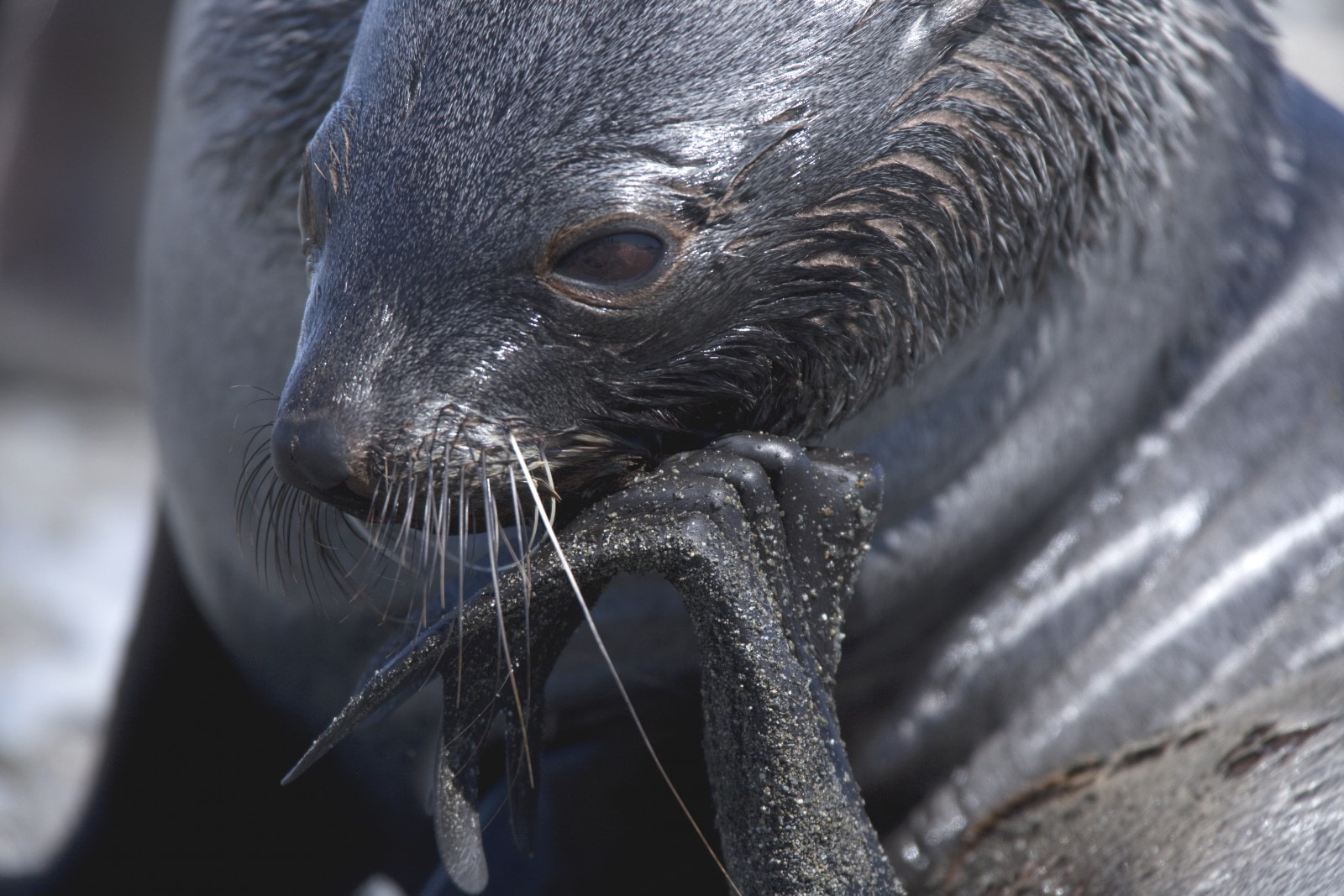
Once hunted to the brink of extinction, the Antarctic fur seal is now one of the most populous and charismatic species of seal you’re likely to encounter during your Antarctica trips. Unlike other members of its large family, the fur seal has external ears, or pinnae, a short snout, and a thick coat of dark brown fur. Male seals tend to be larger than females, with weights ranging from 91 kg (200 lbs.) to 215 kg (474 lbs.).

Diet

The diet of the fur seal primarily consists of various species of Antarctic fish, squid, and a significant amount of krill. This strict diet of sea creatures undoubtedly contributes to their strong odor, which often greets you before you even see them! During foraging trips, fur seals can dive to depths of 180 meters (590 ft.) and hold their breath for up to 10 minutes.

Breeding behavior

From October to November, bulls establish breeding territories along the beaches of Antarctica in hopes of securing a female. Fur seals have historically exhibited polygynous mating behavior, meaning a male will mate with multiple females during one season. During a successful breeding season, a male fur seal, or a “bull,” can mate with as many as 20 females!

Once mates and territories are established, males become increasingly aggressive and defensive. Vocalizations, including a guttural growl, lunging, and displaying, are typical defensive behaviors of male fur seals. Territorial disputes commonly break out between males, leading to serious injuries and even death. After mating, males leave the pregnant females to raise the pups while they seek more females to mate with. Gestation lasts approximately 12 months, and females give birth to one pup. For the next four months, mothers spend their time weaning their pups and feeding out in the ocean.

Predators of fur seals

Even as a top predator in the waters of Antarctica, the fur seal faces significant danger, especially as a pup. Leopard seals, some of the most vicious Antarctic predators, quickly locate pup colonies. The pups are most vulnerable when learning to swim for the first time, especially since they are no longer under their mother’s supervision. Unfortunately, many pups meet their end this way. Killer whales are another predator of the fur seal and will swim into shallow waters, waiting for adults to return from foraging trips.

Sealing in Antarctica

During the 18th and 19th centuries, the United States and Great Britain heavily hunted the Antarctic fur seal throughout its range. Their extremely soft pelts were used to adorn clothing and were highly fashionable and in high demand. Although unregulated hunting had detrimental effects on fur seal populations, this activity was responsible for much of the early exploration of the continent. Unfortunately, this increased hunting pressure brought the fur seal to the brink of extinction by the early 20th century. The outlook was grim for the seals, but even with a greatly reduced population, conservation and preservation were still possible.

In 1972, the Antarctic Treaty System established the continent and waters of Antarctica as protected areas where no hunting or collecting of seals or other marine mammals could occur. With this intense hunting pressure relieved, fur seals were able to proliferate throughout their range and surpass their pre-sealing population numbers.

Conservation

Currently, the Antarctic fur seal is a protected species under CITES (Convention on International Trade of Endangered Species) and a branch of the Antarctic Treaty System dedicated to seals called the Convention for the Conservation of Antarctic Seals. According to these stringent laws, no fur seals can be “taken,” or collected and transported internationally in any way for any purpose without government-issued permits. Violations of these laws can result in fines and even jail time for repeat offenders.

Since the establishment of these laws, fur seal populations have increased exponentially throughout Antarctica. Researchers suggest that there may be between two and four million individuals breeding at South Georgia, where whaling pressure was exceptionally high during the 19th and 20th centuries. In the absence of whales, krill populations soared, providing a steady and reliable food source for other Antarctic wildlife species, including the fur seal. This uninterrupted food source allowed populations to sharply increase.

Many researchers have become increasingly concerned with the fur seals’ population explosion and overcrowding of individuals at breeding and haul-out sites, which has directly linked to a decrease in Antarctic grass populations. There simply isn’t enough room to accommodate millions of seals! As the population continues to increase, researchers are beginning to suggest the loosening of conservation laws to prevent damage to sensitive plant species. Further action on this issue has yet to be taken.

Like many other sea-dwelling species, the Antarctic fur seal faces an uncertain future with the increase of ocean pollution, plastic abundance, and global climate change. Changing ocean temperatures directly influence prey abundance and availability, which can have potentially negative effects on their population size.

Where to see fur seals

One of the best places for Antarctic fur seal spotting is South Georgia. You’ll most likely smell them before you see them, but make sure to keep a careful eye out! Their summer fur blends in perfectly with the lichen-covered ground, camouflaging them with their surroundings. Their aggressive behavior is well documented, and they have even been known to chase and bite humans that tread a little too close. Make sure to keep a safe distance!

Best Deals

Related Trips

Remote Weddell Sea Explorer incl. South Georgia - South Sandwich Islands - Neuschwabenland - Larsen Ice Shelf - Paulet and Devil Island - Elephant Island, incl. helicopters - Nexta Expeditions
Antarctica
Ushuaia

Remote Weddell Sea Explorer incl. South Georgia - South Sandwich Islands - Neuschwabenland - Larsen Ice Shelf - Paulet and Devil Island - Elephant Island, incl. helicopters

calendar22 Jan 2026 - 18 Feb 2026
clock28 Days / 27 Nights
From $ 26.500 per person

Blog
go-leftgo-right

Around Spitsbergen vs. North Spitsbergen - Nexta Expeditions
Blog

Around Spitsbergen vs. North Spitsbergen

Svalbard, particularly Spitsbergen, was the first polar expedition cruise destination. It's no surprise that there are numerous trip programs available in this region. Among the most unique are the Around Spitsbergen and North Spitsbergen cruises.
Seizing the Season: Spitsbergen’s Late Spring, Early Summer - Nexta Expeditions
Blog

Seizing the Season: Spitsbergen’s Late Spring, Early Summer

Most Arctic expedition cruises can be categorized into two main types: those that operate during the autumn and winter, focusing on the northern lights, and those that sail during the high season (mid to late summer), concentrating on a broader range of experiences.
Cheapest Antarctica Cruises: How to Save on Your Journey - Nexta Expeditions
Blog

Cheapest Antarctica Cruises: How to Save on Your Journey

Antarctica, the world’s most remote and pristine continent, is often seen as a destination reserved for luxury travelers. However, affordable options do exist, making this dream journey accessible to more adventurers. With careful planning and the right provider, like Nexta Expeditions, you can explore the icy wilderness without breaking the bank. This guide will show you how to save on your Antarctic cruise while still enjoying a high-quality experience.
Seven Tips to Get the Most out of Your Expedition Cruise - Nexta Expeditions
Blog

Seven Tips to Get the Most out of Your Expedition Cruise

Polar cruises are easy to enjoy, but there’s an art to getting the most out of them.
A Diving Dream Fulfilled - Nexta Expeditions
Blog

A Diving Dream Fulfilled

Last January, Mark Hatter achieved a dream he’d been training for over two years. Booking his berth aboard the m/v Ortelius and making the long flight to Ushuaia, Argentina, he and two of his friends sailed down the famous Drake Passage, bound for Earth’s southernmost continent. But their Antarctica trip was not just about shoreline walks and photographing penguins.
Birds of the North: 29 Arctic Birds and Seabirds - Nexta Expeditions
Blog

Birds of the North: 29 Arctic Birds and Seabirds

The Arctic is home to some of the world’s most majestic mammals, both on land and sea. However, the bird life in this region is equally remarkable, showcasing numerous exotic species that are highly prized by bird enthusiasts worldwide.
Weddell Sea: the Original Antarctic Adventure - Nexta Expeditions
Blog

Weddell Sea: the Original Antarctic Adventure

According to historian Thomas R. Henry, visiting the Weddell Sea requires a brave heart. In his 1950 book, "The White Continent," he described sudden “flash freezes” that occur in the region. It was one of these flash freezes that trapped Ernest Shackleton’s ship, Endurance, in January 1915, forcing his crew to endure over a year in the harsh environment before they could escape.
Taking the Polar Plunge - Nexta Expeditions
Blog

Taking the Polar Plunge

There are some human activities that for many people simply defy understanding: We juggle chainsaws, we breathe fire, we fling ourselves out of perfectly good airplanes.
The Research Stations of Antarctica and the sub-Antarctic - Nexta Expeditions
Blog

The Research Stations of Antarctica and the sub-Antarctic

Numerous research stations operate throughout the Antarctic and sub-Antarctic, engaged in all manner of scientific inquiry. This article will cover the stations under the management of the British Antarctic Survey (BAS), which conducts year-round terrestrial and atmospheric research in some of the most compelling polar locations on Earth.
Traditional Lifestyles of the Inuit - Nexta Expeditions
Blog

Traditional Lifestyles of the Inuit

The Inuit are an indigenous Arctic people who speak the languages of the Eskaleutian family and reside in four countries surrounding the North Pole: Greenland, Canada, the United States, and Russia.
Narwhals: the Aquatic Unicorns of the Arctic - Nexta Expeditions
Blog

Narwhals: the Aquatic Unicorns of the Arctic

Though narwhals are among the rarest whale species encountered during our Arctic expeditions, a journey to the Arctic regions of Greenland and Svalbard always holds the potential for spotting these elusive creatures.
Navigating by touch through the sea ice - Nexta Expeditions
Blog

Navigating by touch through the sea ice

Ships are meant to glide effortlessly through calm waters, but our Greenland expedition vessel Ortelius is shuddering and wiggling as it navigates through the calm yet frozen waters between Svalbard and the islands. We’re on the North Atlantic Odyssey, a journey that starts in continental Europe and concludes near the North Pole in Svalbard. Onboard are 115 enthusiastic passengers. Most of them are currently on the outer decks, cameras in hand, captivated by the sea ice.
Imperial Antarctica: the Snow Hill Emperor Penguins - Nexta Expeditions
Blog

Imperial Antarctica: the Snow Hill Emperor Penguins

Recently, a rare achievement was made by visiting Antarctica’s northernmost emperor penguin colony on Snow Hill Island. Typically surrounded by impassable pack ice, Snow Hill is a notoriously difficult destination in the Weddell Sea cruise itinerary, only accessible using helicopters carried especially for this purpose.
Polar Diving: A Supreme Underwater Adventure - Nexta Expeditions
Blog

Polar Diving: A Supreme Underwater Adventure

Most scuba divers are drawn to warm waters and tropical reefs, and it's easy to see why. However, even the most thrilling experiences can become repetitive if done too often.
True South: A New Flag for a Global Antarctica - Nexta Expeditions
Blog

True South: A New Flag for a Global Antarctica

When Evan Townsend signed up to spend the winter of 2018 working at an Antarctic research station, he had no reason to expect he would end the season by designing a new flag for the continent. He had even less reason to expect the support it would receive.
The Dirty Details of Antarctica's Dry Valleys - Nexta Expeditions
Blog

The Dirty Details of Antarctica's Dry Valleys

Situated on the western coast of McMurdo Sound, the McMurdo Dry Valleys represent the largest ice-free region in Antarctica.
Seven Frightfully Fun Polar Ghost Stories - Nexta Expeditions
Blog

Seven Frightfully Fun Polar Ghost Stories

The polar regions are unparalleled when it comes to ghost stories.
Exploration of the Polar Regions - Nexta Expeditions
Blog

Exploration of the Polar Regions

From the Vikings via the first whale and seal hunters to Scott and Amundsen, from the maritime explorers Franklin and Nordenskiöld to present-day polar tourism, a quick tour through history reveals some of the aspects which motivated people to extend their horizons. Existential need, sheer curiosity, imperial greed, polar science, and a taste for adventure all converged in regions which pardon no mistakes.
Orcas of the Polar Seas - Nexta Expeditions
Blog

Orcas of the Polar Seas

The orca, also known as the killer whale, is the apex marine predator and possibly the most widespread vertebrate on the planet. While they are most numerous in colder regions like Antarctica, Norway, and Alaska, they also inhabit tropical and subtropical seas. Here, we’ll explore some essential orca facts you might want to know before encountering them in person, concluding with a fantastic video showcasing our top ten favorite killer whale facts.
Life migrating through the Polar Front - Nexta Expeditions
Blog

Life migrating through the Polar Front

Since James Cook’s second voyage to Antarctica from 1772-1775, which provided the first descriptions of Antarctic animals, scientists have progressively uncovered the biodiversity of the Antarctic and sub-Antarctic regions. Numerous expeditions and research projects have since been undertaken to understand the unique ecosystems of this continent.