

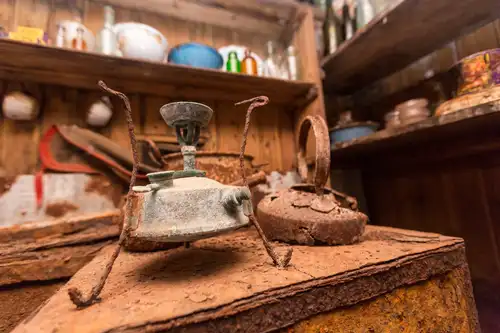
In 1899, Carsten Borchgrevink and his nine crewmen became the first to spend the winter in a hut in Antarctica. (Technically, the Belgian Antarctic Expedition of 1897-1899 was the first to overwinter there, though this was done on their vessel after it was caught in ice.) Borchgrevink and his men spent the dark winter months isolated in a dirty hut, surrounded by equipment and sled dogs fighting each other outside.
Apart from the dogs and the occasional seal, there was no other sign of life. The only light to be seen was during midwinter day when the aurora australis swirled in the sky. When the wind was not raging, the silence was deafening. In the distance, snow peaks dominated the horizon, reminding the men of their insignificance.

The men eating rather than collecting specimens
Scientific data was collected over the winter period with the thermograph and a barograph maintained by five of the party’s men. On Monday mornings, the charts were changed and reset for the week. Regarding the zoological collections the expedition was building up, winter brought about a standstill with only some seals on the ice while the birds had disappeared. Every now and then, marine life washed ashore by the gales. The men resorted to fishing through the ice with a Norwegian pilk to catch specimens for the collections. This required the fisherman to know the layers of temperature in the waters and where the fish are most likely to be. However, there was not very much collecting going on as the men enjoyed a few meals of fish instead!
A set menu leading to boredom
Any change of diet was most welcome as they were on a diet of pressed meat, tinned meat, salted meat, herrings, sardines, and tinned salmon as well as pressed, dried, or tinned vegetables with the menu remaining the same week in and week out. For breakfast, the men had porridge with bacon or ham with bread and butter. The remaining rations consisted of cocoa, tea, and coffee along with cabin biscuits, army rations, soups, cheese, jam, marmalade, and dried fish. During the winter, the men also caught the odd seal and the flesh was eaten.
The sun disappears for the winter
By May 15th, the sun had disappeared completely with true isolation overcoming the men. It would not be for another 72 days till the sun rose again on July 29th, with the only light being from the moon and the aurora australis. The landscape appeared as sculptured stone with the snow peaks in the horizon ‘’enveloped in a lurid crimson glow’’.
Seeing the sun for the last time, it was commented in a diary that:
"We watched the departure of the sun as it slowly skimmed along the horizon like a tired traveller after a long weary march, and yet it seemed reluctant to leave us and to depart with a certain amount of regret, for even after it had dropped below the horizon a deep red afterglow remained in the sky and the crimson flush on the mountains remained for some hours afterwards. It was a splendid site, such blending of colours as I have never witnessed. Red and violet and mauve and yellow etc".
Time to celebrate
On May 17th, it was a great Norwegian holiday, the anniversary of Norway’s separation from Denmark which led to Borchgrevink leaping into politics before the men went for a ski. Later on in the evening, the men had a royal dinner to celebrate and at 6 p.m. the party’s doctor flung a large Norwegian flag from his bunk bed, a flag no one else had seen before. All night the men toasted away to the health of Norway and her King and had a wonderful dinner that was followed by setting three rockets into the sky at 9 p.m. At midnight, the men went down to the beach for a torch procession making a great deal of noise. It was so dark ‘’that with torches it was impossible to see a foot ahead and knew not where we were. Suddenly we got into some very heavy snow, knee deep’’.
A toast to the Queen
On May 25th, the men had their next celebration: the birthday of Her Most Gracious Majesty Queen Victoria. The men were completely cut off from the rest of the world with no newspapers or journals and so had no idea whether the Queen was still reigning or not. A bottle of fine French Chartreuse was opened to celebrate and the men drank away, rejoicing as others were doing all across the English-speaking world. Afterwards, a lively conversation sprung up about Australia and her politics and how she was one of the grandest of all colonies in the Empire due to its climate, scenery, and infinite possibilities.
The men’s enthusiasm waning
By mid-June, the men’s enthusiasm for life on the ice during winter was waning with some suffering severely from homesickness. Imaginary pictures of home, sunshine, and happiness sprung into their minds haunting them for days at a time. Moods became irrational and bitter on many things and all they could do was eat and sleep. Some had wished they had never joined the expedition ‘’as for a handful of men to live together day after day, see nothing and hear nothing but one another is agony’’.
Hanson becomes ill
One of the party members, Nicolai Hanson, became ill. The energetic and likable zoologist who was overcome by illness in the tropics was now needing to spend longer and longer periods in his bunk. The illness was a mystery with it detailed as:
"Mr Hanson, the zoologist, has of late been extremely unwell. Has suffered severely from headaches and has nearly lost the use of his legs".
It appeared he suffered from a deficiency disease as he insisted the men should add seal liver to their diet whenever they could. However, unknown to Hanson and the others, it was not scurvy that was affecting him, rather it was beriberi that was caused by a lack of vitamin B, and liver is extremely rich in vitamin B.
Borchgrevink escapes the hut
With Hanson rapidly deteriorating before the men’s eyes, Borchgrevink took the first opportunity to get away from the hut when on July 21st he set off with another party member and the two Lapps on a sledging trip. They were trying to reach Possession Island, around 40 km away over ice. They were expected to be gone for 20 days and so four sledges were loaded with supplies. The men welcomed their respite from Borchgrevink, however, it was short-lived as unknown to them Borchgrevink had only wanted to get away from the hut for a short period of time, rather than truly aiming to reach Possession Island. Borchgrevink encountered dark clouds over the ice, which indicated open water and to him a trip out was uninviting. Within 48 hours of setting out for his expedition, he returned to the hut to the dismay of the others left behind.

Hanson buried at Cape Adare

By October, Hanson had taken a turn for the worse and on October 14th, a few days after the first skua gull was seen, Hanson passed away. The men were left stunned, shocked, and dismayed. On October 20th, the men interred Hanson on the summit of Cape Adare. The day was fine, clear, calm, and warm for this occasion. A short service was read out prior to leaving the hut and again at the grave with some Norwegian soil sprinkled on top of the coffin. From this point, nothing is there to disturb the eternal rest except for flights of birds.


Blog


10 Terrific Antarctic Bird Facts
Visiting the Nearly Unknown: New Zealand’s Campbell Island
A visit to the fascinating island of Jan Mayen
Arctic vs. Antarctica: A Traveler’s Guide
How and When Did Greenland Become Covered in Ice?
The First Overwintering Hut in Antarctica

The Impact of Small vs. Large Cruise Ships
Encounter with the emperor penguin in Antarctica
“The polar bear will still be there”
10 Books and Films To Prepare for your Antarctica cruise
Top Antarctica Cruise Experiences for 2025
What the ice reveals about Antarctica
Six Must-See Svalbard Sites
Antarctica in Pictures: Photos from 2018
Five Reasons Why Snowshoeing is a Perfect Polar Activity
Antarctic Icon: 44 Facts About the Emperor Penguin
The bio-richness of the Ross Sea
Seven Facts About Antarctic and Sub-Antarctic Penguins
17 Reasons to Cruise the Falklands