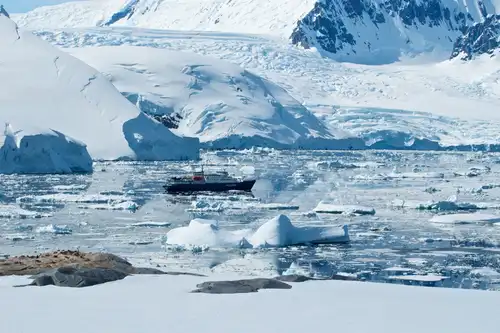


The orca, also known as the killer whale, is the apex marine predator and possibly the most widespread vertebrate on the planet. While they are most numerous in colder regions like Antarctica, Norway, and Alaska, they also inhabit tropical and subtropical seas. Here, we’ll explore some essential orca facts you might want to know before encountering them in person, concluding with a fantastic video showcasing our top ten favorite killer whale facts.

Black-and-white killer whale coloring
Killer whales, characterized by their rounded heads and blunt beaks, are actually the largest members of the dolphin family, not whales. They are renowned for their striking black and white coloration: black backs and flanks, and white underbellies. Most orcas feature a light grey saddle marking just behind their dorsal fins and large elliptical white patches on the sides of their heads, just above and behind the eyes.
Icelandic Orca Project
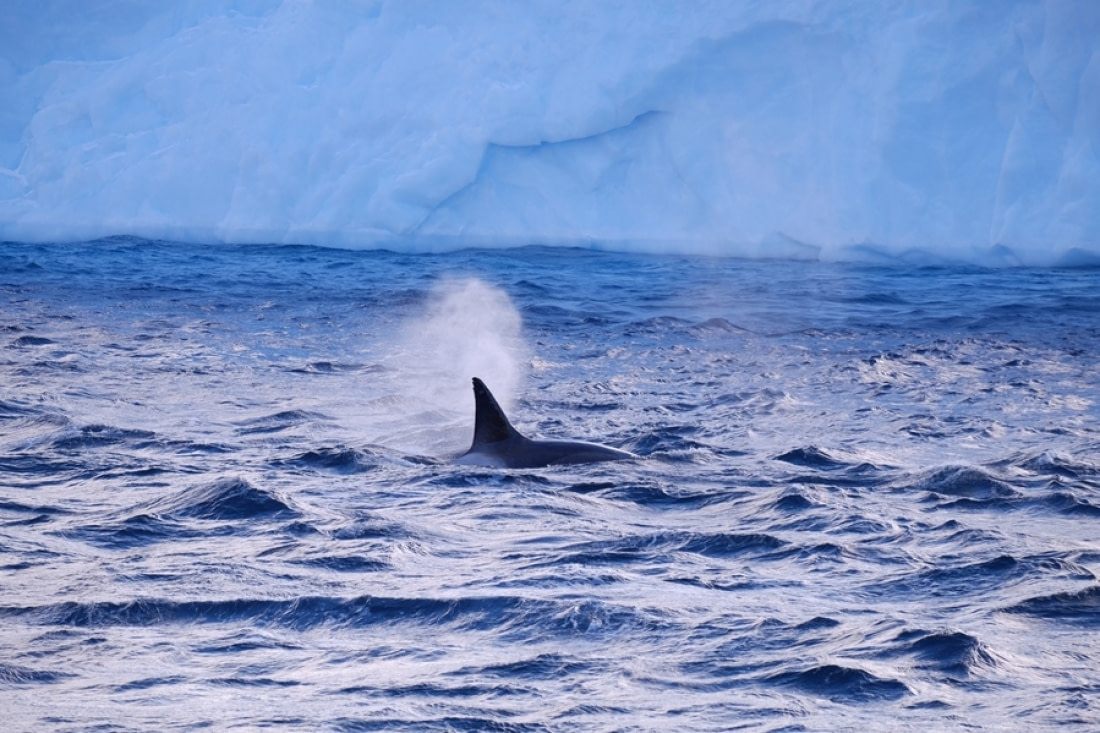
The Icelandic Orca Project studies the social and foraging behaviors of killer whales frequently seen in Icelandic waters. Orca behavior can generally be categorized into foraging, traveling, socializing, and resting. These behaviors are easy to distinguish: traveling killer whales move consistently in a specific direction, while socializing orcas tend to stay near the surface. Resting killer whales are typically idle at the surface for several minutes at a time.

Killer whale shockwave hunting
When Icelandic killer whales hunt herring schools, they encircle their prey to force the school into tighter formations before using their tails to slap the water, creating a shockwave that stuns the fish. This allows the orcas to feed on each fish individually, a method known as “carousel feeding.” Interestingly, this behavior is not observed in Iceland, suggesting a different feeding strategy there. Tagging data from Iceland reveals that killer whales feed on herring schools at the bottom of their dives rather than forcing the fish to the surface. Researchers speculate this difference is due to the varying water depths in Norway and Iceland: Norwegian waters are deep in the fjords, while Icelandic waters, where herring spawning grounds are located, are relatively shallow.

Unique Icelandic orca sounds
Studies on the acoustic sounds produced by killer whales have been ongoing for years. Orcas make clicks, pulsed calls, and whistles, but not all whistles are the same across different killer whale populations. For example, Pacific orcas produce low-frequency whistles with predominantly downward contours, while Atlantic orca whistles are higher in frequency and have a variety of contour shapes.
In contrast, Icelandic killer whales produce a unique call known as the “herding call.” This long, low-frequency call stands out from other whale calls and is heard when orcas are feeding. It is believed that the herding call is used to gather herring into tighter groups, making them easier targets for the orcas' tail slaps.

Day-and-night killer whale feeding
Scientists have studied Icelandic killer whales to determine if they hunt herring more during the day or night. By comparing acoustic data collected using autonomous recorders deployed in Iceland over the winter, researchers found that killer whales feed on herring both day and night, based on the acoustic detection of underwater tail slaps.
In fact, they spent half of their time at night and nearly 75% of the day feeding on fish. There was a change in their herding call and slapping behavior, with more slapping occurring at night. This suggests that in low-light conditions, orcas rely more on acoustics to herd the herring, demonstrating their ability to adapt their feeding behavior to different light conditions.

Real-time orca tracking in Antarctica
Orcas are a major attraction on Antarctica cruises and are of significant interest to scientists. Since 2005, scientists have been attaching small transmitting tags to the dorsal fins of killer whales in Antarctica. Over 25 of these tags, weighing about 40g (.09 pounds), have been attached to different types of orcas around the Antarctic Peninsula and Ross Sea regions. The tags typically last for more than 100 days and have tracked individual movements of over 9,000 km (5,592 miles). The tags transmit data to Argos satellite receivers, providing high-resolution tracking. This allows scientists to study ranging patterns, migration, and foraging behaviors, comparing different types of killer whales. Additionally, the tracking data provides real-time locations, enhancing the understanding of orca prey preferences through more frequent observations.

A quick killer whale turnaround
The satellite data mentioned above has already provided scientists with valuable insights into the migratory habits of killer whales in the Antarctic region. For example, there was a rapid migration of a certain type of orca from the Antarctic Peninsula to the edge of the tropics and back in just 42 days. The data showed that this type of orca foraged near the Antarctic Peninsula, then traveled to Uruguay and Brazil in a round trip covering 9,400 km (5,840 miles).

Orca wave washing
Scientists (and perhaps a few passengers on Antarctica Peninsula trips) have observed orcas near the Antarctic Peninsula cooperatively hunting in pack ice, using their tails to “wave wash” seals off ice floes. Over time, researchers observed three different groups of killer whales hunting off the western Antarctic Peninsula. The study recorded 16 seals and one Antarctic minke whale falling prey to this tactic. Data showed that 86% of the successful hunts involved killer whales cooperatively creating waves with their tails to destabilize the seal. They produced 120 waves during 22 separate attacks, successfully capturing 75% of the Weddell seals targeted. The statistics also revealed that the mean number of waves produced per successful attack was just over four, and the mean length of an attack was 30 minutes, with a range of 15 to 62 minutes.

Five quick facts about the killer whale
1. Adult orcas range in size from 5.5 to 9.8 meters long (18 to 32 feet), with males averaging 7.3 meters (23 feet) and at least 8,000 kg (17,636 pounds) in weight. Female orcas grow to around 6.2 meters (20 feet) and 4,000 kg (8,819 pounds) in weight.
2. The adult male orca’s dorsal fin can be up to 1.8 meters tall (5.9 feet) or more, while females and juveniles have a dorsal fin around one meter (3.2 feet) tall.
3. Killer whale pods can travel in tight formation or be spread across more than one km (0.6 miles), often breathing and diving in a coordinated manner, with each orca reaching speeds of up to 55 km per hour (34 mph) when swimming at full pace.
4. Researchers have found that while Icelandic orcas are very vocal when feeding on herring – producing many calls and clicks, along with herding calls and tail slapping – they are very silent when traveling, remaining quiet for extended periods.
5. It is believed that killer whales in Antarctica migrate to warmer waters for periodic skin maintenance. The warmer waters allow their skin to regenerate without the heat loss that would occur in colder Antarctic waters.
Ten killer facts about the orca
Reading about orcas is excellent preparation for seeing them in person, and watching an orca video is a fitting complement to that. Below we cover ten killer whale facts we hope will inspire you to join us on one of our wildlife-watching cruises.


Blog



The Impact of Small vs. Large Cruise Ships
Why You Should Visit Greenland: 11 Things to See, Do, and Explore
Ice streams and lakes under the Greenland Ice Sheet
Cheapest Antarctica Cruises: How to Save on Your Journey
Encounter with the emperor penguin in Antarctica
A Look Into the International Research Stations of Antarctica
Five Reasons You Should Cruise the Ross Sea Immediately
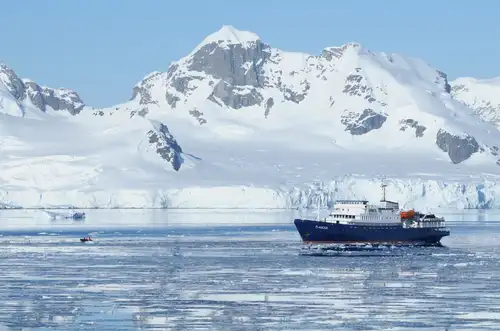
The Ultimate Traveler’s Guide to the Arctic and Antarctica
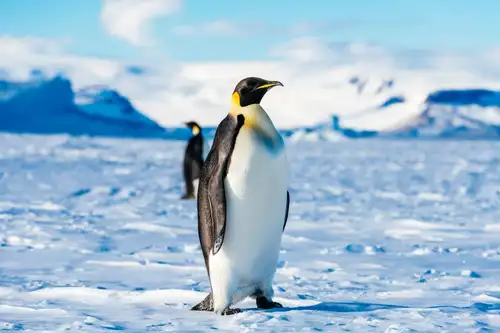
Penguins, Petrels, and Prions: Top Antarctica Bird Tour Spots

Arctic Flowers, Trees, and Other Plant Life
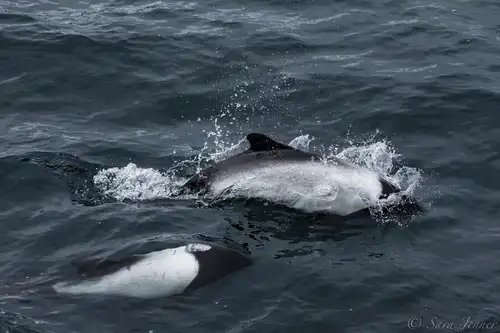
The Small but Social Commerson’s Dolphin
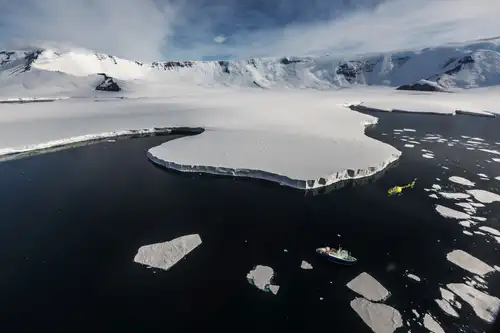
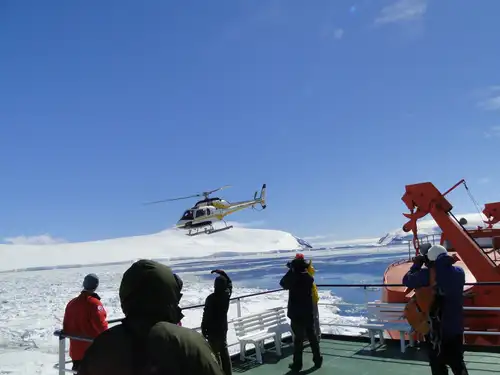
Taking a polar expedition cruise delivers no shortage of show-stopping highlights, but one of the most exhilarating is lifting off from the ship in a helicopter and taking flight over the incomparable Antarctic wilderness.
The Wonderful Weddell Sea: Places, Pics, and Impressions
Arctic and Antarctic Basecamp Cruises – Choose Your Own Adventure

Polar Cuisine in Pictures
Arctic Seals
All things ice in the Antarctic
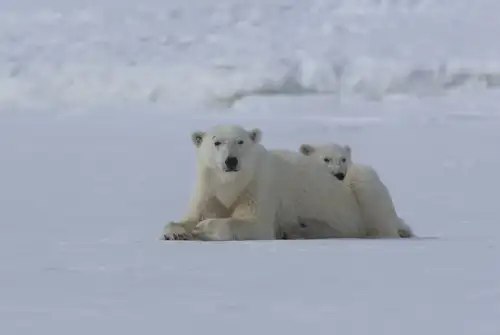
Polar Bears and Pack Ice: 22 Pics from North Spitsbergen

Seizing the Season: Spitsbergen’s Late Spring, Early Summer