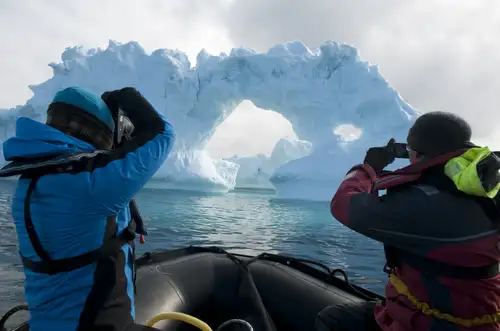


The Greenland ice sheet is a dynamic mass of dense, flowing, and deforming ice. Snow deposited on the central parts of the ice sheet is gradually compressed into ice that slowly moves towards the ice margin. At the ice margin, the ice is removed by melting or by breaking off into icebergs.

Dense snow on the ice sheet
New snow deposited on the Greenland Ice Sheet has a density between 50 and 70 kg/cubic metre, which is just 5-7 percent of the density of water (1,000 kg/cubic metre). In the central part of the ice sheet, the temperature never rises above freezing, so the snow never melts. Instead, it becomes buried under new layers of snow, with the weight of the new snow compressing the layers below, increasing its density.
Once the density of the snow reaches 830 kg/cubic metre, which is around 80 metres deep, all the air passages between the crystals are sealed off, so the only air that exists is in trapped bubbles. As the depth increases, the density of the ice increases further, and at 917 kg/cubic metres, air bubbles are compressed. At this stage, the ice has become glacier ice and cannot be compressed anymore.
Ice core drilling, deep into the sheet
Ice core drilling in Greenland started in 1955, and since then, numerous short and deep ice cores have been retrieved from the ice sheet. A recent project – the North Greenland Eemian Ice Drilling (NEEM) – was an international ice core project that aimed at retrieving an undisturbed record of the interglacial period 115,000-130,000 years ago.
The scientists found from the ice core that the period was warmer than previously thought. In fact, the climate in Greenland was around 8 degrees Celsius warmer than today during the last interglacial period. The data came from ice cores drilled more than 2.5 kilometres into the ice sheet, each layer recording annual snowfall.
Like tree rings, the scientists could determine the age. In the labs, researchers examined the heavy oxygen isotope O18 in the ice core to determine the temperature in the clouds when the snow fell, and therefore the climate in the past. The trapped air bubbles were also examined, providing knowledge about the air composition of the ancient atmosphere.
Recreating past climates
From the ice core data, scientists could recreate the annual temperatures almost 130,000 years back in time. The data indicated that during this warm period, there was intense surface melting that can be seen in the ice core as layers of refrozen meltwater.
Meltwater from the surface had been found to have penetrated down into the underlying snow, where it once again froze into ice. From past climate studies, scientists know this surface melting has occurred very rarely in the past 5,000 years.
Scientists also found that the ice sheet is resilient in the face of rising temperatures, with the data indicating that the volume of the ice sheet had not reduced by more than 25 percent during the warmest 6,000 years of the period.
Ice streams flowing under the ice sheet
The current ice core project in Greenland, the East Greenland Ice core Project (EGRIP), which will last until 2020, is attempting to understand the behaviour of the ice streams that are found through the Greenland ice shelf. The ice streams discharge into the ocean and account for half the loss of mass from the Greenland ice sheet.
In the north-east part of Greenland, the biggest ice stream begins right at the central ice divide and cuts through the ice sheet in a wedge-like shape to feed into the ocean through three large ice streams. The onset of the ice stream on the ice divide is believed to be caused by strong melting at the base, with the ice streams reaching velocities of up to 100 metres/year, 200 kilometres from the ice divide (but still 500 kilometres from the coast).
Over the next few years, the project will drill an ice core through the 2,550 metres of ice reaching to the bedrock to achieve the goals of understanding the dynamics of the ice flow in an ice stream and understanding the water processes.
Multinational efforts on the ice
The project will involve scientists from around six nations, with national funding agencies from Denmark, Germany, Japan, Norway, and the U.S. already having committed themselves to support EGRIP both financially and logistically. Examples include the U.S. National Science Foundation lending a ski-equipped LC-130 aircraft and sharing the costs of the flights, and Germany lending a DC3 aircraft and vehicles. Moving forward, Switzerland, France, China, and Italy have also announced their participation in the project.
Preserved DNA in the ice
Before scientists drilled ice cores in the Greenland Ice Sheet, the only fossils found came from ice-free areas that described past warm climatic periods. However, with the advent of deep ice core drilling in Greenland, researchers are now coming across frozen molecular remnants of past species, or ‘fossil DNA’, which can be dated back hundreds of thousands of years.
By analysing the DNA from prehistoric organisms, scientists can gain insights into the ecosystems that were found during previous warm periods in Greenland. This is possible due to Greenland’s Ice Sheet’s cold temperatures freezing over the DNA: normally, DNA decays and fragments, but in frozen environments, the decomposition rate slows down. If the DNA is covered in soil particles or is in dry or cold, or permafrost, then the decomposition rate falls even more as the soil particles have a protecting effect.
Sub-glacial lakes
In addition to ice streams, scientists have also discovered two subglacial lakes 800 metres below the Greenland ice sheet, each lake measuring roughly 8-10 square kilometres. The find by scientists of the Scott Polar Research Institute at the University of Cambridge used airborne radar measurements to reveal the lakes beneath the ice sheet. The lead scientist Dr Steven Palmer stated that the “results show that subglacial lakes exist in Greenland, and that they form an important part of the ice sheet’s plumbing system”.
The researchers found that the newly discovered lakes are likely fed by melting surface water draining through the cracks in the ice. In fact, a surface lake situated nearby may also replenish the sub-glacial lakes during warm summers. This means the lakes are part of an open system and are connected to the surface, which is different from Antarctic lakes that are often isolated ecosystems as the surface temperatures remain below freezing all year round.
Previously, scientists believed that Greenland’s steeper ice surface meant that any water below the ice was squeezed out to the margin and that because the ice in Greenland is thinner than Antarctica, any lakes that formed would have quickly frozen over as the thicker Antarctic ice can act like an insulating blanket that prevents the freezing of water trapped beneath the surface.

What the ice tells us about the stars
As life on Earth is dependent on liquid water and studying ice can tell us about past climates, studying ice on other planets and moons will tell us about past climates and the evolution of these parts of the Solar System. Luckily, scientists don’t have to travel to faraway planets to understand their history. They can travel to Greenland or Antarctica, as the Earth and planets and moons in the Solar System all originate from the same cloud of dust and gas, and so scientists can make ‘gestimates’ of likely climates on other planets in our system.
 12 Aug - 31 Aug 2026
 15 Aug - 28 Aug 2026
 16 Aug - 25 Aug 2026
 25 Aug - 07 Sep 2026
 21 Sep - 01 Oct 2026
Related Trips
Spitsbergen - Northeast Greenland, Fly & Sail
12 Aug 2026 - 31 Aug 2026  20 Days / 19 Nights
Northeast Greenland Extreme
15 Aug 2026 - 28 Aug 2026 14 Days / 13 Nights
East Greenland, Scoresby Sund, Including Long Hikes
16 Aug 2026 - 25 Aug 2026 10 Days / 9 Nights
Northeast Greenland Extreme
25 Aug 2026 - 07 Sep 2026 14 Days / 13 Nights
East Greenland, Scoresby Sund - Aurora Borealis, Fly & Sail
21 Sep 2026 - 01 Oct 2026 11 Days / 10 Nights
East Greenland, Scoresby Sund - Iceland , Aurora Borealis, Fly & Sail
01 Oct 2026 - 12 Oct 2026 12 Days / 11 Nights

Blog


The Emperor Penguin of the Drake Passage
Solargraphy & Pin Hole photography in the Arctic
Exploration of the Polar Regions
Seven Facts About Antarctic and Sub-Antarctic Penguins
Why a Polar Diving Cruise Should be Your Next Great Decision
Deception Island deceptively active
A Diving Dream Fulfilled

The World Is Changing for Greenland's Native Inuit People
Experience King Penguins, Seals and More in South Georgia
Imperial Antarctica: the Snow Hill Emperor Penguins
Islands of the Blessed: Things to Do Around Cape Verde
The Most Enchanting Antarctica Cruise Islands
The First Buildings in Antarctica: Borchgrevink’s Historic Huts
Science of the Ross Ice Shelf
The Small Mammals of the Arctic and Antarctica
Five Reasons Why Snowshoeing is a Perfect Polar Activity
12 Things to Do in Antarctica

The Arctic Hare: Easter Bunny

Seven Frightfully Fun Polar Ghost Stories