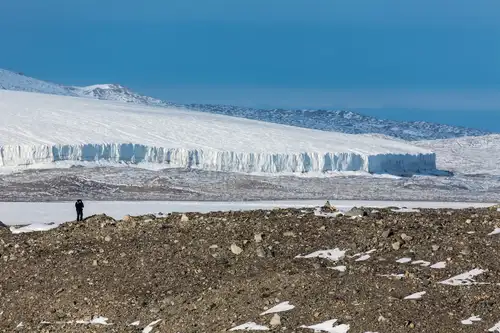


When many people think of the Arctic, they probably imagine a stark white wasteland devoid of anything except snow, glaciers, and the occasional far-wandering polar bear.
Indeed, though it may sound odd to non-polar enthusiasts, this romantic juxtaposition of barren beauty is often what attracts people to the Arctic. But while this notion is true in many cases, it is far from the whole story. Arctic locations like Svalbard and Greenland may not have the biodiversity some other areas on the planet can boast, but they are nonetheless home to a wide host of flora not only incredibly hardy but (in our opinion) quite beautiful.
Since Svalbard and Greenland lie in the same floristic region, known as the Boreal Biogeographical Region, they naturally share much of the same plant life. Svalbard has over 160 vascular plant species, though not many trees except for the birch and a few low-growing willow species. Rich with tundra flowers like mountain avens, buttercups, and especially saxifrages, Svalbard specializes in hardy, low-growing plants that can withstand immense snowpack and other extreme weather conditions.
The same can be said of Greenland, which has generally more fertile tundra populated by bushes, flowers, and expansive areas of thick-growing heath. Its gray willow, which sticks to the fjords, can grow as high as a human and is among the taller trees found in the Arctic. But in both Svalbard and Greenland, most vegetation tends to be found in the fjords. So not surprisingly, fjords are also more diverse in birds and mammals, both land and marine.
Here is a list of 21 of our favorite Arctic plant species, most of which can be easily identified when in bloom during the early spring and summer. While this list (alphabetically presented) is far from comprehensive, it will give you a few interesting details about the more common Arctic flora you can hope to see and photograph on your expedition cruise.
1. Arctic bell heather, Cassiope tetragona
This dwarf shrub forms distinct plant communities, often growing on heaths and ridges. Due to its high content of resin, it can burn even if wet and is often used as a fuel course among indigenous peoples of Greenland.

2. Arctic dandelion, Taraxacum arcticum
A perennial flowering plant that grows on heaths and in damp meadows, the Arctic dandelion likes to position itself in areas that offer early protection from snow and a healthy supply of bird droppings.

3. Arctic mouse-ear, Cerastium arcticum
This perennial herb is also known as the Arctic mouse-ear chickweed. It can be found as often in damp spots as gravelly open areas, sometimes growing loose but more often in tufts.

4. Boreal Jacob’s ladder, Polemonium boreale
Known for its unpleasant odor, this nonetheless beautiful flower grows most often in crevices and along rocky or gravelly slopes. It is also called the northern Jacob’s ladder.

5. Dwarf birch, Betula nana
The dwarf birch is a true species of the Arctic tundra, occuring almost exclusively in its often-inhospitable conditions. When this hardy tree is spotted south of the Arctic, it is mainly in high-elevation areas over 300 meters (980 feet).

6. Dwarf fireweed, Chamaenerion latifolium
One of the more well-known Arctic perennials on this list is the dwarf fireweed, also known as the river beauty willowherb. Inuit peoples often consume its shoots and leaves, which are said to taste like spinach, preparing them in various ways: as tea, boiled in fat, or mixed raw into salads. It grows in clumps at various elevations throughout the far north, volunteering most often in gravel bars flooded with snowmelt.

7. Moss campion, Silene acaulis
Going also by the names cushion pink and compass plant, the moss campion is a ground-hugging wildflower that prefers drier, high-elevation rocky ridges and tundra. Due to its vibrant color, it easily stands out in its usual surroundings.

8. Mountain avens, Dryas octopetala
The eightpetal mountain-avens, white dryas, or white dryad are other names by which this Arctic flower is known. A small evergreen alpine bush, the mountain avens is the national flower of Iceland and the official flower of the Northwest Territories. It often forms heath communities and tends to grow in dry, rocky areas.

9. Mountain sorrel, Oxyria digyna
A perennial plant in the buckwheat family, the mountain sorrel is known for its tough taproot and especially for its immense medicinal importance. Its sour-tasting leaves are rich in vitamin C and were once used by Svalbard whalers and the Inuit to treat and prevent scruvy. Mountain sorrel is also called wood sorrel, Alpine mountain-sorrel, or just Alpine sorrel.

10. Polar campion, Silene uralensis
This perennial Arctic plant goes by many names: cockle, nodding campion, mountain campion, apetalous catchfly, mountain catchfly, and nodding catchfly. While it does attract pollinators like bees and butterflies, it does not (as some of its names suggest) catch flies.

11. Polar willow, Salix polaris
Growing largely in the high Arctic tundra, this creeping dwarf shrub is one of the smallest of willows on the planet and also occurs in many subarctic regions.

12. Saxifrage (bog), Saxifraga hirculus
Beginning our section on one of the most common Arctic plants, the saxifrage, is the brightly colored bog saxifrage. The saxifrage is a genus of holarctic perennials, also known as rockfoils, named after the Latin saxifraga, meaning “stone-breaker.” This is not due to its ability to split rocks but rather to treat kidney or bladder stones. It is also called marsh saxifrage or yellow marsh saxifrage.

13. Saxifrage (drooping), Saxifraga cernua
The drooping saxifrage, bulbet saxrifrage, or nodding saxifrage is a common flower found across the high Arctic and high-elevation regions of the subarctic (and even the Alps). Often growing in mossy and sandy areas, snow beds, and ledges, this saxifrage is a herbaceous plant that, while perennial, tends to be short-lived.

14. Saxifrage (purple), Saxifraga oppositifolia
One of the most northern-growing plants on the planet, the purple saxifrage is a low-growing species we often encounter along Arctic coastal bluffs, rock crevices, mountain scree, and of course, the tundra.

15. Saxifrage (snow), Saxifraga nivalis
The snow saxifrage is a perennial plant typically found on shady, damp cliffs and rocks where competition from other plants is minimal. Though it is also called alpine saxifrage, this name can lead to confusion as it also applies to three other species of saxifrage.

16. Saxifrage (tufted), Saxifraga cespitosa
The next-to-last saxifrage on our list, the tufted saxifrage, is also called the tufted alpine saxifrage and is an Arctic flower that shares many similarities with the other saxifrages mentioned here: it grows in gravelly locations and on ledges, has a stout taproot, and occurs not just in the far north but alpine regions in the UK, Siberia, and North America.

17. Saxifrage (whiplash), Saxifraga flagellaris
The whiplash saxifrage, flagellate saxifrage, spider saxifrage, or less commonly spider plant (which more accurately refers to an unrelated evergreen perennial), is one of the rarer saxifrages we see, though it is not technically endangered. It occurs all over the Eurasian Arctic Coast, Rocky Mountains, and Caucasus, among other northerly areas.

18. Snow buttercup, Ranunculus nivalis
The hardy snow buttercup enjoys well-watered (but also well-drained) meadows and heaths as well as rocky places with a base of scree, making Svalbard and Greenland solid gold real estate for this perennial herb.

19. Svalbard poppy, Papaver dahlianum
Competing with the purple saxifrage as the world’s northernmost plant, the Svalbard poppy is also found in Greenland and certain areas of northern Norway. Both this poppy and purple saxifrage have been recorded on Kaffeklubben Island (Coffee Club Island) off the northern coast of Greenland, giving them their unique far-north status. Like most Arctic flowers, this poppy grows in gravelly areas and ledges.

20. Yellow Arctic whitlowgrass, Draba alpina
This Arctic flower is among the rarer plants we encounter and can sometimes be confused with yellow saxifrage. There are also other types of whitlowgrass that resemble the Arctic variety, such as Draba aizoides, though this species grows farther south in Europe and is especially common in the British Isles.

21. Woolly lousewort, Pedicularis lanata
The final Arctic flower on our list is also called the bumblebee flower. While it is native to Alaska and Canada, where we do not sail, we sometimes spot the woolly lousewort during our Arctic cruises to Svalbard and Greenland. This flower prefers the middle tundra zone and is among the less common species we encounter, though this only makes a sighting all the more special. We conclude our thorough-but-incomplete list with a photo of our late friend and much-loved expedition guide, Arjen Drost, enjoying just a such a moment.

Title image by Olga Lartseva
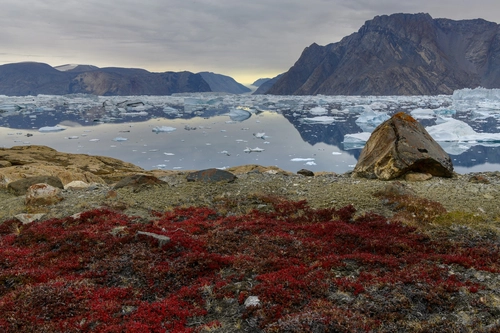
 12 Aug - 31 Aug 2026
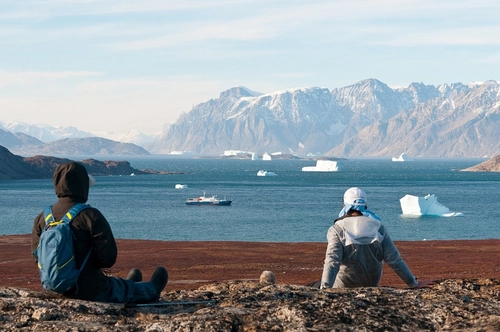 15 Aug - 28 Aug 2026
 16 Aug - 25 Aug 2026
 25 Aug - 07 Sep 2026
 21 Sep - 01 Oct 2026
Related Trips
Spitsbergen - Northeast Greenland, Fly & Sail
12 Aug 2026 - 31 Aug 2026  20 Days / 19 Nights
Northeast Greenland Extreme
15 Aug 2026 - 28 Aug 2026 14 Days / 13 Nights
East Greenland, Scoresby Sund, Including Long Hikes
16 Aug 2026 - 25 Aug 2026 10 Days / 9 Nights
Northeast Greenland Extreme
25 Aug 2026 - 07 Sep 2026 14 Days / 13 Nights
East Greenland, Scoresby Sund - Aurora Borealis, Fly & Sail
21 Sep 2026 - 01 Oct 2026 11 Days / 10 Nights
East Greenland, Scoresby Sund - Iceland , Aurora Borealis, Fly & Sail
01 Oct 2026 - 12 Oct 2026 12 Days / 11 Nights

Blog


Book Recommendations for Your Polar Cruise
Eight Engaging Reindeer Facts
Taking a polar expedition cruise delivers no shortage of show-stopping highlights, but one of the most exhilarating is lifting off from the ship in a helicopter and taking flight over the incomparable Antarctic wilderness.

The Impact of Small vs. Large Cruise Ships
Northeast Greenland National Park
The Eight Albatrosses of Antarctica and the Sub-Antarctic
Scoresby Sund: the Greatest Greenland Adventure
Large and in Charge: Antarctica’s Southern Elephant Seals
Orcas of the Polar Seas
Exploration of the Polar Regions

Top 10 Tips for Packing Your Polar Photography Equipment
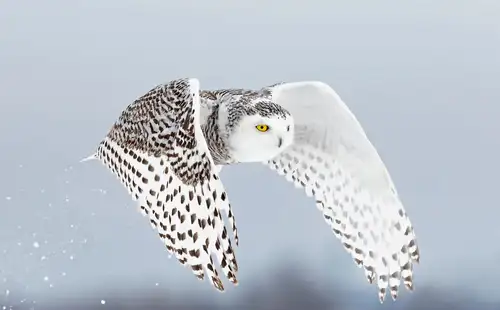
Secrets of the Snowy Owl: Habitat, Adaptations, and Other Facts
Adding Antarctica to Your Seven-Continents Bucket List
Adélie penguins in the Ross Sea - Antarctica
Graham Land: A landscape dominated by volcanoes

The Eight Great Penguin Species of Antarctica
Greenland's History: When Vikings Ruled the Ice Age
9 Facts about the Greenland Shark
Danger Beneath the Water: 10 Facts About Leopard Seals