The Small But Social Commersons Dolphin - Nexta Expeditions
The Small but Social Commerson’s Dolphin

The Small but Social Commerson’s Dolphin

Despite being one of the lesser-known Antarctic cetaceans, Commerson's dolphins are quite social and have been given various names over the years, including Piebald dolphins, skunk dolphins, and panda dolphins. These names have been in use since their discovery in 1767 by French naturalist Philibert Commerson.

Commerson spotted these lively dolphins breaching the water near his ship while navigating the Strait of Magellan. He quickly identified them as a new, previously undescribed species.

Since this serendipitous discovery, researchers have gathered limited information about Commerson's dolphins. Their population size remains a mystery due to their geographic isolation and elusive behavior, making them a challenging species to study.

blog-image

The size and appearance of Commerson’s dolphins

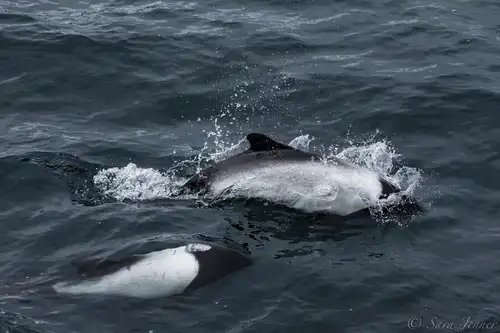
Commerson's dolphins are among the smallest cetaceans, reaching only about 1.5 meters (five feet) in length when fully grown.

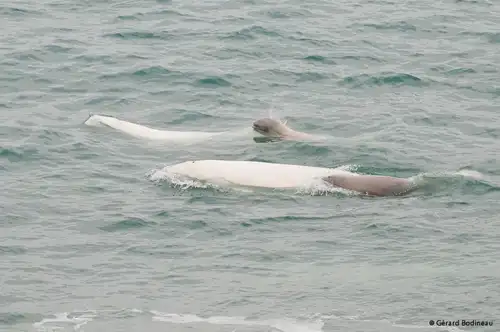
Their distinctive black-and-white coloration makes them easily recognizable. Unlike other dolphin species, Commerson's dolphins do not have a rostrum or beak.

Varieties of Commerson’s dolphins

There are two recognized subspecies of Commerson's dolphin.

The primary subspecies, Cephalorynchus commersonii commersonii, is found around the inlets of Argentina, Tierra del Fuego, and the Falkland Islands.

The second subspecies, Cephalorynchus commersonii kerguelenensis, has established a small population in the shallow waters off the coast of South Africa, near the Kerguelen Islands.

The main difference between these two subspecies is their coloration. The Kerguelenensis subspecies has lighter shades of grey and black compared to their Argentinean counterparts.

How these two genetically identical subspecies became separated by 8,500 kilometers (5,300 miles) is unknown, but it may have happened when a small group of Commerson's dolphins swam too far northeast in the Antarctic Circumpolar Current.

blog-image

Sexual differences and reproductive facts

Distinguishing between male and female Commerson's dolphins is relatively easy: Males have a teardrop-shaped black blotch on their bellies, while females have rounder blotches.

Both sexes reach full maturity between six and nine years of age. Courtship, mating, and birth occur from September to February. Gestation lasts about 12 months, resulting in the birth of a single calf.

blog-image

Diet of Commerson’s Dolphins

Commerson's dolphins primarily feed on shrimp, octopus, various fish species, and even marine worms.

They often engage in cooperative hunting, where groups of up to 15 dolphins work together to herd schools of prey, making it easier for them to feed.

blog-image

Commerson's dolphin conservation

Population estimates for Commerson’s dolphins are based on limited data. The last comprehensive census in 1984 in the Strait of Magellan estimated about 3,400 individuals.

Due to their low estimated population size, Commerson's dolphins are listed as a threatened species. Conservation efforts include reducing ocean pollution and enforcing strict commercial fishing regulations.

Anti-poaching laws are also in place to prevent the unregulated hunting of Commerson's dolphins for their meat or oil. However, enforcing these regulations is challenging, especially in the vast and remote Southern Ocean.

blog-image

Where to see Commerson’s Dolphins

Falkland Islands cruises offer the best chance to see Commerson's dolphins, but sightings are not guaranteed due to the species' rarity. However, the overall experience of an Antarctica trip makes the effort worthwhile.
Best Deals

Related Trips

Falkland Islands - South Georgia - Antarctica - Nexta Expeditions
Antarctica
Ushuaia

Falkland Islands - South Georgia - Antarctica

calendar21 Dec 2025 - 08 Jan 2026
clock19 Days / 18 Nights
From $ 15.600 per person
Antarctica - Basecamp - free camping, kayaking, snowshoe/hiking, mountaineering, photo workshop - Nexta Expeditions
Antarctica
Ushuaia

Antarctica - Basecamp - free camping, kayaking, snowshoe/hiking, mountaineering, photo workshop

calendar28 Dec 2025 - 09 Jan 2026
clock13 Days / 12 Nights
From $ 10.550 per person
Antarctica - Basecamp - free camping, kayaking, snowshoe/hiking, mountaineering, photo workshop - Nexta Expeditions
Antarctica
Ushuaia

Antarctica - Basecamp - free camping, kayaking, snowshoe/hiking, mountaineering, photo workshop

calendar29 Dec 2025 - 10 Jan 2026
clock13 Days / 12 Nights
From $ 11.100 per person
Antarctica - Discovery and learning voyage - Nexta Expeditions
Antarctica
Ushuaia

Antarctica - Discovery and learning voyage

calendar08 Jan 2026 - 18 Jan 2026
clock11 Days / 10 Nights
From $ 9.250 per person
% Save up to $ 3.450
Antarctica - Discovery and learning voyage - Nexta Expeditions
Antarctica
Ushuaia

Antarctica - Discovery and learning voyage

calendar09 Jan 2026 - 19 Jan 2026
clock11 Days / 10 Nights
From $ 9.250 per person
Antarctica - Discovery and learning voyage - Nexta Expeditions
Antarctica
Ushuaia

Antarctica - Discovery and learning voyage

calendar18 Jan 2026 - 28 Jan 2026
clock11 Days / 10 Nights
From $ 9.250 per person
Falkland Islands - South Georgia - Antarctica - Nexta Expeditions
Antarctica
Ushuaia

Falkland Islands - South Georgia - Antarctica

calendar19 Jan 2026 - 06 Feb 2026
clock19 Days / 18 Nights
From $ 16.600 per person
% Save up to $ 7.350
Falkland Islands - South Georgia - Antarctica - Nexta Expeditions
Antarctica
Ushuaia

Falkland Islands - South Georgia - Antarctica

calendar28 Jan 2026 - 16 Feb 2026
clock20 Days / 19 Nights
From $ 12.650 per person
Antarctica - Discovery and learning voyage - Nexta Expeditions
Antarctica
Ushuaia

Antarctica - Discovery and learning voyage

calendar06 Feb 2026 - 16 Feb 2026
clock11 Days / 10 Nights
From $ 9.250 per person
Falkland Islands - South Georgia - Elephant Island - Antarctica - Polar Circle - Nexta Expeditions
Antarctica
Ushuaia

Falkland Islands - South Georgia - Elephant Island - Antarctica - Polar Circle

calendar16 Feb 2026 - 10 Mar 2026
clock23 Days / 22 Nights
From $ 17.800 per person
Antarctica – Uncharted islands of the Deep South - Nexta Expeditions
Antarctica
Ushuaia

Antarctica – Uncharted islands of the Deep South

calendar18 Feb 2026 - 04 Mar 2026
clock15 Days / 14 Nights
From $ 12.100 per person
Deep South Basecamp experience - Nexta Expeditions
Antarctica
Ushuaia

Deep South Basecamp experience

calendar04 Mar 2026 - 17 Mar 2026
clock14 Days / 13 Nights
From $ 11.200 per person

Blog
go-leftgo-right

Seven Sublime Antarctic Bays - Nexta Expeditions
Blog

Seven Sublime Antarctic Bays

Antarctica is renowned for its glaciers, icebergs, and panoramic colonies of penguins. However, less known are the stunning crystal-clear bays that dot the Great White Continent, many of which are explored on our Antarctica cruise routes.
Why You Should Visit Greenland: 11 Things to See, Do, and Explore - Nexta Expeditions
Blog

Why You Should Visit Greenland: 11 Things to See, Do, and Explore

There's nothing quite like witnessing your first Greenland glacier, navigating into the island's largest fjord system (which also happens to be Earth's largest), or observing a humpback whale breach over the dark Greenland Sea.
Svalbard a Disneyland for geologists - Nexta Expeditions
Blog

Svalbard a Disneyland for geologists

Svalbard is situated in the north-western corner of the Eurasian plate. Historically, Svalbard was part of a vast continent that included North America, Greenland, and Eurasia. At one point, both Northeast Greenland and Svalbard were submerged under the ocean before resurfacing.
10 Terrific Antarctic Bird Facts - Nexta Expeditions
Blog

10 Terrific Antarctic Bird Facts

Antarctica is a premier destination for birdwatching, boasting around 45 unique species. Describing them all would require an extensive article, so here we will focus on 10 fascinating facts about the birds you can encounter in Antarctica.
11 Seals You May See in Antarctica or the Arctic - Nexta Expeditions
Blog

11 Seals You May See in Antarctica or the Arctic

1. Weddell seals – These seals are known for their calm demeanor and spend most of their lives beneath the Antarctic ice. Although they need to come up for air, they can remain underwater for up to 45 minutes. Weddell seals can dive to depths of 610 meters (2,000 feet) in search of food. These vocal animals usually have one pup annually and can grow up to 3 meters (10 feet) and weigh 544 kg (1,200 lbs).
Exploration of the Polar Regions - Nexta Expeditions
Blog

Exploration of the Polar Regions

From the Vikings via the first whale and seal hunters to Scott and Amundsen, from the maritime explorers Franklin and Nordenskiöld to present-day polar tourism, a quick tour through history reveals some of the aspects which motivated people to extend their horizons. Existential need, sheer curiosity, imperial greed, polar science, and a taste for adventure all converged in regions which pardon no mistakes.
Fierce and Feathered: the Skuas of Antarctica - Nexta Expeditions
Blog

Fierce and Feathered: the Skuas of Antarctica

At first glance, the skuas you encounter in Antarctica may appear to be merely darker-feathered seagulls. But looks can be deceiving.
The Small Mammals of the Arctic and Antarctica - Nexta Expeditions
Blog

The Small Mammals of the Arctic and Antarctica

As Lillian Gish says in Night of the Hunter, “It’s a hard world for little things.”
15 Falkland Islands Bird Photos - Nexta Expeditions
Blog

15 Falkland Islands Bird Photos

The remote sub-Antarctic archipelago of the Falkland Islands is a haven for bird enthusiasts, offering a unique and abundant selection of birds, especially seabirds.
Traditional Lifestyles of the Inuit - Nexta Expeditions
Blog

Traditional Lifestyles of the Inuit

The Inuit are an indigenous Arctic people who speak the languages of the Eskaleutian family and reside in four countries surrounding the North Pole: Greenland, Canada, the United States, and Russia.
10 Books and Films To Prepare for your Antarctica cruise - Nexta Expeditions
Blog

10 Books and Films To Prepare for your Antarctica cruise

The deep sea remains one of the most mysterious and least explored regions on our planet. With its vast, dark expanses and unique ecosystems, it continues to captivate scientists and adventurers alike.
5 Misconceptions You Might Have About Greenland - Nexta Expeditions
Blog

5 Misconceptions You Might Have About Greenland

True South: A New Flag for a Global Antarctica - Nexta Expeditions
Blog

True South: A New Flag for a Global Antarctica

When Evan Townsend signed up to spend the winter of 2018 working at an Antarctic research station, he had no reason to expect he would end the season by designing a new flag for the continent. He had even less reason to expect the support it would receive.
Polar bear feast - Nexta Expeditions
Blog

Polar bear feast

The polar bear was relishing his meal; the snow and his face were turning red from the blood. As we observed him eating, our own stomachs began to grumble. It was time for lunch.
Antarctica: When to Visit, How to Plan, What to Expect - Nexta Expeditions
Blog

Antarctica: When to Visit, How to Plan, What to Expect

Antarctica is an astonishing location loved in equal measure by ice enthusiasts and continent hoppers, but it also asks a lot in return for its prestigious polar status.
A Day on m/v Plancius - Nexta Expeditions
Blog

A Day on m/v Plancius

Stepping aboard this long-running expedition vessel, it’s easy to forget that she’s been making voyages to the polar regions since “Afternoon Delight” by Starland Vocal Band was on the Billboard Hot 100.
The ozone layer in Antarctica - Nexta Expeditions
Blog

The ozone layer in Antarctica

An ozone molecule is composed of three oxygen atoms rather than the usual two. It exists in the atmosphere in trace amounts. Ozone molecules are created through the interaction of ultraviolet (UV) radiation from the sun with oxygen molecules: When an O2 molecule is split, the two free oxygen atoms bond with other O2 molecules to form O3 molecules.
Five Reasons You Should Cruise the Ross Sea Immediately - Nexta Expeditions
Blog

Five Reasons You Should Cruise the Ross Sea Immediately

In our search for lesser-known holiday spots that still offer fully developed amenities like spas and gift shops, we often miss out on some of the planet's truly underrated treasures.
Svalbard’s 12 Most Iconic Animals - Nexta Expeditions
Blog

Svalbard’s 12 Most Iconic Animals

Each of our Arctic regions offers its own distinct and unforgettable features: Greenland boasts mountainous shorelines and record-setting fjords, Northern Norway is renowned for the aurora borealis and historic masted schooners, and Svalbard (especially Spitsbergen) is where you're most likely to encounter a variety of Arctic wildlife.
11 South Orkney Animals: Whales, Seabirds, and Penguins Aplenty - Nexta Expeditions
Blog

11 South Orkney Animals: Whales, Seabirds, and Penguins Aplenty

The South Orkney Islands are often overlooked as a destination for Antarctic travel.