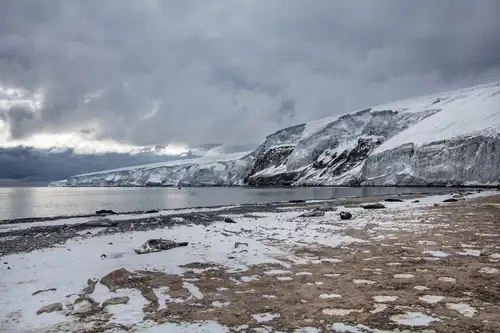


Antarctica’s Ross Ice Shelf is vast, spanning 487,000 sq. km – comparable to the size of France – with a thickness that varies from a few hundred meters near the sea to over 1,200 meters away from the floating edge. The edge along the Ross Sea forms a towering ice wall, rising up to 50 meters above the water, with most of the ice submerged below the waterline.
The Ross Ice Shelf is continuously supplied with ice from glaciers draining from both the East and West Antarctic Ice Sheets. As new ice is added, existing ice is removed through basal melting and ice calving at the front. This ice shelf is crucial for stabilizing the Antarctic ice sheet, acting as a buttress for the ice moving over the land surface.

Science of the Ross Ice Shelf
One of the primary studies focused on the Ross Ice Shelf is the Ross Ocean and ice Shelf Environment and Tectonic setting Through Aerogeophysical surveys and modelling (ROSETTA). This large multidisciplinary and multi-institutional project aims to enhance our understanding of the ice shelf system's dynamics. ROSETTA researchers collect high-resolution data to determine the thickness and structure of the Ross Ice Shelf and characterize the bedrock and seabed bathymetry beneath it. The surveys also gather magnetics and gravity data for geological interpretations and use radar, LiDAR, and imagery to map the ice shelf, including crevasses, channels, debris, and marine ice distribution.
ROSETTA’s overall aims
ROSETTA focuses on three main areas:
- Understanding the ice (ice moves into and across the shelf at speeds ranging from 200-1000 meters/year, taking between 500 and 1,000 years to travel from where it first goes afloat to where it ends at the calving edge);
- Understanding the underlying bed (the bed structure beneath the ice shelf influences the ocean circulation below);
- Understanding the ocean (general ocean circulation, tidal currents, and overall mixing in the Ross Sea embayment, including beneath the ice shelf, are sensitive to the geology below and changes in the ice shelf extent and thickness).
Modelling the ice below
In a recent study, scientists from Lamont-Doherty Earth Observatory, Scripps Institution of Oceanography, and the United States Geological Survey flew over the Ross Ice Shelf using the IcePod, an array of radars and other instruments attached to a C-130 fuselage, to study the interactions between the ice, ocean, and underlying land. The ROSETTA project has completed 18 survey lines and 4 tie lines from nine flights, producing over 16,000 line kilometers of data.
In November of last year, they provided a range of LiDAR (Light Detection and Ranging) images from the IcePod. During the flight, the IcePod is lowered to collect data, with the LiDAR instrument sending out light pulses to illuminate the area below. The time for the reflected light to return is measured, enabling computer software to create three-dimensional images of the land surface.
New maps of the sea floor
As part of the ROSETTA project, scientists from New Zealand’s GNS Science will spend up to six hours per day in a C-130 flying above the Ross Ice Shelf. Using a GNS Science-owned and operated gravity meter, the data gathered will help create a new map of the sea floor bathymetry under the ice shelf. This new map will have 25-times better resolution than the 30-year-old map it replaces.
GNS Science is involved in this project due to its extensive experience in airborne geophysical surveying, having completed an updated airborne gravity survey for New Zealand. The gravity meter used in the study is about the size of a washing machine and can accurately measure small changes in gravity caused by undulations in the sea floor.
Reconstructing the ice shelf’s history
Meanwhile, University of Otago-led scientists embarked on an expedition to conduct acoustic-based imaging of the seafloor and its sediment layers in the Ross Ice Shelf. Over the next three years, researchers will also use a hot water drill built at Victoria University of Wellington to bore through the ice to observe the ice/ocean interface directly, measure ocean properties, and sample sediments on the sea floor. This data will help reconstruct the Ross Ice Shelf’s history since the last ice age.
ANDRILL discovering strange creatures
In a recent study, National Science Foundation (NSF)-funded researchers from the University of Nebraska-Lincoln discovered a new species of small sea anemones burrowed into the underside of the Ross Ice Shelf, with their tentacles stretching out into the cold water from a ceiling. Thousands of these small creatures were found living upside down, hanging from the ice, unlike anemones that usually live on the sea floor.
These little white anemones have been named Edwardsiella andrillae in honor of the ANDRILL Program (Antarctic geological DRILLing), a multinational collaboration of over 200 scientists, students, and educators from Germany, Italy, New Zealand, the United Kingdom, and the United States. The objective is to drill back in time to recover a history of paleoenvironmental changes.
The anemones found are less than an inch long in their contracted state but can stretch out three to four times longer in their relaxed state. They have between 20 and 24 tentacles, with an inner ring of eight longer tentacles and an outer ring of 12 to 16 tentacles. Scott Borg, head of the Antarctic Science Section of NSF’s Division of Polar Programs, noted that the discovery reveals how much remains unknown and unexplored by scientists even after more than 50 years of active research on the continent.
Upside down fish
This discovery was made after scientists lowered a 4.5-foot cylinder equipped with two cameras, a side-mounted lateral camera, and a forward-looking camera, into a drilling hole bored through the 270-meter-thick Ross Ice Shelf to learn more about the ocean currents beneath the ice shelf. In addition to the anemones, the scientists observed fish that routinely swam upside down, with the ice shelf serving as the floor of their world, as well as polychaete worms, amphipods, and an odd-looking creature dubbed the ‘egg roll’, a four-inch-long, one-inch-diameter, neutrally buoyant cylinder seen bumping along the field of sea anemones and sometimes hanging onto them.
Analysing the creatures
To learn more about the anemones, the team stunned the creatures with hot water and used an improvised suction device to retrieve the animals from their burrows for transportation to McMurdo Station for preservation and further study. Scientists will attempt to answer various questions, including how they survive without freezing, how they reproduce, and what they eat. To understand more about the anemones, the scientists propose using a robot capable of exploring deep in the ocean and further from the access hole drilled into the ice.



Blog


The Evolving Shipboard Eco-traveler
Antarctica’s Hourglass Dolphin
The Northern Lights dancing across the skies
Baleen Whales – The Gentle Giants of the Ocean
Peaks, Fjords, and Auroras: 14 East Greenland Attractions
International Polar Bear Day
Where the Polar Bears Roam
Path of Polar Heroes: Hiking Shackleton’s Historic Route
10 Weather-Fueled Facts about Antarctica
Taking the Polar Plunge
9 Facts about the Greenland Shark
A Look Into the International Research Stations of Antarctica

Traditional Lifestyles of the Inuit
The first race to the South Pole in 50 years
Hondius Photography and Video Workshops
Highlights from the First Arctic Voyage of Hondius
The Small but Social Commerson’s Dolphin
Wreck Diving in Antarctica
Amazing Greenland