A Diving Dream Fulfilled - Nexta Expeditions
A Diving Dream Fulfilled

A Diving Dream Fulfilled

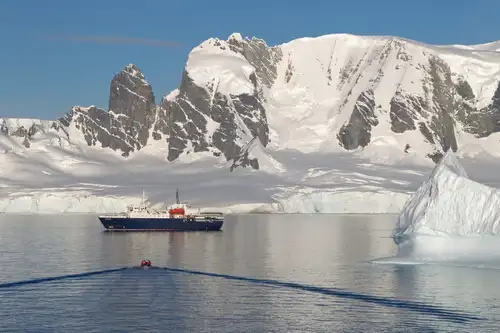
Last January, Mark Hatter achieved a dream he’d been training for over two years. Booking his berth aboard the m/v Ortelius and making the long flight to Ushuaia, Argentina, he and two of his friends sailed down the famous Drake Passage, bound for Earth’s southernmost continent. But their Antarctica trip was not just about shoreline walks and photographing penguins.

No, Mark and his friends had something more ambitious in mind, an adventure that would take them well beyond the first glimpse of Antarctica’s stark beauty – or should we say, well below it. Donning dry suits and strapping on air tanks, they took a true polar plunge below the bergs, experiencing a world even few veteran divers have seen firsthand. Mark’s experiences, first published in Divernet (the online presence of Diver Magazine, for which he’s a contributor), are summarized here.

The night before: sailing the Drake “rite of” Passage

Waiting for a long-anticipated adventure can be as exciting (or agonizing) as engaging in one. Mark’s article describes his hours of binge-watching Antarctica documentaries, waiting for Ortelius to complete its navigation of the Drake, the turbulent two-and-a-half-day gateway to Antarctica.

Staving off seasickness with scopolamine patches and generous helpings of wine, he’s halfway through a documentary on Shackleton when one of his friends pounds on his door, alerting him to the fact that the Elchior and Anvers islands are coming into sight. These islands, showing the first hint of the Antarctic landscape, tell Mark that his two years of cold-water dive training are soon to pay off.

Good clean fun or just plain crazy?

As Mark and his friends, Paul and Sean, draw closer to Antarctica, their excitement builds with the appearance of each new iceberg. The certification level and experience required for polar dive cruises is steep, but after so many months of planning and training, Mark feels up to the task. There are only 10 divers booked, including Mark and his friends.

Along with the dive leader, a Swede Mark describes as having a “Viking jaw and unflappable demeanor,” the group represents a combined five decades of cold-water dive experience. Many have described Mark’s goal and indeed the entire sport of polar diving as crazy, but naturally there’s a whole other group that insists it’s just good clean (albeit cold) fun. After a thorough briefing on Ortelius, Mark is about to find out which camp he belongs to.

blog-image

The first dives: Cuverville Island, Brown’s Station, and Antarctic bug life

Mark’s article describes in detail the first few dives, during which he and his friends become accustomed to their weight allocations – and the below-freezing Antarctic water. They accomplish a 20-meter (65-foot) dive of 40 minutes, the usual depth and time parameters. Later that day, they dive along a vertical wall near Brown’s Station. Visibility is about 5 meters (16 feet), typical for midsummer in Antarctica, as the 24-hour sunlight creates large plankton blooms.

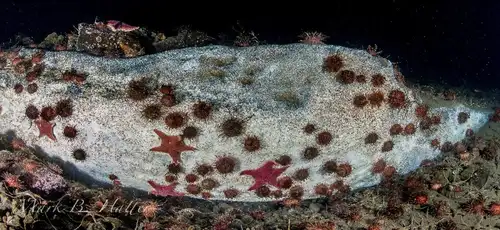
Mark marvels at the vibrant sea stars, but mostly it is the isopods (an order of crustacean) that capture his attention. Mark’s friend Paul spots a crabeater seal swimming nearby, but unfortunately neither Mark nor Sean see it. Even at your most alert, it’s impossible to notice everything below Antarctica’s waters.

blog-image

The final dives: Pleneau, Petermann, and Deception Island

After camping out under the Antarctic stars with thirty other guests (all of them listening to the distant thunder crack of calving icebergs from their sleeping bags), Mark and his friends sail as far south as Ortelius will take them: 65° 07’ S, 064° 02’ W, which takes them to their next dive site near Pleneau and Petermann islands.

After those dives, it’s an overnight Neumayer Channel voyage to Wilhelmina Bay, with Deception Island planned as the final dive location. A semi-active caldera in the South Shetlands, Deception Island belches sulphurous gas into the wind, though its sheltered bay is relatively protected from that. Mark dives near the island’s 19th-century whaling station, spotting among the many plate-sized anemones a whalebone half-buried in volcanic sand.

blog-image

Antarctica accomplished, onward to the Arctic!

Back on Ortelius, Mark and his dive mates celebrate their successful trip with liberal fingers of Scotch. But far from sating their love of polar diving, Antarctica has only fueled it: They’re already planning the next phase, setting their sights on the Northern Hemisphere this time. Until Mark’s Arctic 2019 polar diving adventure is published, you can read the full version of his Antarctica dives here.


Blog
go-leftgo-right

Svalbard vs. the Canadian Arctic - Nexta Expeditions
Blog

Svalbard vs. the Canadian Arctic

It’s easy to assume the Arctic is uniform, a vast expanse of northern freeze shaped by snow, ice, and endless darkness.
Six Seal Species You Might See On Your Greenland Cruise - Nexta Expeditions
Blog

Six Seal Species You Might See On Your Greenland Cruise

If you spot a grand old whiskered man lounging in solitary splendor, there's a good chance you're looking at a bearded seal. Your Greenland cruise will take you to bays where these solitary fellows (except during breeding season) hunt for fish in the relatively shallow waters near the shores.
The Wildlife of Antarctica’s Seas and Skies - Nexta Expeditions
Blog

The Wildlife of Antarctica’s Seas and Skies

Antarctica is one of the most pristine environments on Earth, home to whales, penguins, seals, and birds, providing nature lovers with a treasure trove of wildlife memories to take back home.
Amazing Greenland - Nexta Expeditions
Blog

Amazing Greenland

If you ever get the chance to take a trip to Greenland, you will be amazed by its coastlines, fjords, ice-covered peaks, and great expanse of snow-covered land. You will also notice that Greenland is a rugged area with a rich diversity of life, making it a dream location for scientists as well.
The Mysteries of the Beluga Whale - Nexta Expeditions
Blog

The Mysteries of the Beluga Whale

Beluga whales, also known as white whales, sea canaries, and sometimes melonheads, are a rare but cherished sight during Arctic cruises, thanks to their striking appearance. Despite the rarity of beluga sightings, a good amount is known about these friendly-faced cetaceans.
Under the Greenland Ice Sheet - Nexta Expeditions
Blog

Under the Greenland Ice Sheet

Anyone who ventures to the right part of the globe can encounter vast amounts of ice, but a Greenland cruise offers something truly unique: ice sculptures hidden beneath the northern ice sheet. Scientists once thought these sculptures were rocky hills buried in ice, similar to the Ghost Mountains in Antarctica. However, it turns out that Mother Nature has crafted one of the most exclusive art exhibits in the world. These sculptures are not visible from the surface, but some scientists have managed to get a sneak peek using radar equipment.
The Small Mammals of the Arctic and Antarctica - Nexta Expeditions
Blog

The Small Mammals of the Arctic and Antarctica

As Lillian Gish says in Night of the Hunter, “It’s a hard world for little things.”
Antarctic Explorer’s Voyage - Nexta Expeditions
Blog

Antarctic Explorer’s Voyage

There’s off the beaten track, and then there’s really off the beaten track.
8 Whales You Might See During Your Antarctica Cruise - Nexta Expeditions
Blog

8 Whales You Might See During Your Antarctica Cruise

They're powerful, beautiful, and really, really big. Whales are a wonder of the natural world, and one of the best places to see them is Antarctica. In fact, whale watching is one of the most popular and rewarding activities you can enjoy on an Antarctic trip.
Life in the Polar Regions - Nexta Expeditions
Blog

Life in the Polar Regions

Polar bears in the Arctic, penguins in Antarctica.
Birding Opportunities Abound in Spitsbergen - Nexta Expeditions
Blog

Birding Opportunities Abound in Spitsbergen

Seabirds are the most prevalent type of bird in Spitsbergen. Experts have estimated that there are 164 bird species that have been found throughout Spitsbergen at various points during recent history, but only 30 of them are known to turn to the Svalbard Islands as their primary breeding spot.
Coming Back from the Brink: The Fur Seals of Antarctica - Nexta Expeditions
Blog

Coming Back from the Brink: The Fur Seals of Antarctica

Once hunted to the brink of extinction, the Antarctic fur seal is now one of the most populous and charismatic species of seal you’re likely to encounter during your Antarctica trips. Unlike other members of its large family, the fur seal has external ears, or pinnae, a short snout, and a thick coat of dark brown fur. Male seals tend to be larger than females, with weights ranging from 91 kg (200 lbs.) to 215 kg (474 lbs.).
Polar Marine Visitors: the Whales of Antarctica and the Arctic - Nexta Expeditions
Blog

Polar Marine Visitors: the Whales of Antarctica and the Arctic

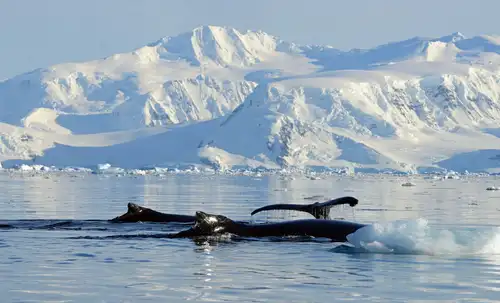
Whales are the world’s largest mammals, found in the Arctic and Antarctica. This article covers some of the major species you may see on voyages to these remarkable areas.
Kayaking In Greenland - Nexta Expeditions
Blog

Kayaking In Greenland

Think of Greenland and two images come to mind:
Graham Land: A landscape dominated by volcanoes - Nexta Expeditions
Blog

Graham Land: A landscape dominated by volcanoes

An Antarctic cruise may explore the upper tip of the Antarctic Peninsula where one finds Graham Land, a jagged, glaciated part of Antarctica with a landscape dominated by volcanoes. Despite the volcanoes being over 200 million years old they are far from extinct with volcanic activity occurring today. Graham Land is connected to Palmer Land at the point where the Antarctic Peninsula widens from around 75 km to around 200 km south of Marguerite Bay.
Eight Engaging Reindeer Facts - Nexta Expeditions
Blog

Eight Engaging Reindeer Facts

When we think about reindeer, we might also think of Saami herders or the holidays or teams of these beloved Arctic animals pulling a bell-covered sleigh across the nighttime sky. Only the first of these options, however, is something you're likely to encounter on an Arctic expedition cruise - and that's only in Northern Norway.
Visa to Argentina for Antarctic Expedition Travelers (2025 Guide) - Nexta Expeditions
Blog

Visa to Argentina for Antarctic Expedition Travelers (2025 Guide)

Argentina is the main gateway for travelers heading to Antarctica, with most expedition cruises departing from the southern city of Ushuaia. Whether you’re flying in through Buenos Aires or connecting domestically, knowing Argentina’s visa requirements is critical for a smooth journey before and after your polar adventure.
The Norse Settlement of Greenland - Nexta Expeditions
Blog

The Norse Settlement of Greenland

Erik the Red is a significant and vibrant figure in the history of the Norse Vikings. His story is primarily documented in the Icelandic Sagas Huaksbók (14th Century) and Skalhóltsbók (15th Century). These accounts offer slightly different versions of events that occurred 3-400 years earlier. The original saga of Erik the Red is believed to have been written around 1200 A.D., with the Skalhóltsbók version considered closest to the original. Additionally, Flateyjarbók (13th Century), which includes the Saga of the Greenlanders, is a crucial source for understanding the settlement of Greenland and the discovery of Vinland – North America.
A Day on m/v Plancius - Nexta Expeditions
Blog

A Day on m/v Plancius

Stepping aboard this long-running expedition vessel, it’s easy to forget that she’s been making voyages to the polar regions since “Afternoon Delight” by Starland Vocal Band was on the Billboard Hot 100.
Greenland: Where the Kayak Was Invented - Nexta Expeditions
Blog

Greenland: Where the Kayak Was Invented

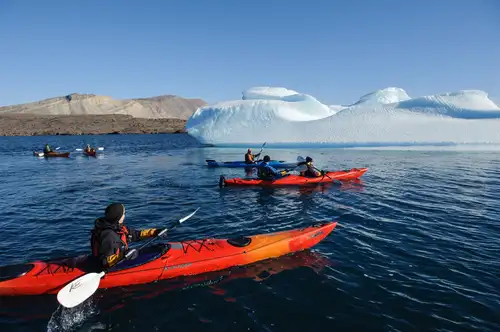
If you've ever enjoyed kayaking, you owe a debt of gratitude to the ancient Greenlandic Inuit who originally designed them for hunting. The thrilling adventures people now have navigating some of the world's most challenging rapids wouldn't be possible without the Inuit's need for a nimble form of water transportation. While travelers still use kayaks in this region, they are typically not fishing, whaling, or sealing. Consequently, recreational kayaks have been adapted to fit their new role.