The Giant Petrels Of King George Island - Nexta Expeditions
The Giant Petrels of King George Island

The Giant Petrels of King George Island

Antarctica is undeniably one of the world’s premier birding destinations.

Nowhere else can you spot penguins, storm petrels, skuas, and kelp gulls all within the same view through your binoculars. Regardless of your level of birding interest or experience, witnessing these birds in their natural environment is always inspiring.

However, one bird species stands out among the rest.

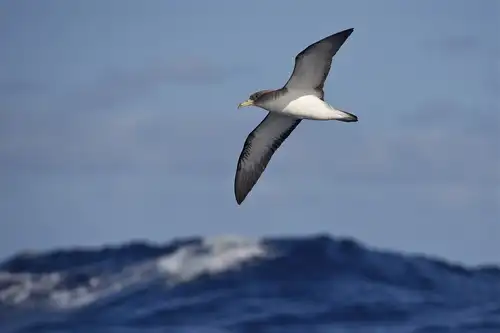
The giant petrel can often be seen awkwardly moving along the beaches of King George Island, as if it has just learned to walk. More frequently, though, it is observed gliding through the air on its impressive wingspan of 180 to 210 cm (71 to 83 inches).

With its striking grey eyes and tube-nosed beak, the giant petrel of King George Island is a remarkable sight, no matter how you encounter it.

blog-image

King George Island’s tubenose seabirds

Sometimes called “stinkers” because they scavenge on anything dead, dying, or weak, giant petrels are the largest birds in the Southern Hemisphere.

There are currently two recognized species of giant petrels: northern giant petrels and southern giant petrels. These species are nearly identical, though they exhibit several different color variations, or “morphs.”

These morphs can range from white to dark grey.

Since giant petrels spend most of their lives at sea, they have evolved unique adaptations: Their beaks feature tube-shaped nostrils that filter salt from seawater, allowing them to drink fresh water. This adaptation has led to the term “tubenoses.” Other tubenoses include shearwaters, fulmars, albatrosses, storm petrels, and diving petrels.

blog-image

Giant petrel breeding rituals

Giant petrels are solitary creatures, spending months alone feeding at sea. But when the austral summer arrives in October, they migrate to the circumpolar regions of Antarctica to breed.

Preferring privacy, they nest several hundred meters apart in colonies that have been used for generations.

Building a nest is a simple task, usually involving the rearrangement of a few stones. A few weeks after establishing a nesting site, the eggs begin to appear. These eggs can be around 20 cm (8 inches) in diameter, resembling dinosaur eggs.

Giant petrels lay only one egg per year, making it crucial for the parents to be vigilant in protecting their vulnerable young.

However, giant petrel parents are sensitive to disturbances and may abandon their egg if they sense danger. Evolution has taught them that their own survival is more important than their unhatched egg, as they can always nest again the following year.

blog-image

Working with giant petrels on King George Island

The austral summer (October to March) provides mild enough conditions for scientists to study giant petrels on King George Island.

At the start of the breeding season, scientists monitor giant petrels from a safe distance using binoculars and high-powered spotting scopes. They then take a census of the colonies, map them, and compare the data to historical records.

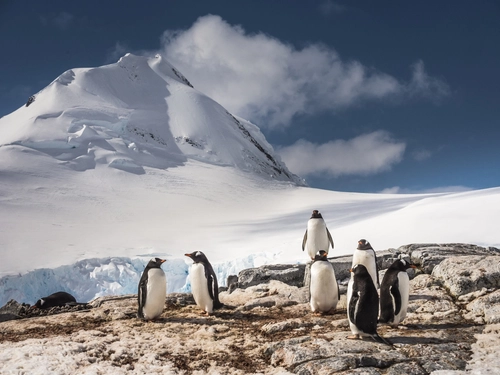
Occasionally, a giant petrel colony will overlap with a penguin colony, making disturbances from penguins (and visiting humans) a challenging issue.

In such cases, it’s crucial for scientists to approach the giant petrel colony slowly and avoid close contact. Giant petrels may emit a low “uuuurrr” sound if they feel threatened.

blog-image

Giant petrel chicks

When giant petrel chicks begin to emerge from their eggs, it’s time for the parents to start feeding them.

Feeding is a round-the-clock task that involves catching fish at sea, scavenging for dead seals along the beaches, and searching penguin colonies for unattended eggs or chicks. Giant petrel chicks enjoy some of the best dining in Antarctica.

When disturbed, giant petrel chicks have a defense mechanism known as “gakking.”

Gakking is the sound they make as they projectile vomit at predators (or unwitting scientists). The fluid they expel is a mix of digestive juices and food remnants, producing an unpleasant odor.

For conservation purposes, scientists must continue to study giant petrel chicks. Researchers fit the young birds with a metal band around their leg, with a number corresponding to the year they were banded.

Each year, when scientists return to collect data, they try to read these band codes to determine which giant petrels have returned to breed.

blog-image

The conservation of giant petrels

From 1997 to 1998, thousands of giant petrels were killed in illegal longline fishing operations in the Southern Ocean.

The long lines were intended for Patagonian toothfish but ended up catching over 4,000 giant petrels and numerous other seabirds and marine mammals. This fishing method has since been regulated, allowing the giant petrel population to recover.

Although giant petrels are no longer in immediate danger of extinction, the increasing presence of marine plastics and other debris continues to pose a threat to their populations.

blog-image

King George Island (and other places to see giant petrels)

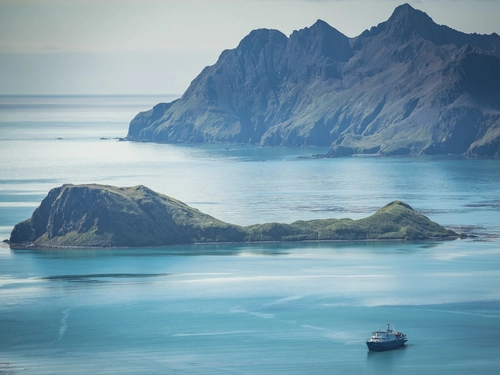
King George Island, the largest in the Shetland chain, is an Antarctic island perfectly situated within the breeding range of giant petrels.

This makes King George Island one of the most reliable places to observe these birds, though they are also commonly seen in most coastal areas of Antarctica and the sub-Antarctic islands. They are also abundant in the Drake Passage.

If you’re heading south for an exciting Antarctica cruise, be sure to keep your binoculars handy!

blog-image

Title image by Thomas Laumeyer

Best Deals

Related Trips

Falkland Islands - South Georgia - Antarctica - Nexta Expeditions
Antarctica
Ushuaia

Falkland Islands - South Georgia - Antarctica

calendar21 Dec 2025 - 08 Jan 2026
clock19 Days / 18 Nights
From $ 15.600 per person
Antarctica - Basecamp - free camping, kayaking, snowshoe/hiking, mountaineering, photo workshop - Nexta Expeditions
Antarctica
Ushuaia

Antarctica - Basecamp - free camping, kayaking, snowshoe/hiking, mountaineering, photo workshop

calendar28 Dec 2025 - 09 Jan 2026
clock13 Days / 12 Nights
From $ 10.550 per person
Antarctica - Basecamp - free camping, kayaking, snowshoe/hiking, mountaineering, photo workshop - Nexta Expeditions
Antarctica
Ushuaia

Antarctica - Basecamp - free camping, kayaking, snowshoe/hiking, mountaineering, photo workshop

calendar29 Dec 2025 - 10 Jan 2026
clock13 Days / 12 Nights
From $ 11.100 per person
Antarctica - Discovery and learning voyage - Nexta Expeditions
Antarctica
Ushuaia

Antarctica - Discovery and learning voyage

calendar08 Jan 2026 - 18 Jan 2026
clock11 Days / 10 Nights
From $ 9.250 per person
% Save up to $ 3.450
Antarctica - Discovery and learning voyage - Nexta Expeditions
Antarctica
Ushuaia

Antarctica - Discovery and learning voyage

calendar09 Jan 2026 - 19 Jan 2026
clock11 Days / 10 Nights
From $ 9.250 per person
Antarctica - Discovery and learning voyage - Nexta Expeditions
Antarctica
Ushuaia

Antarctica - Discovery and learning voyage

calendar18 Jan 2026 - 28 Jan 2026
clock11 Days / 10 Nights
From $ 9.250 per person
Falkland Islands - South Georgia - Antarctica - Nexta Expeditions
Antarctica
Ushuaia

Falkland Islands - South Georgia - Antarctica

calendar19 Jan 2026 - 06 Feb 2026
clock19 Days / 18 Nights
From $ 16.600 per person
% Save up to $ 7.350
Falkland Islands - South Georgia - Antarctica - Nexta Expeditions
Antarctica
Ushuaia

Falkland Islands - South Georgia - Antarctica

calendar28 Jan 2026 - 16 Feb 2026
clock20 Days / 19 Nights
From $ 12.650 per person
Antarctica - Discovery and learning voyage - Nexta Expeditions
Antarctica
Ushuaia

Antarctica - Discovery and learning voyage

calendar06 Feb 2026 - 16 Feb 2026
clock11 Days / 10 Nights
From $ 9.250 per person
Falkland Islands - South Georgia - Elephant Island - Antarctica - Polar Circle - Nexta Expeditions
Antarctica
Ushuaia

Falkland Islands - South Georgia - Elephant Island - Antarctica - Polar Circle

calendar16 Feb 2026 - 10 Mar 2026
clock23 Days / 22 Nights
From $ 17.800 per person
Antarctica – Uncharted islands of the Deep South - Nexta Expeditions
Antarctica
Ushuaia

Antarctica – Uncharted islands of the Deep South

calendar18 Feb 2026 - 04 Mar 2026
clock15 Days / 14 Nights
From $ 12.100 per person
Deep South Basecamp experience - Nexta Expeditions
Antarctica
Ushuaia

Deep South Basecamp experience

calendar04 Mar 2026 - 17 Mar 2026
clock14 Days / 13 Nights
From $ 11.200 per person

Blog
go-leftgo-right

Penguin Wisdom: Life Lessons from Our Favorite Flightless Birds - Nexta Expeditions
Blog

Penguin Wisdom: Life Lessons from Our Favorite Flightless Birds

As enthusiasts of wildlife travel, we believe every creature has something valuable to impart - from the grand blue whale to the tiny cephalopod, the formidable polar bear to the elusive Arctic fox.
Eight Engaging Reindeer Facts - Nexta Expeditions
Blog

Eight Engaging Reindeer Facts

When we think about reindeer, we might also think of Saami herders or the holidays or teams of these beloved Arctic animals pulling a bell-covered sleigh across the nighttime sky. Only the first of these options, however, is something you're likely to encounter on an Arctic expedition cruise - and that's only in Northern Norway.
Eight Antarctic Misconceptions - Nexta Expeditions
Blog

Eight Antarctic Misconceptions

Antarctica has given rise to some pretty far-fetched rumors.
First to the North Pole: Five Failed but Brave Expeditions - Nexta Expeditions
Blog

First to the North Pole: Five Failed but Brave Expeditions

Being first to reach the North Pole was seen by several nations as economically invaluable due to the open polar sea said to encircle it, but for the explorers themselves it was also a gloriously adventurous grab for immortality.
Solargraphy & Pin Hole photography in the Arctic - Nexta Expeditions
Blog

Solargraphy & Pin Hole photography in the Arctic

Secrets of the Snowy Owl: Habitat, Adaptations, and Other Facts - Nexta Expeditions
Blog

Secrets of the Snowy Owl: Habitat, Adaptations, and Other Facts

The snowy owl (Bubo scandiacus), also known as the great white owl or Arctic owl, is one of the most distinctive bird species on the planet. While you won’t find them in all areas of the Arctic – they don’t exist in Svalbard due to the lack of lemmings – snowy owls are seen in the polar regions of Eurasia and North America and are a potential visitor during Greenland cruises. The binomial species name, “scandiacus,” is derived from Scandinavia, as this is where the bird was first discovered. The snowy owl is the official bird of Quebec, and they are a must-see for countless bird watchers and naturalists.
Gough Island: Seabird Capital of the South Atlantic - Nexta Expeditions
Blog

Gough Island: Seabird Capital of the South Atlantic

Gough Island is a remote volcanic island in the South Atlantic, uninhabited except for a small party of meteorologists and (sometimes) biologists.
8 Scientific Wonders of the Arctic - Nexta Expeditions
Blog

8 Scientific Wonders of the Arctic

The Arctic’s frozen landscape not only contains scenic gems, it also prompts fascinating advances in research. Here are some of the eight best.
Of Treacherous Rocks & Audacious Fin Whales - Nexta Expeditions
Blog

Of Treacherous Rocks & Audacious Fin Whales

Soon large blows filled our view; small groups of fin whales sped by heading north all the while feeding on concentrations of krill & small fish. Group after group was seen, with many simply feeding in the general area and not heading anywhere in particular. Soon it became evident that we were not simply seeing a few random groups of fins, but a very large concentration spread out over a large area of sea just north and around the islands north of the South Shetlands. Dozens upon dozens of fin whales were feeding, diving around the ship and on the horizon in massive numbers; we must have seen well over fifty fin whales in the general area of Elephant Island, something many of the guides had never seen before.
Antarctica in Pictures: Photos from 2018 - Nexta Expeditions
Blog

Antarctica in Pictures: Photos from 2018

Pictures can never truly capture the essence of an experience, and this is especially true for the breathtaking adventures in Antarctica.
Top 10 Tips for Packing Your Polar Photography Equipment - Nexta Expeditions
Blog

Top 10 Tips for Packing Your Polar Photography Equipment

One of the most common questions I get asked before a cruise is, “What photography equipment should I bring?” It’s a broad question, and answers vary based on the individual. There are, however, a few key pointers that apply to almost everyone.
Baleen Whales – The Gentle Giants of the Ocean - Nexta Expeditions
Blog

Baleen Whales – The Gentle Giants of the Ocean

They are the largest animals on Earth, yet they thrive on some of the tiniest creatures. These giants can reach lengths of 30 meters (90 feet), but it is the microscopic zooplankton, krill, and small fish that sustain them. These are the baleen whales. Unlike toothed whales, baleen whales lack teeth. Instead, they use plates of baleen in their mouths to trap and consume their tiny prey.
Birds of the South: 33 Antarctic Birds and Seabirds - Nexta Expeditions
Blog

Birds of the South: 33 Antarctic Birds and Seabirds

Of the many compelling reasons people travel to Antarctica and the sub-Antarctic, bird life is among the most beloved.
Arctic Icon: 10 Facts about the Polar Bear - Nexta Expeditions
Blog

Arctic Icon: 10 Facts about the Polar Bear

Polar bears are to the Arctic what penguins are to Antarctica.
All things ice in the Antarctic - Nexta Expeditions
Blog

All things ice in the Antarctic

The first documented sighting of an iceberg in Antarctica occurred on February 1, 1700, when Edmond Halley was on an expedition to measure the Earth's magnetic field. He noted in his diary that he encountered "great Islands of Ice, of Soe Incredible a hight and Magnitude that I scare dare to write my thoughts on it."
Discover the Scoresby Sund Fjord System in East Greenland - Nexta Expeditions
Blog

Discover the Scoresby Sund Fjord System in East Greenland

Are you considering a trip to Greenland? One destination you absolutely must visit is the world's largest fjord with stunning landscapes: Scoresby Sund.
The Best Arctic and Antarctic Trips for Families - Nexta Expeditions
Blog

The Best Arctic and Antarctic Trips for Families

Polar expedition cruises are often enjoyed by couples and an increasing number of solo travelers, but they can also be a fantastic adventure for families. If you have the budget to bring the whole family along, there are various polar trips that will make everyone equally excited about the ice.
Antarctica’s first Marine Protected Area - Nexta Expeditions
Blog

Antarctica’s first Marine Protected Area

In October of this year, the Commission for the Conservation of Antarctic Marine Living Resources, which includes 24 countries such as the United States, the European Union, Australia, and New Zealand, reached a consensus on a New Zealand/United States proposal to establish a large-scale Marine Protected Area (MPA) in the Ross Sea region.
The Ins, Outs, and Ups of Polar Mountaineering & Ski Mountaineering - Nexta Expeditions
Blog

The Ins, Outs, and Ups of Polar Mountaineering & Ski Mountaineering

Traveling to the polar regions, whether to the Arctic or Antarctica, is an adventure almost no matter what you do.
The History of Antarctica in Maps - Nexta Expeditions
Blog

The History of Antarctica in Maps

Long before human eyes ever beheld Antarctica, the ancients were convinced that it existed – or at least something like it.