Antarcticas Hourglass Dolphin - Nexta Expeditions
Antarctica’s Hourglass Dolphin

Antarctica’s Hourglass Dolphin

Though hourglass dolphins are especially rare, they’re actually not a threatened or endangered species.

This isn’t just luck, however, or some oversight of ecological research.

Rather, it’s due to certain inherent traits of hourglass dolphins. For one, their habitat is the remote, cold Antarctic and sub-Antarctic waters. Also, hourglass dolphins are not hunted commercially. And finally, these timid dolphins tend to avoid human contact.

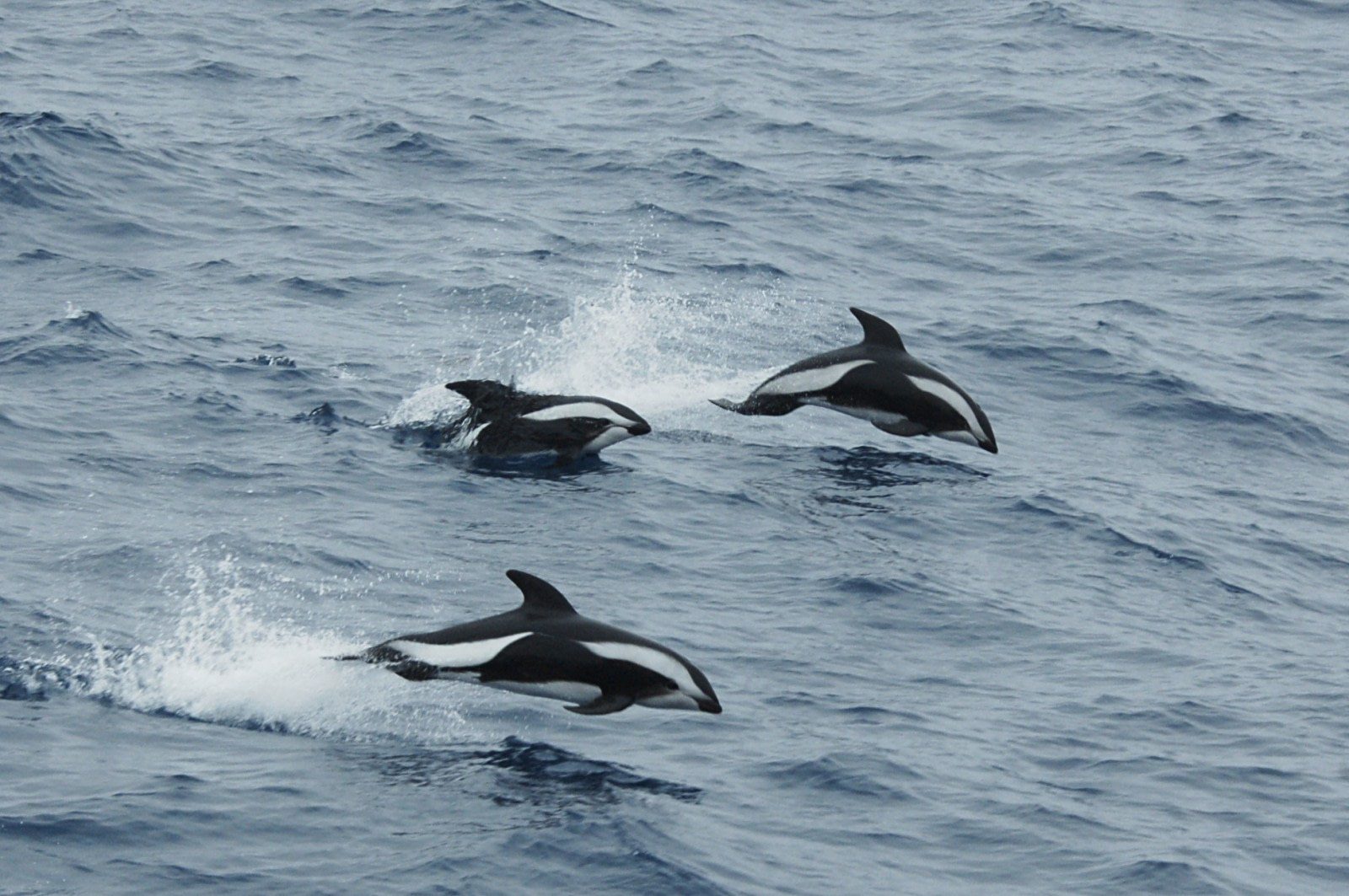
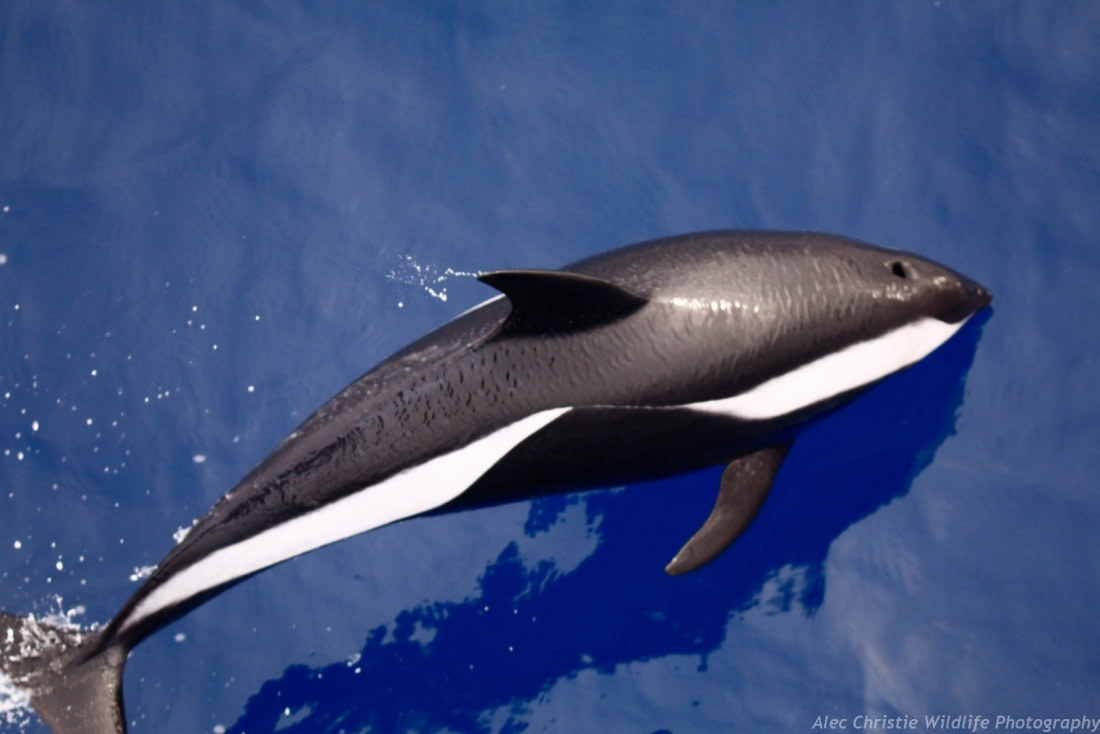
Small and stocky, with a striking black and white pattern that gives them their common name, hourglass dolphins are one of the least-studied cetaceans in the world.

Scientists still know little about their behavior and biology: As of 2010, less than eight hourglass dolphins had even been studied.
blog-image

Many names, two habitats, one hourglass dolphin

The scientific name of the hourglass dolphin is Lagenorhynchus cruciger, which means “jar-beaked” and refers to their small, jar-shaped rostrums (beak-like snouts), while cruciger, which means “cross-carrier,” references the unique cross-like color scheme on their flank.

The hourglass dolphin has also been classified as Lagenorhynchus wilsoni, for Edward Wilson, an Antarctic naturalist in the early 20th century.

Other names for hourglass dolphins are as follows: skunk dolphins, Wilson's dolphins, and southern white-sided dolphins. Hourglass dolphins are also nicknamed “sea cows” due to their distinct black and white coloring.

How to identify hourglass dolphins

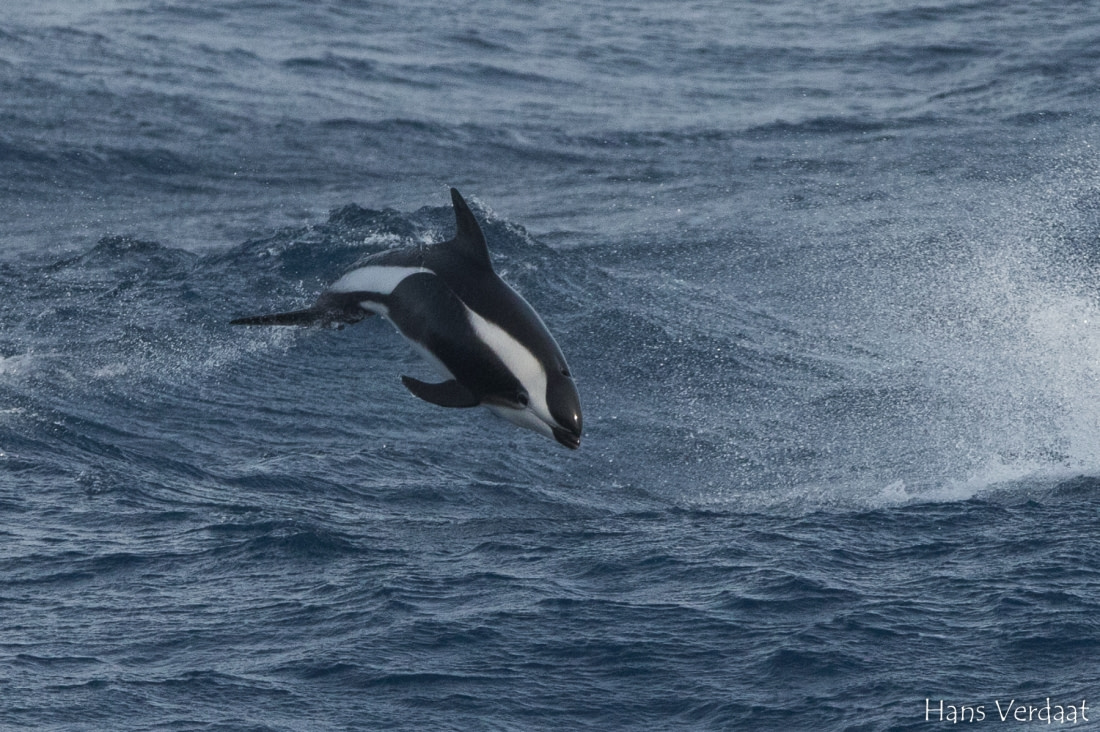
The coloring of hourglass dolphins sets them apart from other dolphins, but above the Antarctic Convergence they still might be confused with dusky and Peale's dolphins, which are also black and white.

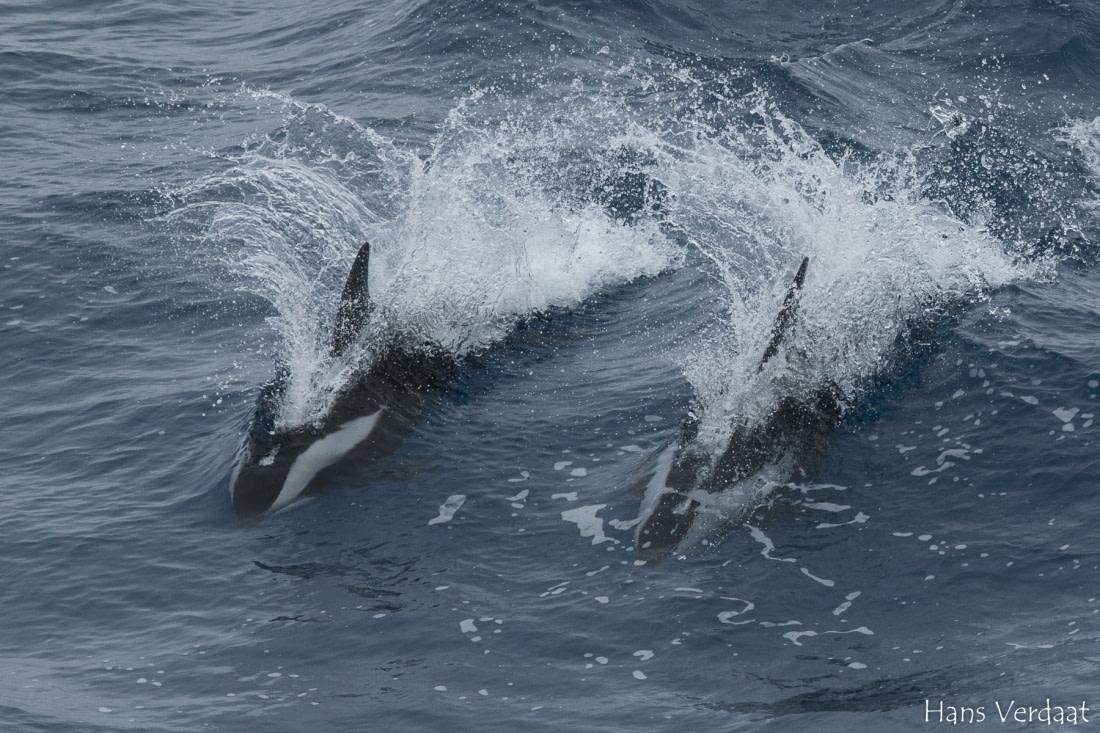
Below the Convergence, however, hourglass dolphins are the only small cetaceans with a dorsal fin, which is tall, hooked, and has a broad base.

Some hourglass dolphins, thought to be adult males, have a marked backward bend approximately halfway up the fin. Their unique coloration and the shape of their fins make it easy to identify these hourglass dolphins.
blog-image

The southern habitat of hourglass dolphins

Hourglass dolphins are most commonly seen around the Antarctic Convergence, between South America and Macquarie Island.

Their habitat is also known to extend to the south coast of New Zealand, near the South Shetland Islands, and around Tierra del Fuego. The largest concentration of hourglass dolphin sightings, however, has been in the Drake Passage. Hourglass dolphins are usually found in southern waters during the summer and northern waters during the winter. This fluctuating habitat seems to suggest that hourglass dolphins migrate seasonally following cold-water currents.

The large social circle of hourglass dolphins

Gregarious and sociable, hourglass dolphins typically congregate into pods ranging from one to 60 individuals, with their average group size being around seven.

Not only are hourglass dolphins sociable with their own species, but they have also been seen in the company of fin whales, sei whales, southern bottlenose whales, Arnoux's beaked whales, orcas (killer whales), long-finned pilot whales, and southern right whale dolphins.

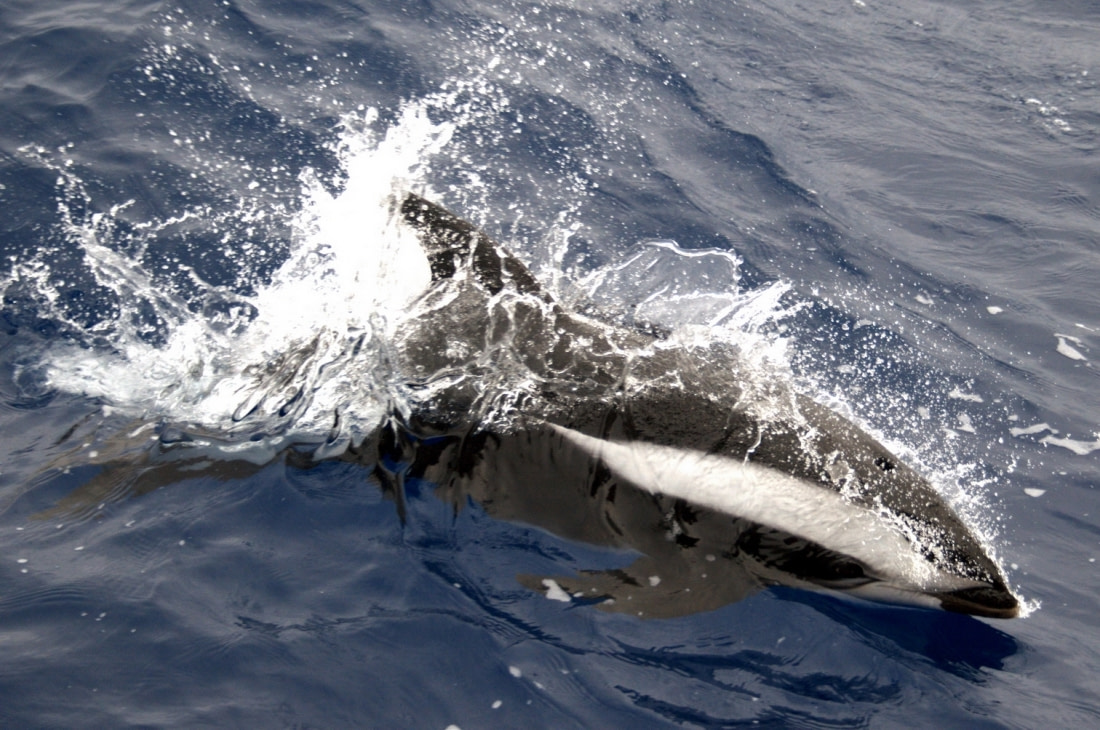
Hourglass dolphins enjoy bow-riding the waves of these much larger animals and have even been spotted altering their direction to catch the waves of boats and ships.

Swimming in long, low leaps, hourglass dolphins can look like swimming penguins from a distance. Whalers have historically looked for this behavior to identify fin whales.
blog-image

Hourglass dolphin food facts

Hourglass dolphins feed on lanternfish, squid, and crustaceans, and have been spotted feeding in groups of seabirds and plankton swarms.

They have conical teeth: 26 - 34 in their upper jaws and 27 - 35 in their lower jaws.

Hourglass dolphins use echolocation for orientation and prey location. A recent study, in fact, showed that they produce clicks that allow them to detect prey at more than twice the distance of other dolphin species.

The family life of hourglass dolphins

Little is known about the parental behavior of hourglass dolphins. In studies of their social habits, only three calves were identified out of a group of 1,634 hourglass dolphin adults.

Scientists believe this low offspring number may be explained by the possibility that hourglass dolphins breed during winter, when the weather prevents detailed studies.

However, it may also be due to the tendency of hourglass dolphins to avoid vessels.
blog-image

Threats to the hourglass dolphin population

Hourglass dolphins are not hunted commercially, have never been systematically exploited, and are almost never caught in fishing nets. Scientists believe the species is probably preyed upon by killer whales, though there is no documented evidence of this.

It is likely, then, that the hourglass dolphin population is near its original levels: 144,300 is the current estimated population. Embark on a thrilling Antarctica cruise to any of our extraordinary sites and enjoy the opportunity to view these beautiful creatures yourself!


Blog
go-leftgo-right

What’s so Special about East Spitsbergen? - Nexta Expeditions

Blog

What’s so Special about East Spitsbergen?

We’ve previously discussed our north Spitsbergen journeys and Spitsbergen circumnavigations, but the eastern parts of this incredible island have not received the attention they deserve. Despite the name, our east Spitsbergen voyages explore much more than just the eastern side of Spitsbergen.
The Impact of Small vs. Large Cruise Ships - Nexta Expeditions
Blog

The Impact of Small vs. Large Cruise Ships

The generalization that larger ships impact the environment more than smaller ships seems like such a no-brainer that if someone said it to you, you’d be easily forgiven for thinking you were being tricked.
The Ways and Wildlife of the Weddell Sea - Nexta Expeditions
Blog

The Ways and Wildlife of the Weddell Sea

The Weddell Sea is situated off the coast of Antarctica, at the southernmost part of the Atlantic Ocean. Its coordinates are 75 degrees south and 47 degrees west, encompassing the Argentine, Chilean, and British territories of Antarctica. The severe weather and extensive pack ice have historically made the Weddell Sea challenging to access, but modern icebreaker ships are now enabling explorers to venture into this remote area.
The Plants of Antarctica - Nexta Expeditions
Blog

The Plants of Antarctica

Surviving in Antarctica is a monumental challenge for any plant. The extreme cold, limited sunlight, scarce moisture, poor soil, and short growing season make it nearly impossible for most flora to thrive. Yet, some plants have adapted to these harsh conditions and have managed to flourish where others cannot.
11 Seals You May See in Antarctica or the Arctic - Nexta Expeditions
Blog

11 Seals You May See in Antarctica or the Arctic

1. Weddell seals – These seals are known for their calm demeanor and spend most of their lives beneath the Antarctic ice. Although they need to come up for air, they can remain underwater for up to 45 minutes. Weddell seals can dive to depths of 610 meters (2,000 feet) in search of food. These vocal animals usually have one pup annually and can grow up to 3 meters (10 feet) and weigh 544 kg (1,200 lbs).
Bouvet Island: The Most Remote Island in the World - Nexta Expeditions
Blog

Bouvet Island: The Most Remote Island in the World

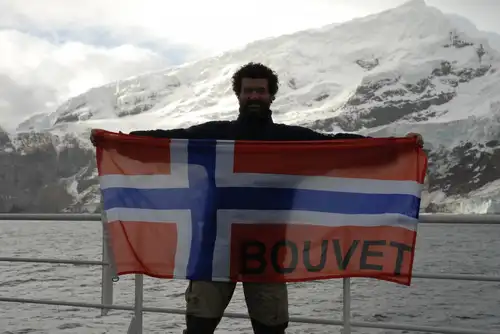
On January 1, 1739, French Commander Jean-Baptiste Charles Bouvet de Lozier made an extraordinary discovery: a volcanic island so remote that it lies 2,600 km (1,600 miles) from the nearest inhabited land.
Spitsbergen: Alkefjellet magic - Nexta Expeditions
Blog

Spitsbergen: Alkefjellet magic

If they knew their way home, why not follow them? Equipped with GPS and compass, we approached the cliffs by zodiac. First, we heard the noise from the colony – the distinct calls of guillemots, kittiwakes, and Glaucous gulls. Then the cliffs gradually emerged from the mist.
Six Seal Species You Might See On Your Greenland Cruise - Nexta Expeditions
Blog

Six Seal Species You Might See On Your Greenland Cruise

If you spot a grand old whiskered man lounging in solitary splendor, there's a good chance you're looking at a bearded seal. Your Greenland cruise will take you to bays where these solitary fellows (except during breeding season) hunt for fish in the relatively shallow waters near the shores.
Day and night in Antarctica - Nexta Expeditions
Blog

Day and night in Antarctica

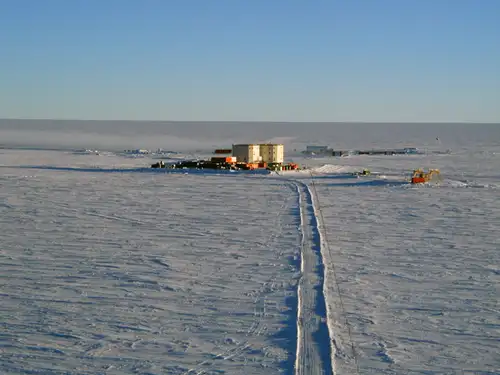
At the Concordia station, a French-Italian research facility situated 3,233 meters above sea level at Dome C on the Antarctic Plateau, European Space Agency (ESA) scientists are investigating the effects of extended space missions. The station is more isolated than the International Space Station, with the nearest humans located 600 kilometers away.
Greenland: East vs. West - Nexta Expeditions
Blog

Greenland: East vs. West

East and West Greenland offer vastly different experiences due to their unique climates, wildlife, habitation, and geology.
10 Tried-and-True Bird Photography Tips - Nexta Expeditions
Blog

10 Tried-and-True Bird Photography Tips

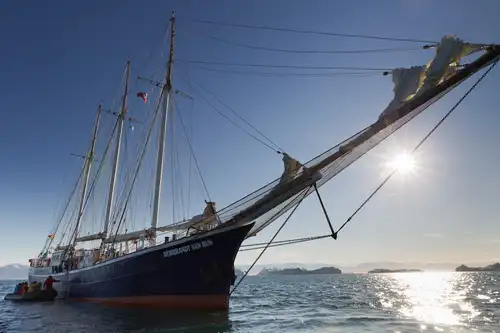
It’s easy to understand our fascination with birds: they’re beautiful, graceful (usually), and most of them have the power of flight.
Ancient Arctic Exploration - Nexta Expeditions
Blog

Ancient Arctic Exploration

When it comes to polar exploration, the Arctic boasts a much longer history compared to Antarctica.
South Georgia in Spring - Nexta Expeditions
Blog

South Georgia in Spring

What a fantastic time to be in South Georgia! Perhaps the best time of the year! The wildlife is abundant, and the light is simply magical for photography. Kings, Gentoos, Chinstraps, and Macaronis are all present along the shorelines. Elephant and Fur seals are also plentiful! Wandering albatrosses are welcoming their newly hatched chicks, while the non-breeders are actively engaged in their courtship rituals, practicing a ceremonial dance. Light-mantled, Sooty, and Grey-headed albatrosses are still feeding their fluffy chicks, as are the Giant petrels. We've been fortunate with the weather, finding ourselves in the right place at the right time to succeed in all our landings and zodiac cruises so far.
Exploration of the Polar Regions - Nexta Expeditions
Blog

Exploration of the Polar Regions

From the Vikings via the first whale and seal hunters to Scott and Amundsen, from the maritime explorers Franklin and Nordenskiöld to present-day polar tourism, a quick tour through history reveals some of the aspects which motivated people to extend their horizons. Existential need, sheer curiosity, imperial greed, polar science, and a taste for adventure all converged in regions which pardon no mistakes.
The Wildlife of Antarctica’s Seas and Skies - Nexta Expeditions
Blog

The Wildlife of Antarctica’s Seas and Skies

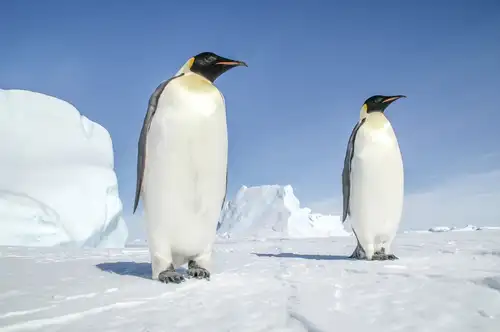
Antarctica is one of the most pristine environments on Earth, home to whales, penguins, seals, and birds, providing nature lovers with a treasure trove of wildlife memories to take back home.
Antarctic Icon: 44 Facts About the Emperor Penguin - Nexta Expeditions

Blog

Antarctic Icon: 44 Facts About the Emperor Penguin

What polar bears are for the Arctic, emperor penguins are for Antarctica. These flightless aquatic birds are probably the most recognizable animals in the southern polar regions and certainly among the most popular wildlife attractions for our passengers.
The ozone layer in Antarctica - Nexta Expeditions
Blog

The ozone layer in Antarctica

An ozone molecule is composed of three oxygen atoms rather than the usual two. It exists in the atmosphere in trace amounts. Ozone molecules are created through the interaction of ultraviolet (UV) radiation from the sun with oxygen molecules: When an O2 molecule is split, the two free oxygen atoms bond with other O2 molecules to form O3 molecules.
What to pack for your Atlantic Odyssey voyage? - Nexta Expeditions
Blog

What to pack for your Atlantic Odyssey voyage?

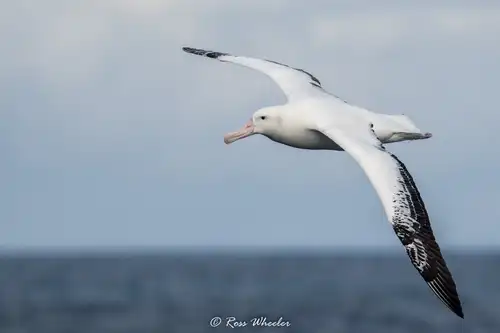
When packing, avoid burdening yourself with excessive clothing or gear. Opt for casual, practical attire that can be layered. Consider including the following:
The Eight Albatrosses of Antarctica and the Sub-Antarctic - Nexta Expeditions
Blog

The Eight Albatrosses of Antarctica and the Sub-Antarctic

Our guests are typically wildlife enthusiasts, with a particular interest in bird life. While many bird lovers focus on the penguins we encounter, there's a smaller yet equally passionate group that favors the more airborne seabirds. Among this birdwatching subset, the albatross is a species that garners (and deserves) significant attention.
Camping in Antarctica: a True Expedition Experience - Nexta Expeditions
Blog

Camping in Antarctica: a True Expedition Experience

We often think of camping as a summer activity, filled with warm nights, campfire dinners, and serene mountain lakes. However, there's a whole other world of camping to explore.