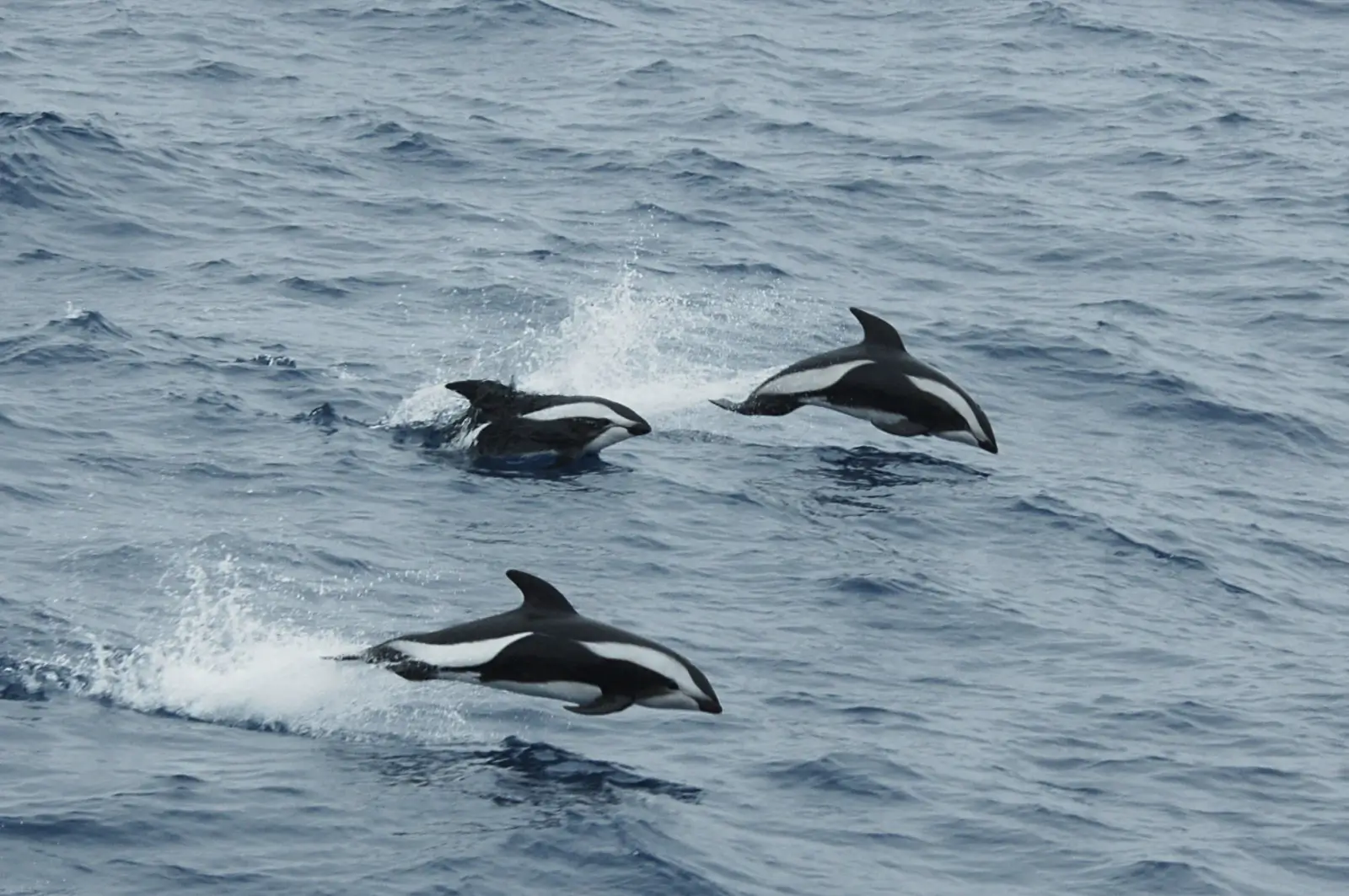


The umbrella term “whale” refers to a wide variety of large marine mammals. To zero in on blue whales, however, we’ll need to unpack this term a bit. The Latin word for whale, cetus, is the root of the whale infraorder, Cetacea, the largest parvorder of which is Mysticeti.
Also known as baleen whales or whalebone whales, Mysticeti are characterized by sieve-like baleen structures in their upper jaw, which they use to filter food from seawater. Gray whales, right whales, bowhead whales, and blue whales all fall within this parvorder.
We realize that’s a lot of facts for an opening paragraph, but stick with us.
Though it’s quite possible to write a whole book (in fact, many) of fascinating facts about blue whales, here we’ll attempt to cover only what we feel are the ten most basic. This includes such core trivia as blue whale size, diet, habitat, and other key facts about the largest animal ever to have existed on Earth.

1. Blue whales are the largest animals ever to have lived on Earth
Research has never yielded proof of an Earthly animal larger than the blue whale, which grows to lengths of 30 meters (100 feet), as long as three school buses. They can weigh as much as 200,000 kg (440,000 pounds), and several of their organs are the largest in the animal kingdom. Low-gravity saltwater contributes to why blue whales were able to grow larger than other animals.
Blue whale hearts, for example, can weigh around 180 kg (400 pounds). However, it is also a fact that they have proportionally small brains, about 7 kg (15 pounds), only .007% of their body weight. All blue whales are descended from land-living mammals and are thought to have begun their transition to seaborn life around 50 million years ago.

2. The blue of the blue whale comes partially from the sea
Although blue whales seem to have a deep blue color underwater, they are in fact revealed to be gray when surfacing. It is the color of the water and light from the sun that make them look deeper blue than they really are.
Blue whales have light gray or yellow-white undersides, and their yellow ventral coloring is due to the accumulation of diatoms (microscopic unicellular marine algae) in cold water.

3. Each blue whale has its own unique marking
Before modern whaling began in the late 19th century, few facts were known about blue whales. Nowadays, however, researchers have applied photo-identification to learn that the mottled pigmentation pattern characteristic of the species is unique to each individual.
The mottling is distinct enough that individual blue whales can easily be recognized in clear photographs. Indeed, the amount of detail in the markings is so great that exact duplicates are extremely unlikely. This means of identification has enabled researchers to learn more about blue whale lifespans and migration routes.

4. Blue whales have one of the loudest voices on the planet
Though we cannot hear them underwater, blue whales have one of the loudest voices on Earth. Their call can be louder than a jet engine and has been measured at 188 decibels. It is thought that in good conditions, blue whales can hear each other across distances of up to 1,600 km (1,000 miles).
A fact common among baleen whales is that they often communicate using these loud, low-pitched songs. During mating periods in late autumn until the end of winter, adult blue whales perform mating calls that aid in breeding selection and can likewise be heard over incredibly long distances.

5. Conscious sleeping means maximum blue whale efficiency
Blue whales are mid-water hunters, but they need to come to the surface to breathe. They inhale and exhale through twin blowholes shielded by a large splashguard. These blowholes are large enough for a child to crawl through, though we don’t recommend that.
When blue whales surface to breathe and exhale, air comes out in a vertical cloud of pressurized vapor rising up to nine meters (30 feet) high.
Another fact is that blue whales can dive deep for food, sometimes over 500 meters (1,650 feet). They can spend about 35 minutes underwater, too, though most dives last 10 – 20 minutes or even less. Blue whales, like other whales and dolphins, are conscious breathers. They never fall asleep completely, resting only one half of their brain at a time. The other half stays awake to prevent drowning.

6. Big blue whales survive on small things
Despite being Earth’s largest animal, blue whales primary eat krill, a small aquatic lifeform resembling shrimp. The Norwegian word “krill” means “young fry of fish.” Blue whales can eat as many as 40 million krill per day, or around (3,630 kg) 8,000 pounds daily.
In order to maintain their diet, blue whales are almost always found in areas with high concentrations of krill, such as the Arctic Ocean. Lacking the esophagus size to consume larger sources of food, blue whales are also unable to chew and break down food into smaller pieces. To put this fact in simpler terms, blue whales cannot swallow adult humans.
Just in case you were wondering...

7. The migration patterns of blue whales are highly diverse
Many whales, especially baleen whales, tend to migrate long distances each year between cold-water feeding grounds and warm-water breeding grounds. These migration patterns are not thoroughly understood, but they are highly diverse.
Some blue whales appear to be year-round residents of high-productivity habitats. Other blue whale groups migrate to cold water, like the Arctic and Antarctica. As such, they are occasionally spotted on both Arctic cruises and Antarctic cruises.
After the end of feeding season, blue whales travel back to warmer water, where there are better places for birthing. It’s also a fact that on long migrations, blue whales are known to fast for up to four months, living off body fat accumulated during their feeding season.

8. Even baby blue whales are bigger than most animals
Female blue whales breed only once every three years, with gestation lasting between 11 – 12 months. They usually have only one calf, which leads to one of our favorite facts about these impressive marine mammals...
Blue whale calves are born more than seven meters long (25 feet) and weigh up to 3,000 kg (6,600 pounds), entering the world already ranking among its largest creatures. They are suckled up to a year before feeding independently. Until then, baby blue whales consume only mother’s milk, gaining about 90 kg (200 pounds) per day during their first year.

9. A built-in thermal insulator keeps blue whales warm
Heat loss in the water is 27 times greater than on land, but blue whales have nonetheless adapted to the coldest oceans found on the planet. More than a quarter of a blue whale’s body mass is blubber that acts as a form of injury protection and thermal insulator, though it is an unfortunate fact that commercial hunting for blue whale blubber has contributed to the animal’s endangered status.

10. Blue whales were once far more numerous
Blue whales have a global distribution, occurring in all of the world’s oceans. In pre-whaling eras, there may have been more than 250,000 blue whales worldwide, but rampant hunting in the 1900s reduced blue whale populations by more than 99 percent. From 1904 to 1967, more than 350,000 blue whales were killed in the Southern Hemisphere alone.
Fortunately, the 1966 International Whaling Commission finally gave these mammals some protection.
Blue whales are one of the rarest whale species in the world, numbering between 10,000 – 25,000 today. Most biologists consider them to be among the most endangered of the great whales. Whatever the case, the fact remains that blue whales are a beloved and awe-inspiring sight among all our passengers, staff, and crew.



Blog



Exploration of the Polar Regions
10 Terrific Antarctic Bird Facts
An igneous paradise: Franklin Island
16 Conversation-Starting Svalbard Facts
Penguins, Petrels, and Prions: Top Antarctica Bird Tour Spots

The Ins, Outs, and Ups of Polar Mountaineering & Ski Mountaineering
The History of Antarctica in Maps

Svalbard a Disneyland for geologists
Six Must-See Svalbard Sites
Light in the Land of the Midnight Sun

Two for the Snow: Polar Cruises for Couples
Circumnavigating Spitsbergen

Not Eskimos: 10 Enlightening Facts About the Inuit
Cheapest Antarctica Cruises: How to Save on Your Journey
The Ancient Fossil Forests of Antarctica
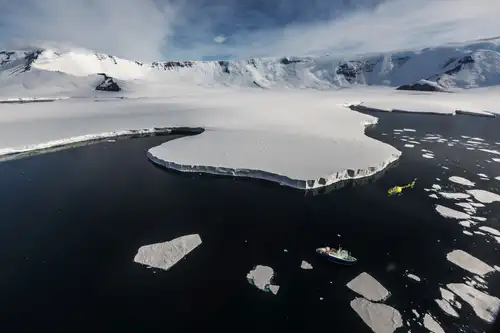
Taking a polar expedition cruise delivers no shortage of show-stopping highlights, but one of the most exhilarating is lifting off from the ship in a helicopter and taking flight over the incomparable Antarctic wilderness.
Imperial Antarctica: the Snow Hill Emperor Penguins
Weddell Sea, Shackleton’s Endurance, and New Swabia
Flowers in Antarctica